US Dollar
 Euro
Euro
 Australian Dollar
 Canadian Dollar
 Polish Zloty
 British Pound











Product Description
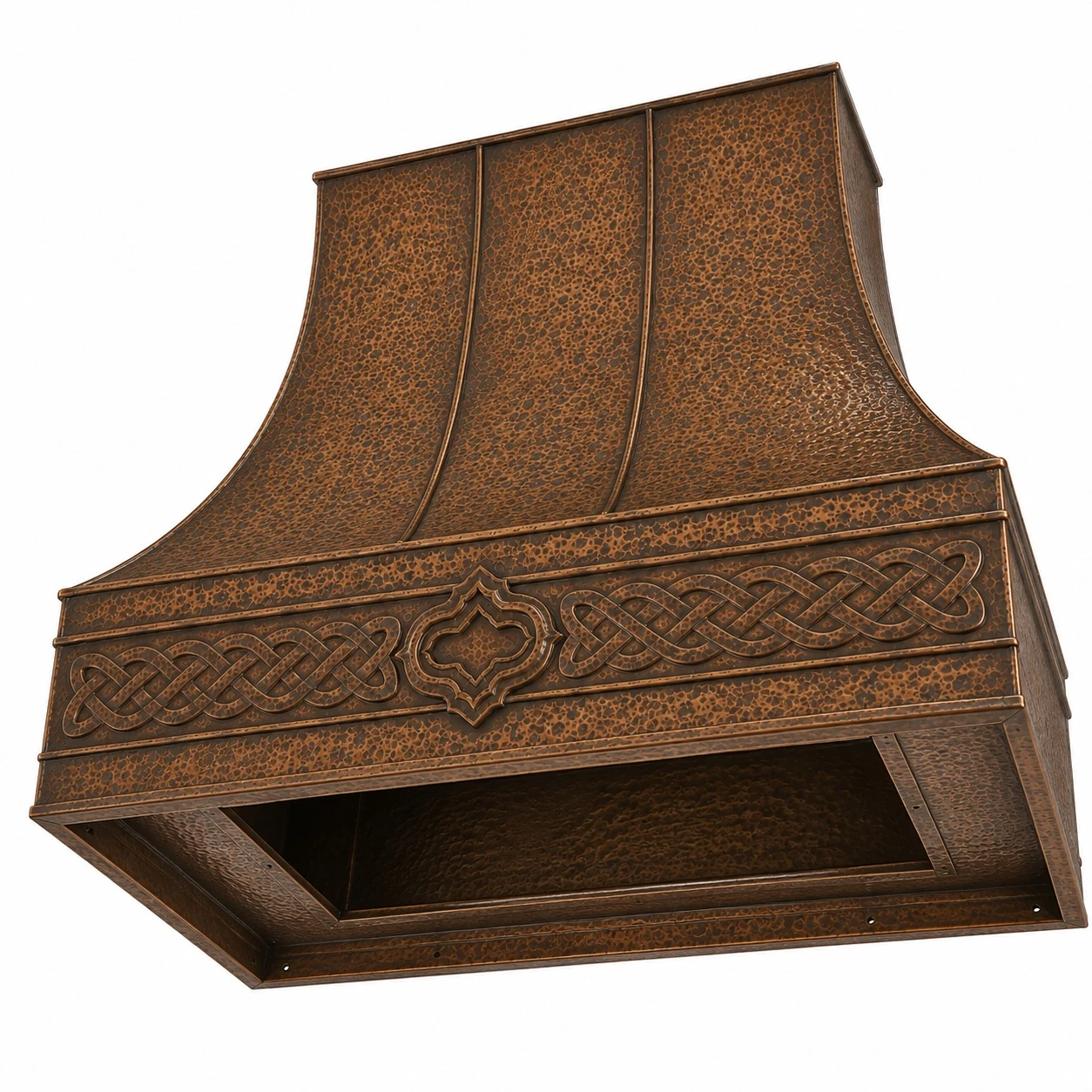
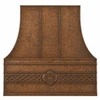
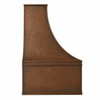
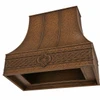
This Celtic knot copper range hood with embossed apron combines a restrained architectural canopy with detailed hand-worked ornament concentrated along its lower section. The relatively narrow upper body expands through straight sloping planes into a broad flared base, creating a substantial trapezoidal profile rather than a curved bell or dome silhouette. Its defining feature is the deep apron, where raised interlaced knotwork introduces texture and shadow without covering the entire hood in decoration. Handcrafted from premium 16-gauge copper, the enclosure is available with a smooth surface for clearer architectural definition or hand hammering for additional texture. Choose natural fired, honey, antique, coffee, or oxidized patina, or a hand-polished finish. Made to order in Santa Clara del Cobre, Mexico, it can be produced from 28 to 78 inches wide and 24 to 72 inches high for wall-mounted or kitchen island installation. Learn more about the ornamental architecture and handcrafted copper construction in our Celtic knot copper range hood guide. Customize the dimensions, copper surface, finish, mounting configuration, and ventilation preparation for your project.
Product Summary
- Flared trapezoidal copper canopy
- Embossed Celtic knot apron
- Smooth or hand-hammered copper
- Five patinas or hand-polished finish
- Wall or kitchen island construction
Celtic Apron Design
The apron establishes the individual identity of this handcrafted copper hood. Unlike designs covered with vertical straps, exposed rivets, scrollwork, floral motifs, or repeated ornament, this model concentrates its Celtic knotwork within the deep lower apron while leaving the flared canopy visually restrained. The contrast makes the decorative pattern easier to appreciate without overwhelming the broad copper surfaces above it. This division also gives surrounding materials more freedom: patterned tile, carved cabinetry, natural stone, plaster, or timber can complement the hood without competing with decoration extending across the entire canopy.
Embossed Knotwork
Interlaced lines form a continuous raised pattern across the apron, producing changing highlights and shadows as kitchen lighting moves across the copper. Because the knotwork is embossed into the apron rather than added as a separate appliqué, it appears integrated with the hood's construction. The design provides a recognizable Celtic influence while remaining contained within a defined architectural band. Its scale and placement can be considered during custom fabrication so the pattern remains visually proportional on different hood widths.
Flared Silhouette
The canopy narrows toward the top and expands toward the cooking surface through straight, controlled slopes. This creates a flared trapezoidal profile distinctly different from rounded dome enclosures or deeply curved bell hoods. The broad lower section establishes visual weight above the range, while the narrower upper body provides vertical direction toward the chimney or ceiling. From a three-quarter view, the side panels reveal the depth of the flare and make the enclosure appear substantial rather than simply decorative from the front.
Deep Lower Apron
The apron provides a strong termination beneath the sloping canopy and creates sufficient visual space for the Celtic pattern to remain legible. Its depth also frames the underside opening where the ventilation liner or insert is positioned. Keeping the intricate ornament within this lower zone creates a deliberate contrast between decoration and simpler architectural surfaces. That balance makes the hood suitable for interiors with substantial architectural detailing without requiring additional straps, medallions, or decorative bands across the upper body.
Copper Surface
Both smooth and hand-hammered copper are available, and each treatment changes how the design is perceived. Smooth copper creates broader reflections and emphasizes the straight canopy planes, apron boundaries, and embossed knotwork. Hand hammering breaks reflected light into smaller highlights and gives the larger copper fields a more visibly handcrafted surface. Because every enclosure is individually formed and finished, subtle differences in seams, edge work, tool marks, hammer impressions, and surface tone are expected characteristics of artisan metalwork.
Finish Selection
Six finish directions allow the copper to coordinate with different architectural palettes. Natural fired copper combines reddish, bronze, and darker fire-developed tones. Honey creates a lighter amber appearance, while antique offers a quieter aged surface. Coffee develops deeper brown coloration that can increase the visual contrast around the raised apron design. Oxidized copper introduces characteristic blue-green variation. Hand-polished copper provides the brightest treatment and emphasizes reflected light across the metal. Since each finish is developed individually, exact coloration and tonal distribution naturally vary from one hood to another.
Custom Sizing
Made-to-order construction allows the hood to be proportioned around the cooking surface, cabinetry, backsplash, ceiling height, and room architecture rather than forcing the project around a predetermined enclosure. Standard widths range from 28 to 78 inches, heights from 24 to 72 inches, and standard depth is 24 inches. When dimensions change, the canopy slope, apron depth, knotwork scale, and upper-body proportions should remain visually coordinated. This is particularly important for an oversized copper hood with Celtic apron above a professional-style range, where enlarging one section independently could distort the intended composition.
Measurements Needed
Before production, confirm the cooking-surface width, desired hood width, overall height, finished depth, mounting height, ceiling height, backsplash thickness, nearby cabinet clearances, and proposed duct position. For a kitchen island configuration, also establish the cooktop centerline and available ceiling structure. When buyer-supplied ventilation equipment will be used, provide its complete technical information before fabrication so the internal opening and support structure can be prepared around the actual system.
Insert Planning
The decorative copper shell and mechanical ventilation equipment are planned as separate components. Rustica House can supply an optional 200 CFM insert for appropriate residential applications. The enclosure can also support buyer-supplied internal inserts up to 1,260 CFM and external blower systems up to 1,500 CFM when complete specifications are supplied before production. Because ventilation equipment varies in dimensions, controls, lighting, blower configuration, duct requirements, filters, and service access, provide the manufacturer, model, overall dimensions, required cutout, duct size and position, controls, lighting information, and filter-access requirements. This approach allows the custom copper enclosure to be prepared for suitable third-party equipment without restricting the project to one ventilation package.
Drawing Approval
Review the width, height, depth, canopy slope, apron proportions, knotwork placement, insert opening, duct centerline, and mounting configuration before fabrication begins. Drawing approval is particularly useful for wide professional ranges, vaulted ceilings, ceiling beams, thick stone backsplashes, kitchen islands, or cabinetry designed closely around the hood. Confirming these relationships before production helps coordinate the decorative metal enclosure with framing, cabinetry, finished surfaces, and mechanical equipment.
Mounting Options
This Celtic apron kitchen hood can be fabricated for wall-mounted or kitchen island installation. Against a wall, its flared profile can be centered between cabinetry, shelving, stonework, or full-height tile. An island version exposes the canopy and decorative apron from additional viewpoints, making proportional side and rear surfaces especially important. Island installations also require adequate overhead framing and coordinated ceiling ducting. The intended mounting configuration should therefore be established before production so the internal framework, exterior surfaces, chimney, attachment points, and ventilation opening can be prepared correctly.
Buyer Planning
| Planning | Confirm | Buyer Decision |
| Dimensions | Width, height, depth | Coordinate with range |
| Copper surface | Smooth or hammered | Choose visual texture |
| Finish | Patina or polished | Select copper tone |
| Mounting | Wall or island | Plan structural support |
| Ventilation | Insert and duct | Provide specifications |
Range Hood Specifications
- Product: Celtic apron copper range hood
- Shape: flared trapezoidal canopy
- Material: premium 16-gauge copper
- Surface: smooth or hand hammered
- Apron: embossed Celtic knot design
- Width: 28–78 inches
- Height: 24–72 inches
- Depth: 24 inches standard
- Patinas: natural, honey, antique, coffee, oxidized
- Polish: hand-polished copper option
- Mounting: wall or kitchen island
- Insert: optional 200 CFM
- Buyer insert: up to 1,260 CFM
- External blower: up to 1,500 CFM
- Production: approximately 6 weeks
- Delivery: approximately 8 weeks
- Shipping: free U.S. mainland
- Warranty: 12 months
- Origin: Santa Clara del Cobre, Mexico
- SKU: CE61L8T91
PDF and CAD Downloads
Use the proportional PDF drawing and DXF CAD file to coordinate the flared canopy, embossed apron, overall dimensions, ventilation opening, cabinetry, and duct position during project planning.
Copper Craftsmanship
Each hood is handcrafted in Santa Clara del Cobre, Mexico, where individual copper panels are cut, formed, joined, textured, and finished by hand. The decorative lower section requires careful forming so the interlaced pattern remains visually defined while preserving the surrounding apron structure. Smooth and hammered versions reveal the process differently, but both retain subtle evidence of hand fabrication. Minor differences in seams, embossing, hammer patterns, tool marks, edges, and patina distribution give every completed enclosure individual character while preserving its approved dimensions and overall design.
Kitchen Styles
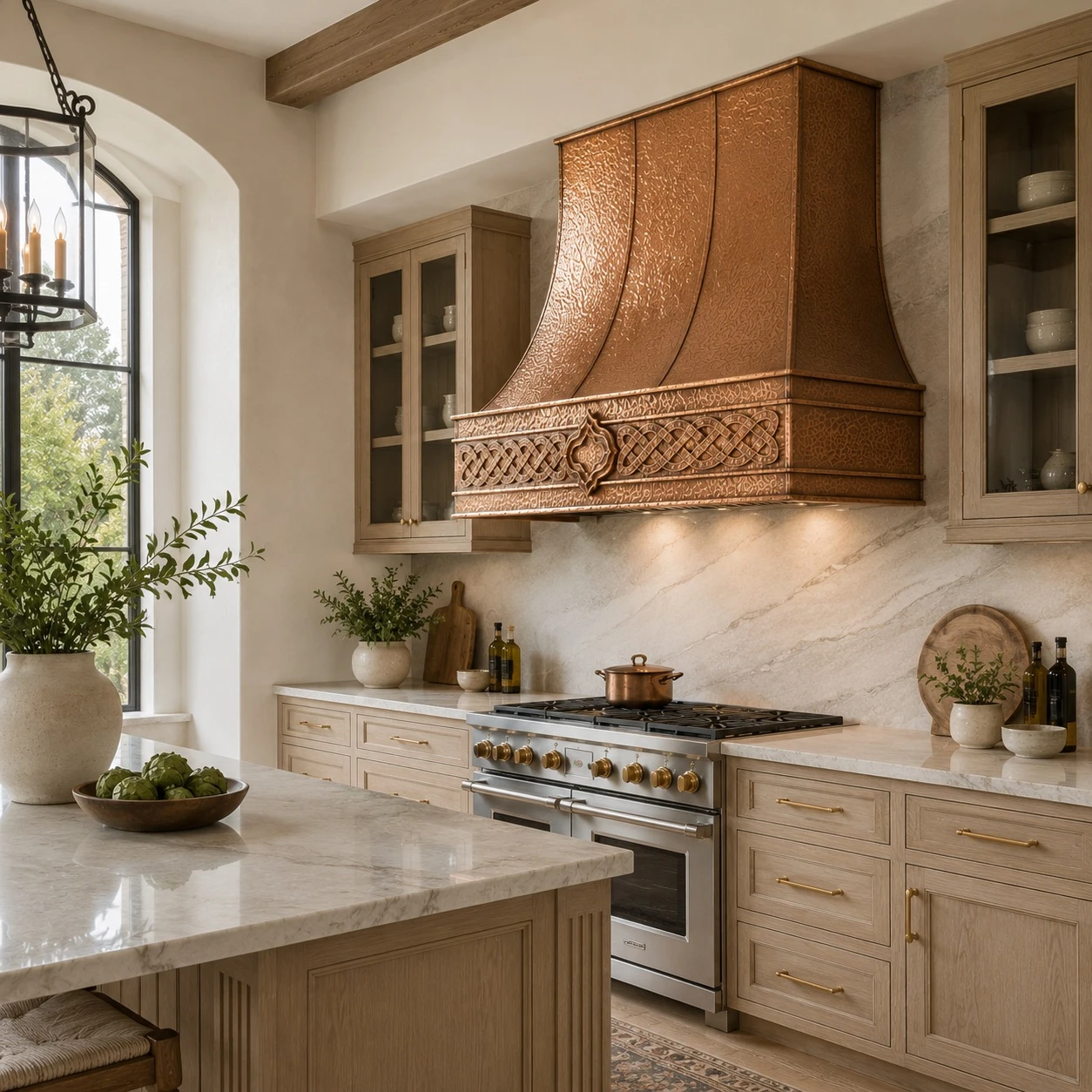
The combination of flared geometry, restrained upper surfaces, and detailed interlaced apron gives this design stronger historic character than a plain tapered metal hood. Its compatibility depends as much on surrounding materials as on the selected copper finish, allowing the same architecture to appear dramatically traditional or considerably more restrained. See how the decorative knotwork and handcrafted copper surface integrate with different interiors in our Celtic knot copper range hood kitchen design images.
Best Kitchen Styles
- Gothic Revival: Dark wood cabinetry, stone surfaces, pointed architectural details, iron lighting, and dramatic vertical proportions provide a natural setting for the interlaced apron. Coffee or antique copper reinforces the deeper material palette, while directional lighting creates shadows across the raised knotwork.
- Old World European: Textured plaster, limestone, aged timber, substantial cabinetry, and traditional hardware complement the flared canopy and decorative lower band. The apron can function as the principal ornamental metal feature while the simpler upper body prevents the kitchen from becoming excessively decorative.
- Rustic European: Reclaimed beams, natural stone, wide-plank floors, handmade tile, and aged cabinetry reinforce the handcrafted copper character. A hammered natural-fired or coffee finish introduces additional surface depth, while the embossed knotwork provides a more individual focal point than ordinary straps or riveted bands.
- Transitional: Restrained paneled cabinetry, pale oak, quartzite, plaster, and simplified hardware can place the historic apron within a cleaner contemporary composition. Smooth honey or hand-polished copper emphasizes the geometry and embossed pattern while reducing the heavier rustic character associated with darker finishes and pronounced hammering.
Other Kitchen Styles
- English Country
- Tudor Revival
- Spanish Colonial
Celtic Hood FAQ
A: Its defining feature is the relationship between a restrained flared trapezoidal canopy and a deep apron carrying embossed Celtic knotwork. Unlike copper hoods covered with straps, rivets, scrollwork, or repeated motifs, most of the ornament is deliberately concentrated along the lower architectural band.
A: Yes. Smooth copper gives the canopy cleaner reflections and emphasizes the raised apron design, while hand-hammered copper adds irregular texture and smaller highlights across the larger metal surfaces. Both treatments are handcrafted.
A: Choose natural fired, honey, antique, coffee, or oxidized patina, or select hand-polished copper. Since the finishes are developed individually, natural variations in color, shading, and tonal distribution are expected.
A: Yes. Wall-mounted and kitchen island versions are available. Island projects require adequate ceiling support, centered placement, and coordinated ducting and electrical service because the enclosure is suspended independently of wall cabinetry.
A: Yes. Internal inserts up to 1,260 CFM and external blower systems up to 1,500 CFM can be accommodated when complete manufacturer specifications are provided before production.
Customize Your Hood
Configure the dimensions, smooth or hammered surface, copper finish, wall or island mounting, and ventilation preparation while preserving the distinctive relationship between the flared canopy and embossed lower apron. Order a handcrafted Celtic knot copper hood designed around the architectural proportions and mechanical requirements of your kitchen.
Related Resources
- Range Hood Insert Guide
- Range Hood Size Guide
- Copper Patina Options
- Copper Hammering Techniques
- Copper Range Hood FAQ
Care & Maintenance
Clean the copper with mild soap, warm water, and a soft nonabrasive cloth, then dry promptly. Avoid acids, ammonia, bleach, abrasive pads, and aggressive metal polishes that can alter the artisan patina. Wax can be used when appropriate to slow natural surface changes, or the copper can be allowed to continue aging. Follow the step-by-step copper cleaning video for the recommended cleaning procedure.
Installation Guide
Confirm structural framing, mounting height, finished hood dimensions, ventilation equipment, duct size, electrical requirements, and appliance clearances before installation. Island configurations require suitable overhead framing and coordinated ceiling ductwork. Review the range hood installation guide with the contractor before fabrication and installation.
Shipping & Returns
Production generally requires approximately six weeks, with overall delivery commonly reaching about eight weeks. Each made-to-order hood is securely crated for freight transportation, with free shipping to the U.S. mainland. Custom dimensions and configurations may affect applicable terms, so review the Shipping & Returns information before ordering.
Warranty
The handcrafted copper enclosure includes a 12-month warranty. Rustica House-supplied ventilation equipment is covered according to applicable terms, while buyer-supplied inserts and external blower systems remain subject to their manufacturers' warranties. Review the complete Rustica House Warranty for coverage information.
Disclaimer: Handmade copper construction produces natural variations in forming, seams, embossing, hammer impressions, tool marks, edges, dimensions, and patina coloration. These characteristics are expected in artisan metalwork and are not manufacturing defects. Lifestyle images are provided for design inspiration and may show optional finishes, configurations, cabinetry, appliances, or decorative items not included with the hood. All product images © Rustica House, unauthorized use is prohibited.