 US Dollar
 Euro
 Australian Dollar
 Canadian Dollar
 Polish Zloty
 British Pound

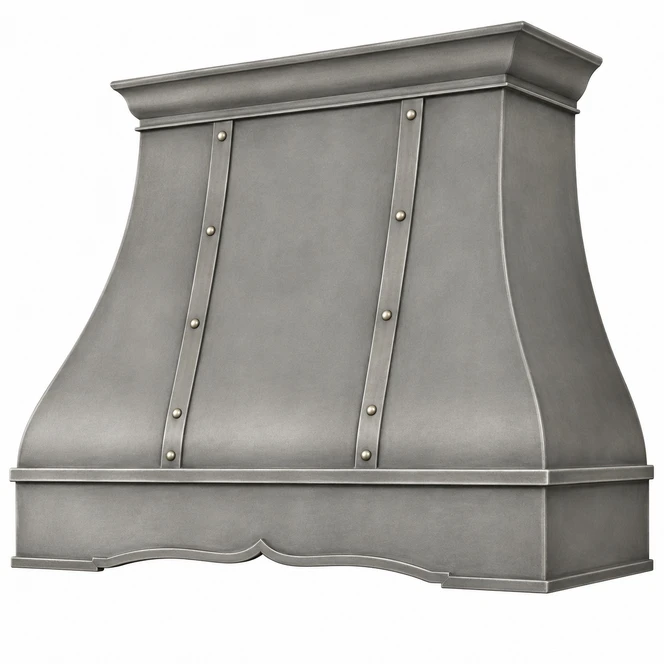
The French country zinc range hood with scalloped apron pairs a softly flared bell canopy with details borrowed from furniture: projecting crown molding, twin riveted straps, and a lower edge that rises to a point at the center. The smooth natural zinc shown in the main photographs has a muted silver-gray tone that lets those details stand out. This image guide compares the front, angled, side, and underside views, then looks at the proportional drawing and six finish examples. For background on how the metal is formed and finished, see our article on zinc range hood craftsmanship. Use the six images to compare proportions, surface textures, and installation details for your kitchen. See how handcrafted zinc range hoods complement natural wood cabinetry, stone countertops, and traditional finishes in our French country zinc range hood kitchen inspiration.
Blog Summary
- Canopy: Soft bell flare with twin riveted straps
- Crown: Projecting molding with a curved face
- Apron: Two scallops meet at a central point
- Finishes: Six examples in smooth and hammered zinc
Front View

The front view shows how the crown and apron frame the bell shape. Two vertical straps divide the canopy into three sections, leaving a broad panel between them. At the bottom, two shallow curves meet at a pointed crest. The scallops are confined to the lower edge, so the apron still reads as a continuous band across the range. Compare it with the simpler curved edge in our curved apron zinc guide.
Angled View

The angled photograph shows the crown wrapping around the corner and the riveted straps following the contour of the front. The side panel is plain, and the apron returns along it in a straight line. The scallops therefore give the hood a decorative front without adding the same detail to every visible surface. If you are comparing strap styles, the antique zinc hood guide shows how contrasting straps change the look of a similar bell shape.
Side Profile

In profile, the front sweeps forward as it descends from the crown to the apron, while the back edge stays vertical. This view is useful when the hood will be seen from a doorway or island seating area. Compare the crown and apron with nearby cabinet molding, and review the full projection rather than judging the fit from the front alone. The metal hood installation guide explains what to coordinate for wall or island mounting.
Underside Opening
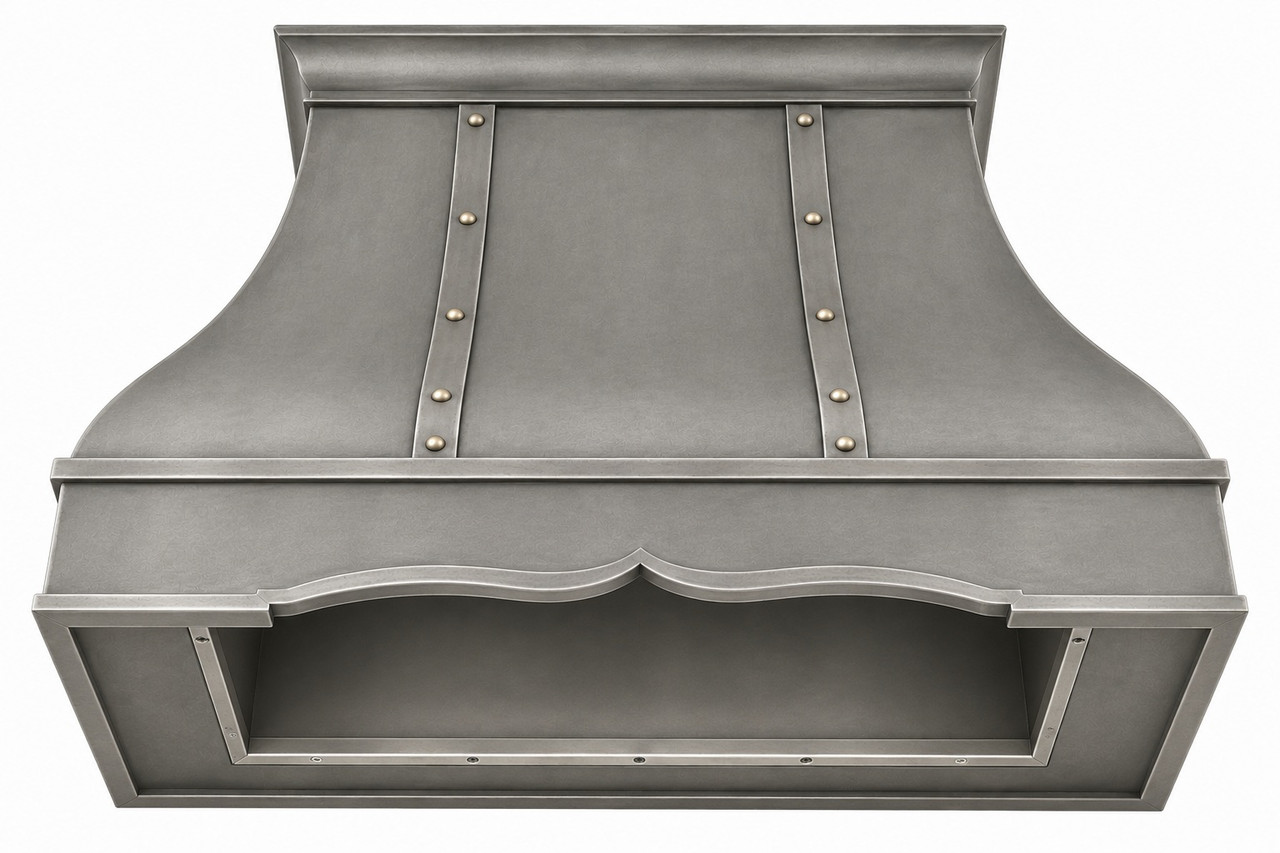
The underside view shows a rectangular opening behind the scalloped front. A metal frame defines the opening, with no installed filters, controls, or lights visible. The scalloped edge is part of the outer apron; the cutout behind it is a separate dimension. Before approving the enclosure, confirm the insert model and check its cutout, mounting requirements, and access for removing the filters. The range hood insert guide explains which equipment details to supply.
Drawing and dimensions

The drawing assigns 12% of the illustrated height to the crown, 68% to the canopy, and 20% to the apron. Those proportions help explain why the lower band looks substantial without dominating the bell shape. The reference drawing lists a 24-inch minimum width, while the model specification gives a 28-inch minimum. Confirm availability before planning around any width below 28 inches. The range hood buying guide provides context for reviewing dimensions before ordering.
| Planning | What to confirm |
|---|---|
| Overall width | Plan around the specified 28–78 inch range. Confirm the widest trim dimension against the cabinet opening. |
| Overall height | Choose within the 24–72 inch range and verify the relationship between the crown and nearby cabinetry. |
| Depth and projection | Check the standard 24-inch depth against the cooking appliance and approved mounting plan. |
| Ventilation opening | Approve the cutout and mounting details using the exact insert specification sheet. |
Six finish examples

The upper row shows smooth surfaces; the lower row shows hammered surfaces. In each row, natural gray appears at left, darkened zinc in the center, and a brighter polished treatment at right. Smooth natural zinc keeps attention on the crown and scallops. Hammered zinc adds smaller highlights across the broad canopy, while the polished examples show stronger reflections. Read about smooth and hammered finishes, then compare samples under your kitchen lighting.
Kitchen material pairings
In a French country kitchen, cream cabinets, limestone counters, and antique brass hardware can bring warmth to the cool zinc. In a transitional kitchen, use simpler cabinet doors and a quiet backsplash so the shaped apron remains easy to see. For a modern farmhouse, consider white oak and a few dark hardware accents alongside natural zinc. These are styling suggestions; the supplied images show the hood itself. For a furnished example, browse our natural zinc kitchen images.
Care and cleaning
When planning routine cleaning, consider the ledge beneath the crown, the edges of the straps, and the recesses around the scalloped trim. Follow the care instructions for the selected finish, and treat the insert and its filters separately. The zinc hood care guide explains how to clean the metal without unnecessarily altering its sheen.
Frequently asked questions
- What makes this French country zinc hood unique?
- It combines a projecting furniture-style crown, twin riveted straps, and two shallow apron scallops that meet at a central point.
- Which finish is shown in the main photographs?
- The main product views show smooth natural zinc with muted silver-gray variation.
- Does the scalloped apron wrap around the sides?
- The scallops are on the front. The angled and side images show a straight apron return.
- What sizes are available?
- The model specification gives a width of 28–78 inches, a height of 24–72 inches, and a standard depth of 24 inches.
- Why does the drawing show a 24-inch minimum width?
- The reference drawing and model specification differ. Confirm any width below 28 inches with Rustica House before using it in your plans.
- Can the hood be mounted over an island?
- The model can be prepared for wall or island mounting. Confirm the visible sides, support, and duct route for your layout.
- Does the underside image show an installed insert?
- No. It shows the framed rectangular opening where compatible ventilation equipment would fit.
- How does hammered zinc change the appearance?
- Hammering creates small variations in texture and reflected light. The smooth examples show broader, more even highlights.
- Should the hood crown match the cabinet crown?
- They can complement each other without matching exactly. Compare their projection and height on the same cabinet elevation.
- What should I approve before fabrication?
- Confirm overall dimensions, crown projection, apron profile, zinc finish, mounting configuration, and the cutout for your selected insert.
Plan your hood
Use the front view to judge how the crown and scalloped apron will sit between the cabinets. Check the side and underside views against the mounting layout, then consult the custom hood insert guide to prepare the equipment details. Explore the French country zinc hood to plan your dimensions, finish, and mounting configuration.