US Dollar
 Euro
Euro
 Australian Dollar
 Canadian Dollar
 Polish Zloty
 British Pound



Product Description
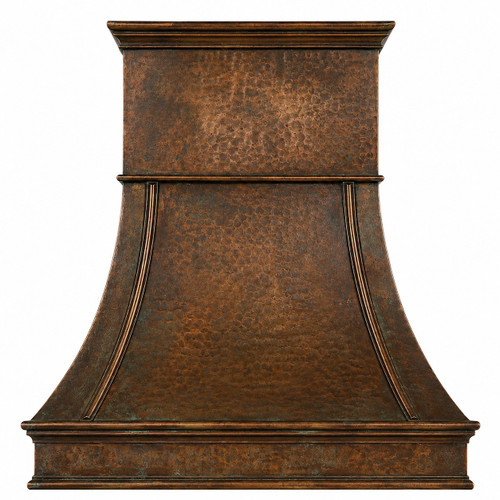
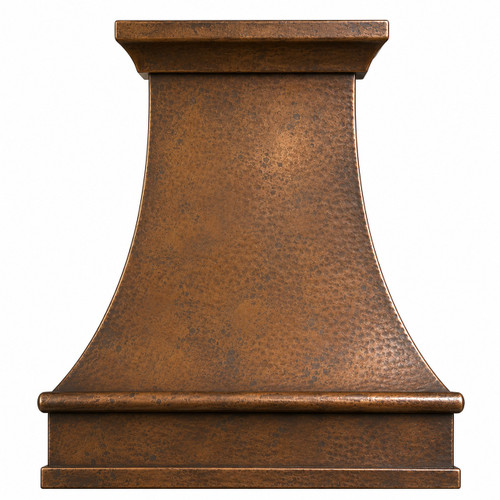
This hand-hammered bell copper range hood with three front-only straps combines a pronounced concave canopy with clean strap-free side panels and substantial architectural molding. A narrow rectangular chimney descends into long bell-shaped curves that expand toward a broad straight apron, creating a formal wall-mount silhouette without floral relief, scalloping, or mixed-metal ornament. Three riveted copper straps divide the front into four balanced fields while leaving both side elevations uninterrupted. Above the chimney, a deep stepped copper crown creates a furniture-inspired transition that coordinates naturally with traditional cabinet molding. Handcrafted in Santa Clara del Cobre, Mexico, from 16-gauge copper, this made-to-order enclosure is available in custom dimensions and six copper patinas and can be prepared for approved ventilation equipment. Its combination of traditional bell architecture and restrained detailing works particularly well in transitional American kitchens. For technical information about bell proportions, front strap placement, stepped crown construction, and ventilation compatibility, see our bell copper range hood three straps technical guide. Customize this copper range hood for your kitchen project.
Product Summary
- Pronounced concave bell canopy
- Three front-only copper straps
- Four balanced front fields
- Clean strap-free side panels
- Exposed domed copper rivets
- Deep architectural stepped crown
- Broad straight copper apron
- Hand-hammered copper surface
- Six copper patina options
- Wall-mount installation
- Custom dimensions available
- Handcrafted in Mexico
Custom Sizing
Each hood is made to order so the width, height, depth, chimney proportions, bell curvature, strap spacing, crown projection, and apron can be coordinated with the kitchen. Standard widths range from 28 to 78 inches, heights from 24 to 72 inches, and standard depth is 24 inches. Custom dimensions can also be produced for project-specific requirements. When the enclosure is resized, the three straps, four front fields, curved canopy, crown, and apron are proportioned together to preserve the original architectural balance.
Measurements Needed
Provide the range or cooktop width, desired hood width, overall hood height, ceiling height, mounting height, finished depth, backsplash thickness, adjacent cabinet clearances, and planned duct location. These measurements help determine the chimney dimensions, bell flare, lower capture area, crown position, and ventilation opening. Review the copper hood sizing guide before approving the final enclosure dimensions.
Ventilation
The copper body functions as an insert-ready enclosure. Rustica House can supply an optional 200 CFM insert for compatible applications. Buyer-supplied internal inserts up to 1,260 CFM can also be accommodated, while external blower systems up to 1,500 CFM can be prepared for when complete equipment specifications are submitted before fabrication. Ducted or recirculating operation depends on the selected ventilation equipment. Review the range hood insert guide during project planning.
Drawing Approval
Final dimensions and mechanical requirements are confirmed before production. For buyer-supplied ventilation, provide the manufacturer, model, body and cutout dimensions, duct diameter and location, controls, lighting, filters, electrical requirements, and service clearances. The production drawing allows the homeowner, designer, cabinetmaker, contractor, and ventilation installer to verify the bell proportions, crown projection, strap alignment, apron position, insert opening, duct centerline, and surrounding cabinetry before fabrication begins.
Bell Architecture
The hood has a tall architectural silhouette organized around a narrow rectangular chimney and a deeply concave lower canopy. Instead of descending through straight diagonal planes like a pyramidal enclosure, the body remains comparatively narrow near the neck before sweeping progressively outward toward the cooking surface. This creates the recognizable bell-shaped profile. The generous lower flare gives the hood appropriate visual weight above a substantial residential range, while the narrower chimney keeps the upper section proportional to surrounding cabinetry.
Deep Concave Canopy
The canopy follows long controlled curves from the narrow neck toward the broad lower apron. Viewed from the side, the rear remains substantially vertical while the front projection increases toward the cooking surface. This creates a pronounced wall-mount profile and distinguishes the design from rounded dome hoods and straight tapered enclosures. The hammered surface follows the changing curvature, allowing highlights and darker patina tones to make the bell silhouette more visible from different viewing angles.
Three Front Copper Straps
Exactly three riveted copper straps organize the front elevation into four balanced vertical fields. Each strap follows the outward movement of the bell canopy and is accented with regularly spaced domed copper rivets. The decorative framework is concentrated on the front rather than continuing around the enclosure. This creates the traditional character of a strapped copper hood when viewed from the cooking area while maintaining a more restrained overall composition.
Clean Side Panels
Both side elevations remain free of straps and rivets, presenting the bell curvature as uninterrupted areas of hand-hammered copper. This strap-free construction is an important distinction from hoods whose decorative bands continue around several visible surfaces. The cleaner profile also makes the enclosure easier to coordinate with fitted cabinetry, stone backsplashes, and contemporary interpretations of traditional kitchen architecture without sacrificing the handcrafted character visible on the front.
Deep Stepped Crown
Multiple projecting copper courses form a substantial stepped crown at the top of the chimney. The layered construction resembles traditional architectural cornice and cabinet crown molding, creating horizontal shadow lines around the upper section. Its depth gives the relatively narrow chimney a stronger termination and visually balances the broad bell canopy below. This architectural crown is particularly effective in kitchens with full-height cabinetry, substantial millwork, and nine- or ten-foot ceilings.
Straight Copper Apron
A broad straight apron anchors the curved canopy with a strong horizontal base. Unlike scalloped, pierced, embossed, or heavily riveted decorative aprons, this lower section remains intentionally restrained. Its simple geometry balances the movement of the concave canopy and the vertical rhythm of the three front straps without introducing another ornamental motif. The result is a traditional copper bell hood that can work beyond heavily rustic or historically themed interiors.
Unique Design
This model is distinguished by the combination of a deep concave bell canopy, exactly three front-only copper straps, four balanced front fields, clean strap-free sides, deep stepped crown, and straight apron. Unlike strapped copper hoods whose bands continue around multiple elevations, the decorative framework is concentrated on the front. Unlike bell hoods with embossed, scalloped, or heavily ornamented aprons, the lower section remains broad and simple. These details give the design a recognizable architectural identity while preserving large areas of uninterrupted hammered copper.
Copper Texture
The enclosure is hammered by hand, producing closely spaced impressions across the chimney, curved canopy, side panels, straps, and lower section. The texture creates small highlights and shadows that become more noticeable where the bell surface changes direction. Rather than relying on applied ornament, the hammered copper provides subtle visual movement across the large metal surfaces. Individual hammer marks naturally vary in depth, spacing, and orientation as part of the handcrafted fabrication process.
Copper Finishes
Six copper patina options allow the hood to coordinate with different cabinetry, stone, tile, flooring, and hardware: Natural Fired, Dark Coffee, Antique, Honey, Oxidized, and Hand Polished. Antique copper is particularly versatile with warm-white cabinetry, natural oak, quiet stone, and aged metal hardware, while darker finishes create a stronger traditional character. Compare the available treatments in the copper patina finish guide.
Wall-Mount Installation
This design is intended principally as a wall-mounted copper range hood. The substantially vertical rear plane allows the front canopy to develop its characteristic projection toward the cooking surface. Installation planning should coordinate wall structure, mounting height, cabinetry, backsplash thickness, electrical service, ventilation access, and duct routing. The projecting crown should also be considered when aligning the enclosure with neighboring cabinets or existing decorative crown molding.
Cabinet Coordination
The bell hood works especially well between full-height cabinets or as the central feature of a built-in appliance wall. Confirm adjacent cabinet widths, crown molding, upper clearances, backsplash termination, and the relationship between the straight apron and nearby cabinet bottoms. Because the sides remain free of straps and rivets, cabinetry can frame the hood without competing with additional decorative metalwork along its side elevations.
Buyer Planning
Confirm the enclosure dimensions, copper patina, ventilation equipment, duct location, cabinetry, and mounting structure before fabrication. Particular attention should be given to maintaining the relationship between the three straps, four front fields, bell curvature, crown projection, and straight apron. Early coordination also helps prevent conflicts involving cabinet molding, backsplash thickness, ventilation access, electrical components, lighting, filters, controls, and ductwork.
| Planning | Confirm | Buyer Decision |
|---|---|---|
| Dimensions | Width, height, depth | Coordinate kitchen scale |
| Patina | Six copper finishes | Coordinate room materials |
| Mounting | Wall installation | Confirm structural support |
| Ventilation | Insert or blower | Submit equipment specs |
| Ducting | Approved duct route | Confirm before production |
Copper Hood Specifications
- Type: Wall-mount range hood
- Shape: Concave bell canopy
- Chimney: Rectangular upper section
- Crown: Deep stepped copper
- Straps: Three front-only riveted straps
- Front: Four balanced copper fields
- Side panels: Clean strap-free copper
- Rivets: Exposed domed copper details
- Apron: Broad straight copper
- Material: 16-gauge copper
- Texture: Hand-hammered
- Width: 28–78 inches
- Height: 24–72 inches
- Depth: 24 inches standard
- Finishes: Six copper patinas
- Insert: Optional 200 CFM
- Buyer insert: Up to 1,260 CFM
- External blower: Up to 1,500 CFM
- Build: Made to order
- Origin: Santa Clara del Cobre
- SKU: WP81G5L58
PDF and CAD Downloads
Technical drawings help homeowners, designers, interior architects, cabinetmakers, contractors, and installers evaluate the bell profile, stepped crown, straight apron, three-strap layout, and overall proportions. CAD files are also useful when a buyer or interior architect is designing a custom range hood around specific cabinetry and ventilation equipment. Buyer-specific dimensions, insert openings, duct locations, and installation requirements are confirmed separately during production approval.
Copper Craftsmanship
Each enclosure is handcrafted in Santa Clara del Cobre, Mexico. Artisans form the rectangular chimney and curved bell canopy, hammer the copper surfaces, fabricate the stepped crown and straight apron, shape three straps to follow the changing front curvature, position the domed rivets, assemble the enclosure, and apply the selected patina. Maintaining consistent spacing between the straps while forming a symmetrical canopy requires careful fitting throughout the fabrication process.
Coppersmith Testimony
The three front straps require particular attention because they must remain visually balanced while following a surface that becomes progressively wider and deeper toward the apron. The stepped crown must also remain level and proportional when custom dimensions change. Learn more about regional copper-forming traditions in the Juan Carlos Hernández copper artisan guide.
Kitchen Styles
The combination of traditional bell architecture and restrained detailing makes this hood particularly adaptable to U.S. suburban kitchens. Its stepped crown relates naturally to architectural cabinetry, while the straight apron and clean side panels keep the enclosure from becoming excessively rustic. Copper adds warmth against painted cabinetry, natural wood, quiet stone, handmade tile, and understated metal hardware. See this handcrafted copper design across different kitchen settings in our bell copper range hood three straps kitchen inspiration.
Best Kitchen Styles
- Transitional: Warm-white cabinetry, quartzite, white oak, restrained hardware, and classic millwork balance the traditional bell form with cleaner contemporary finishes.
- New Traditional: Inset cabinetry, symmetrical layouts, walnut or oak accents, polished stone, and tailored lighting complement the formal crown and three-strap façade.
- Modern Farmhouse: Cream Shaker cabinets, pale oak, handmade tile, apron-front sinks, and simple stone surfaces pair naturally with hammered copper and riveted details.
- French Country: Warm cream cabinetry, limestone, lightly aged wood, quiet patterned tile, and traditional hardware complement the deep bell curve and layered crown.
Other Kitchen Styles
- English Country
- Spanish Colonial Revival
- Rustic Contemporary
FAQ
A: Its defining combination is a deep concave bell canopy, exactly three front-only riveted copper straps, four balanced front fields, clean strap-free sides, a stepped crown, and a broad straight apron.
A: No. All three straps are positioned on the front elevation. Both side panels remain free of straps and rivets so the hammered copper and bell-shaped profile remain uninterrupted.
A: Yes. The substantially vertical rear profile and forward-expanding bell canopy are designed principally for wall installation above a residential range or cooktop.
A: Yes. Width, height, depth, ventilation preparation, and related proportions can be coordinated with the kitchen while preserving the three-strap façade, crown, straight apron, and characteristic bell profile.
A: Yes. Buyer-supplied internal inserts up to 1,260 CFM and external blower systems up to 1,500 CFM can be accommodated when complete equipment specifications are provided before fabrication.
A: Transitional, New Traditional, Modern Farmhouse, and French Country kitchens are especially strong matches because the hood combines traditional architectural proportions with cleaner strap-free sides and restrained ornament.
Customize Your Hood
Configure the enclosure around the cooking surface, cabinetry, ceiling height, backsplash, copper patina, and approved ventilation equipment. Custom sizing preserves the relationship between the narrow chimney, deep concave canopy, three front straps, four front fields, clean side panels, stepped crown, and straight apron. Submit buyer-supplied ventilation specifications before fabrication so the insert opening and duct requirements can be incorporated into the production drawing. Request a custom proposal for this hand-hammered bell copper range hood with three front straps.
Related Resources
- Custom Copper Range Hoods
- Copper Hood Sizing Guide
- Copper Patina Finish Options
- Range Hood Insert Guide
Care & Maintenance
Clean the copper with warm water, mild soap, and a soft nonabrasive cloth, then dry the surface promptly. Avoid acids, bleach, steel wool, abrasive pads, and aggressive polishing compounds that can alter the patina. Pay particular attention around the straps and rivets where cooking residue may collect. Review the copper range hood care guide for additional recommendations.
Installation
Coordinate wall support, mounting height, enclosure dimensions, ventilation access, electrical service, duct diameter, and duct routing before fabrication. Cabinet and crown-molding relationships should also be established before final approval. Review the metal range hood installation guide with the contractor and ventilation installer.
Shipping & Returns
Each made-to-order copper hood is securely crated for freight transportation. Review current production timing, delivery procedures, inspection requirements, custom-order conditions, and applicable return terms on the Shipping & Returns page before ordering.
Warranty
The handcrafted copper enclosure is covered according to applicable Rustica House warranty terms. Buyer-supplied ventilation equipment remains subject to its manufacturer's coverage. Review current coverage, exclusions, and limitations on the Rustica House Warranty page.
Disclaimer: Handmade dimensions, bell curvature, hammer impressions, seams, strap alignment, rivet placement, crown and apron details, and copper finish tones may vary slightly due to artisan fabrication. These variations are expected characteristics of handcrafted copper and are not manufacturing defects. Copper patinas may continue to develop naturally with age and use. Lifestyle images may show optional finishes, appliances, cabinetry, decorative elements, or accessories not included with the product.