Welcome to Rustica House
Custom handcrafted products.
Forged iron, copper, zinc, stone
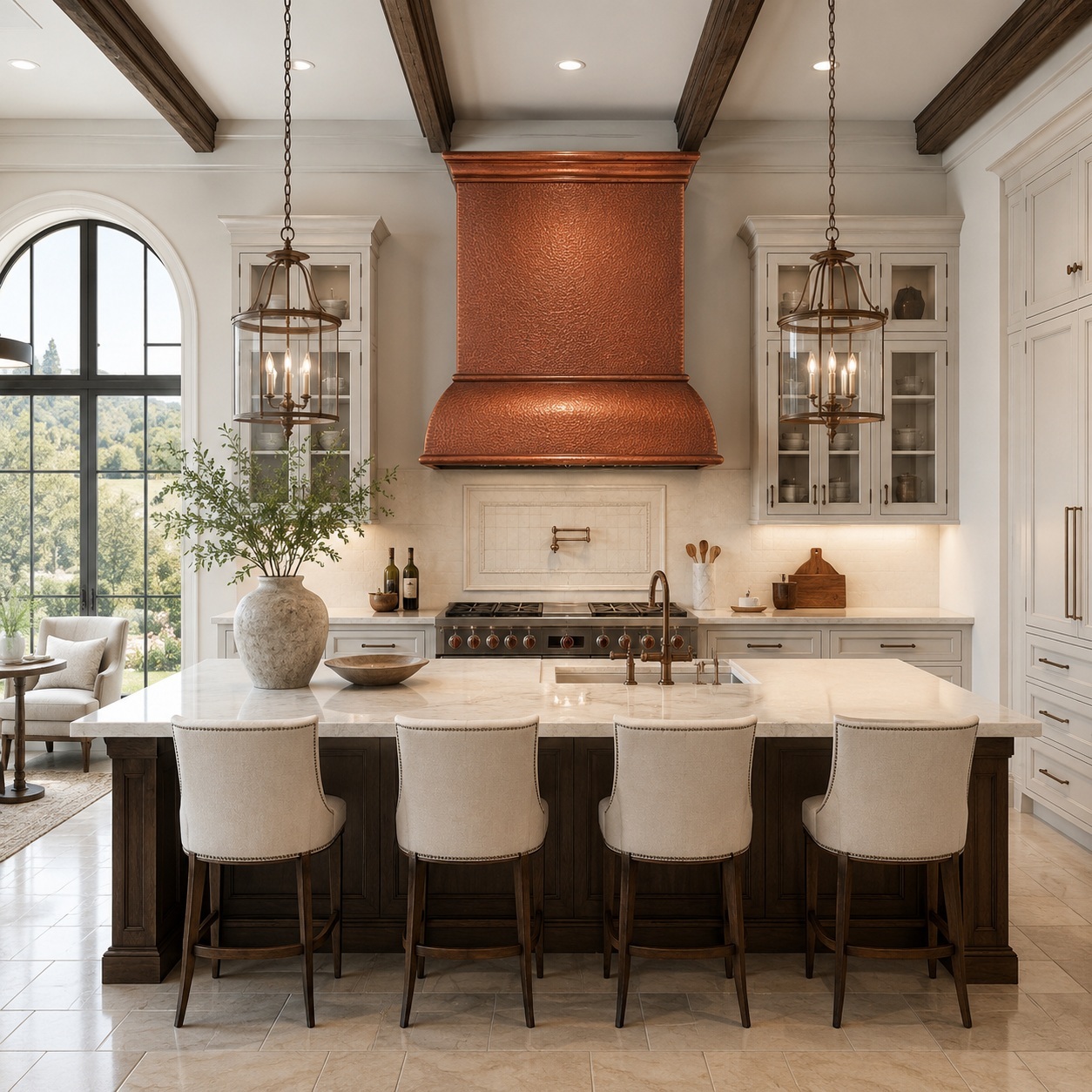
Discover handcrafted dome-shaped copper range hoods with a continuously rounded canopy that curves outward from the upper chimney toward the cooking surface. This traditional profile is also commonly called a curved copper range hood because its front and side surfaces form a smooth convex silhouette instead of straight sloping planes. Browse custom dome hoods by width, height, patina, texture, trim, mounting type, and ventilation preparation. Each hood is made to order from solid 16-gauge copper with smooth or hammered surfaces, custom dimensions, wall or island construction, and preparation for approved ventilation equipment. This collection helps buyers compare dome proportions, finish samples, production requirements, lead times, warranties, shipping information, customer reviews, and the custom quote process before ordering a handcrafted focal point for a transitional, Mediterranean, Spanish, rustic, French country, Old World, or luxury kitchen.

The defining feature of this collection is the rounded dome canopy. Instead of using flat sloping panels, the copper body curves outward in a continuous convex form as it widens from the chimney toward the cooking surface. This dome shape is also called a curved hood because the main body displays visible curvature across the front and sides. Depending on the model, the canopy may connect to a tall rectangular chimney, stepped crown molding, a forged metal collar, decorative straps, rivets, or a substantial lower apron. The uninterrupted curved surface showcases hand-hammered copper especially well because changing light reveals subtle variations across the rounded body.
A dome-shaped copper range hood is defined by the curvature of its main canopy. The body bows outward through a rounded transition rather than descending through straight tapered planes. This distinguishes it from a curved apron hood, where only the lower apron curves while the upper body may remain straight or tapered. It also differs from a traditional bell hood, which usually has a narrower waist and a more pronounced outward flare near the bottom. Dome and curved are often used interchangeably for this profile because both terms describe the continuous rounded architecture of the hood body.
| Style | Main difference | Best match |
|---|---|---|
| Dome or curved hood | Main canopy has a continuous rounded curve | Spanish, Mediterranean, rustic, and luxury kitchens |
| Tapered hood | Flat panels slope toward a narrower chimney | Traditional, transitional, and modern farmhouse kitchens |
| Bell hood | Body narrows before flaring outward near the base | Tuscan, Old World, and classical interiors |
| Curved apron hood | Lower apron curves while the upper body may remain flat | French country and transitional kitchens |
Dome-shaped copper range hoods are ideal for homeowners who want a softer architectural profile than a hood built from straight, angular panels. The rounded canopy creates visual movement while providing a broad surface for displaying natural copper color, hand-hammered texture, and artisan-applied patina. Because the dome is the main decorative feature, the design can remain understated or be enhanced with crown molding, lower trim, riveted straps, forged iron bands, or contrasting metal accents. The shape works especially well above large ranges, where its width and curved volume establish a substantial focal point without requiring embossed motifs or elaborate ornamentation.
Every dome-shaped hood is handcrafted from solid copper and finished by skilled artisans. Available patinas may include natural fired copper, antique, honey, light coffee, dark coffee, and selected specialty finishes. Finish samples may be requested when available so buyers can compare tones before confirming production. Smooth copper emphasizes the clean architectural curve, while hammered copper creates greater surface movement through individually formed hammer marks. Because the copper and patina are completed by hand, variations in color, texture, pattern, and patina depth are normal characteristics rather than manufacturing defects.
Each dome copper hood is manufactured specifically for the buyer’s kitchen and approved project dimensions. Width, height, depth, chimney size, canopy curvature, crown molding, lower apron, trim bands, decorative straps, rivets, surface texture, patina, mounting configuration, and ventilation preparation may be customized. Wall-mounted hoods are designed for placement against a wall between cabinets or within a dedicated surround. Island versions are finished on every visible side and require ceiling-supported installation. Buyers should provide appliance width, cabinet spacing, ceiling height, duct position, insert specifications, and preferred design details before fabrication begins.
Begin by selecting a hood width that matches or exceeds the width of the cooking appliance. Next, confirm the total available height, desired canopy proportions, chimney dimensions, mounting type, patina, and surface texture. A smooth dome with limited trim works well in transitional and refined contemporary kitchens. A hammered canopy with crown molding, riveted straps, or a substantial apron creates a stronger Spanish, Mediterranean, rustic, or Old World appearance. Because the curved body already carries significant visual character, decorative details should support the profile without concealing the continuous rounded surface.
Dome-shaped and curved are commonly used to describe the same general range hood architecture. Both terms refer to a canopy with a rounded convex surface rather than a body formed exclusively from flat planes. Dome emphasizes the overall vaulted or rounded volume, while curved describes the visible front and side contours. Individual models may display a shallow curve, a deep continuous dome, a rounded bell influence, or a curved canopy joined to a rectangular chimney. Product photographs and dimension drawings should therefore be reviewed carefully when comparing the exact curvature and proportions of different models.
Ventilation planning should be completed before production begins. Rustica House can supply an optional 200 CFM insert or prepare the hood for ventilation equipment selected by the buyer. Buyer-supplied inserts up to 1260 CFM and external blower systems up to 1500 CFM may be supported when complete technical specifications are provided before fabrication. Review the range hood insert guide before ordering so the insert dimensions, blower type, CFM capacity, controls, lighting, filters, duct size, discharge position, and service-access requirements can be confirmed early.
Custom fabrication begins after the hood design, dimensions, patina, texture, mounting configuration, and ventilation equipment have been approved. Buyers should send the range width, desired hood width, total hood height, standard or custom depth, ceiling height, cabinet opening, chimney dimensions, duct location, mounting type, insert model, finish preference, delivery address, and any reference images. More complex dome forms, contrasting metal details, oversized dimensions, or specialized ventilation requirements may affect pricing and production time. Confirming complete project information before fabrication reduces the risk of dimensional conflicts during installation.
A: A dome-shaped copper hood has a continuously rounded canopy that curves outward from the upper chimney toward the wider lower body. Its main surface is convex rather than formed from straight sloping panels.
A: Yes. Dome-shaped and curved copper range hood are commonly used for the same general profile because both terms describe the rounded architecture of the main canopy.
A: A dome hood has curvature throughout the main canopy. A curved apron hood may have a straight or tapered upper body with curvature limited primarily to the lower apron.
A: A dome hood generally has a continuous convex canopy. A bell hood often narrows through the middle before developing a stronger outward flare near the cooking surface.
A: Yes. Widths from 28" to 78", heights from 24" to 72", and a standard depth of 24" are available for most designs. Other dimensions may be quoted for suitable projects.
A: Yes. Dome-shaped copper range hoods can be prepared for wall-mounted or island installation when the mounting method and project dimensions are confirmed before production.
A: Most dome models can be made with smooth or hand-hammered copper. Smooth copper emphasizes the uninterrupted curve, while hammered copper adds texture and reflected light.
A: Finish samples may be requested when available so buyers can compare patina tones before approving a custom order. Handmade finishes will still display natural variation.
A: Rustica House can offer an optional 200 CFM insert or prepare the hood for approved buyer-supplied equipment up to 1260 CFM and external blowers up to 1500 CFM.
A: Send the range size, hood width, height, depth, ceiling height, mounting type, patina, texture, insert specifications, duct location, delivery address, and preferred decorative details.
Select the preferred width, height, canopy depth, chimney dimensions, copper patina, surface texture, crown molding, lower trim, decorative accents, mounting configuration, and ventilation preparation for a dome-shaped copper range hood tailored to your kitchen. Before production, provide the appliance dimensions, ceiling height, cabinet opening, duct routing, insert specifications, delivery location, and design preferences so Rustica House can prepare an accurate quote and fabricate the hood for the approved installation conditions.