 US Dollar
 Euro
 Australian Dollar
 Canadian Dollar
 Polish Zloty
 British Pound

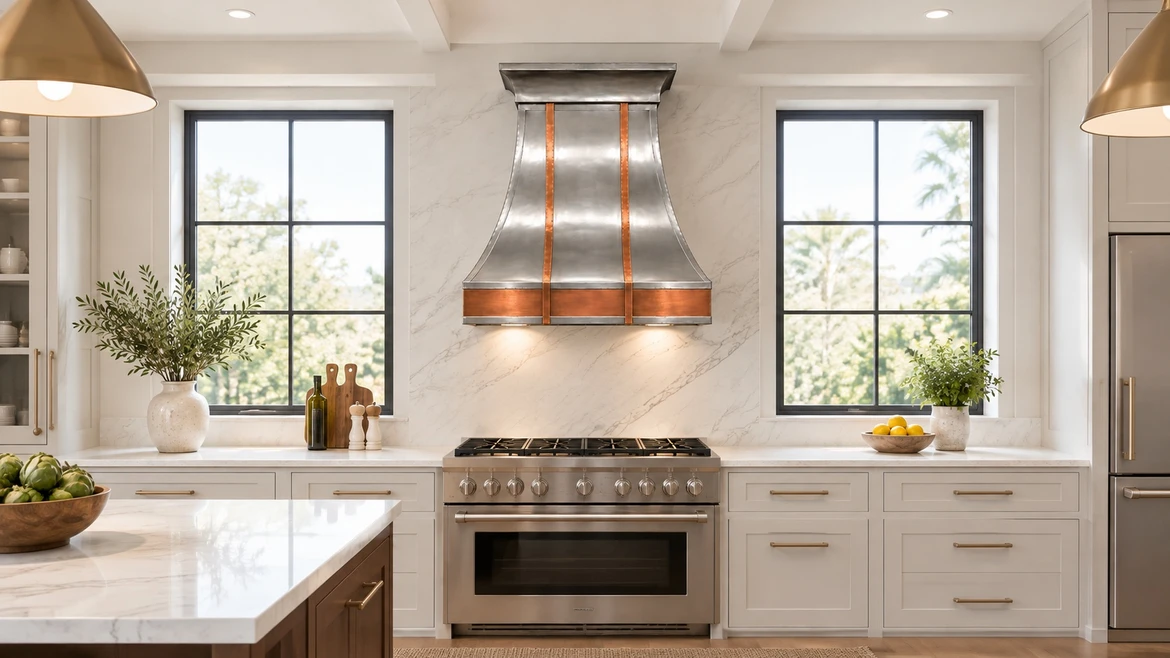
The polished zinc range hood with copper trim combines a reflective bell-shaped canopy, projecting crown molding, twin vertical copper straps, and a broad copper apron. Cool silver-gray zinc forms the main body, while warm copper defines the front and lower perimeter. Available from 28 to 78 inches wide, 24 to 72 inches high, and with a standard 24-inch depth, this handcrafted design can be proportioned for wall or island installation. The supplied photographs reveal its symmetry, side projection, surface reflections, and empty ventilation opening. A technical drawing supports early discussions about crown width, canopy height, and apron scale. For additional kitchen design inspiration, explore our polished zinc range hood kitchen styles and design ideas. Explore each view to plan your dimensions, mixed-metal finishes, and ventilation preparation.
Blog summary
- Body: Reflective polished zinc
- Trim: Copper straps and broad apron
- Shape: Bell canopy with projecting crown
- Planning: Custom sizing and insert preparation
Front view balance
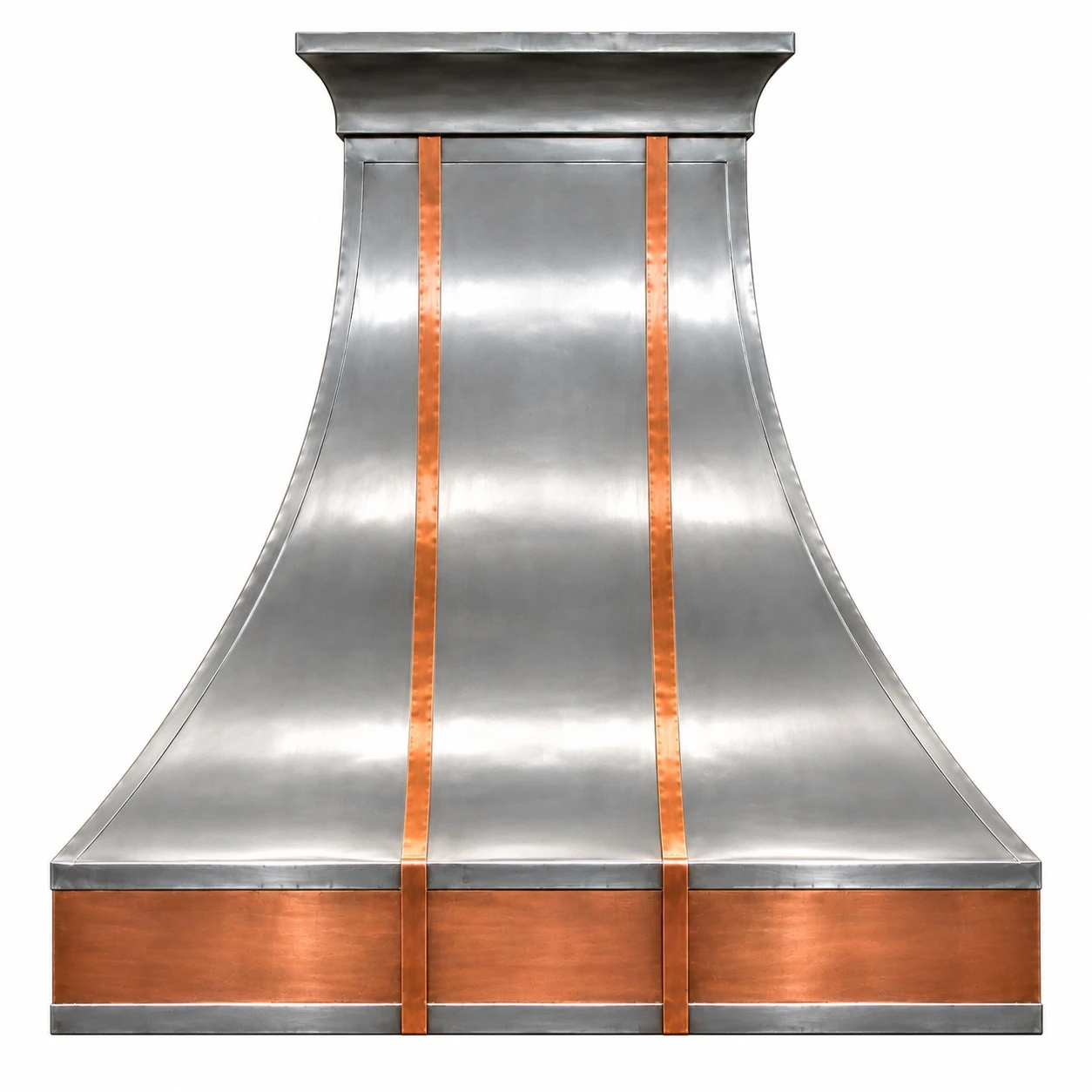
The front photograph establishes a symmetrical composition. Two narrow copper straps descend from beneath the crown, follow the flared canopy, and continue across the copper apron. Their vertical direction balances the broad horizontal band below. Slim zinc borders frame the apron, keeping the warmer metal concentrated within a defined area. This arrangement gives the hood a clear outline without covering most of the reflective body. Our mixed metal hood guide explains how selective contrasting trim can organize a kitchen focal point.
Angled canopy view

The angled photograph reveals the curved front, side panel, and apron return. Copper continues around the lower corner, while zinc edging outlines the top and bottom of the band. The crown also wraps around the visible side, giving the enclosure a finished appearance beyond its front elevation. Notice how the zinc appears darker or warmer depending on the reflected surroundings. Review our smooth and hammered finishes guide when deciding how much surface reflection you want above the range.
Side profile projection

The side profile shows a straight rear edge and a front that curves outward toward the cooking surface. The lower apron establishes the deepest section, while the upper body remains comparatively shallow. This perspective helps when coordinating nearby cabinetry, shelves, and backsplash thickness. It also shows why crown projection and canopy depth should be reviewed separately. Confirm measurements and clearances on the approved installation plan. Our metal hood installation guide covers the layout information needed before fabrication.
Copper strap detailing
The two copper straps connect the crown area with the lower apron, carrying warm color through the full front elevation. Their narrow width leaves generous zinc fields between and beside them. This makes the design adaptable to kitchens where copper is an accent rather than the dominant metal. Confirm the strap width, positioning, and finish when approving the drawing. For a different arrangement of warm trim against zinc, explore our brass corner strap guide.
Underside insert opening

The underside photograph shows a rectangular opening bordered by metal beneath the copper apron. No installed filters, controls, or lights are visible. The exterior hood dimensions do not determine the exact equipment opening, so select the insert early and provide its full specification sheet. Confirm cutout dimensions, mounting support, duct location, lighting, and filter-removal access before production. Our range hood insert guide explains how the ventilation equipment and decorative enclosure should be coordinated.
Drawing and proportions

The drawing illustrates the crown, flared body, transition area, and copper apron as separate proportional sections. It suggests a crown width near 60 percent of the overall hood width and assigns approximately 20 percent of the total height to the apron. Treat these ratios as design references. Custom dimensions may require adjustments to preserve the intended balance and accommodate equipment. For kitchens with greater vertical space, our high ceiling hood guide provides additional context for reviewing upper-body proportions.
Planning the right size
Start with the range, available cabinet opening, finished ceiling height, and required mounting clearance. Then review the hood width, depth, crown projection, and copper apron together. A taller order does not necessarily require every decorative section to increase by the same amount. The final drawing should document the proportions selected for your kitchen. Our range hood sizing guide offers general measurement considerations that can support this planning discussion.
| Planning | What to confirm |
|---|---|
| Width | Choose within the 28–78 inch range and review the overall width against the appliance and cabinet opening. |
| Height | Choose within the 24–72 inch range and approve the crown, canopy, and apron proportions. |
| Depth | Confirm the standard 24-inch depth, front projection, and relationship to adjacent cabinetry. |
| Metal finishes | Approve zinc reflectivity, copper tone, surface texture, and finish-care expectations. |
| Ventilation | Supply the exact insert specifications and approve the opening, supports, and duct connection. |
Finish and light
The polished zinc reflects broad areas of light, emphasizing the canopy’s curvature. Copper adds warmer color along the straps and apron, but its appearance also changes with illumination and surrounding materials. Compare samples under both daylight and the planned kitchen lighting. Confirm whether any protective treatment is included and how it affects maintenance or future patina. The mixed metal planning guide offers further guidance on balancing warm and cool finishes.
Kitchen material pairings
For a modern rustic transitional kitchen, consider Shaker cabinetry, pale stone, and a few warm wood accents. In an industrial loft, copper can soften the relationship between reflective zinc, brick, concrete, and dark window frames. For a European farmhouse, limestone and muted painted cabinets could provide a quieter background for the metalwork. These are styling suggestions rather than interiors pictured in this collection. Explore our modern hood design guide for broader material comparisons.
Care and cleaning
Confirm care instructions for both metals before using cleaners or polishing products. Wipe gently with materials approved for the selected finishes, paying attention to strap edges and the lower apron. Avoid assuming that a product suitable for copper is appropriate for zinc. Ventilation filters and controls should be maintained according to the insert manufacturer’s instructions. Our zinc hood care guide provides a starting point for caring for the main body.
Frequently asked questions
A: It combines a reflective zinc bell canopy, projecting crown, twin copper straps, and a broad copper apron bordered by zinc trim.
A: No. Zinc forms the main canopy, while copper supplies the contrasting straps and apron.
A: The stated range is 28–78 inches wide and 24–72 inches high, with a standard 24-inch depth.
A: Yes. The front photograph shows both straps descending across the canopy and continuing over the apron.
A: The angled and profile photographs show copper continuing along the visible side of the lower band.
A: Its reflective surface picks up changes in lighting, viewing angle, and nearby colors. Approve finish expectations with samples where available.
A: No. It shows the empty rectangular equipment opening and surrounding metal.
A: No. They provide a reference. Final dimensions, crown size, apron height, and strap placement should be approved for the selected configuration.
A: An island configuration can be reviewed. Confirm exposed faces, trim placement, ceiling support, and duct routing before fabrication.
A: Send the range dimensions, kitchen elevation, ceiling height, mounting layout, preferred finishes, and complete ventilation equipment specifications.
Plan your hood
Review the front for symmetry, the side for projection, and the underside for equipment preparation. Compare metal samples with the cabinetry and countertops before approving the final drawing. Explore the zinc hood with copper trim to plan your dimensions, finishes, and mounting configuration.
All product images © Rustica House, unauthorized use is prohibited.