US Dollar
 Euro
Euro
 Australian Dollar
 Canadian Dollar
 Polish Zloty
 British Pound










Product Description
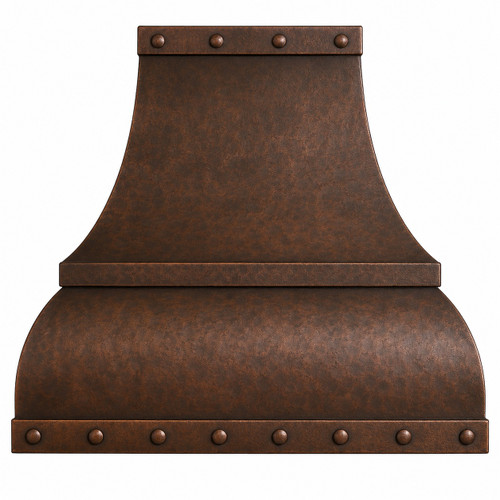
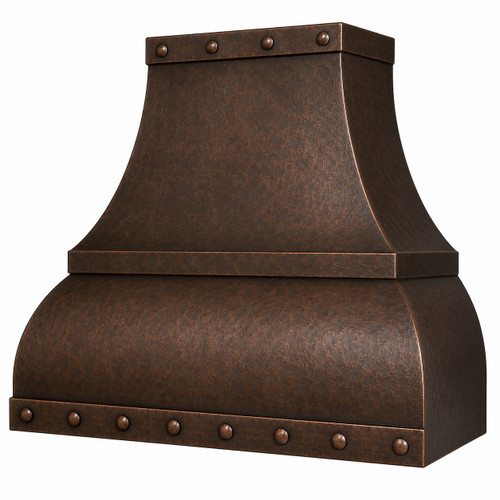
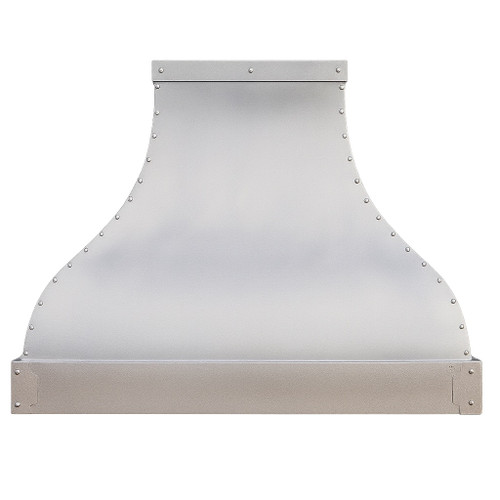
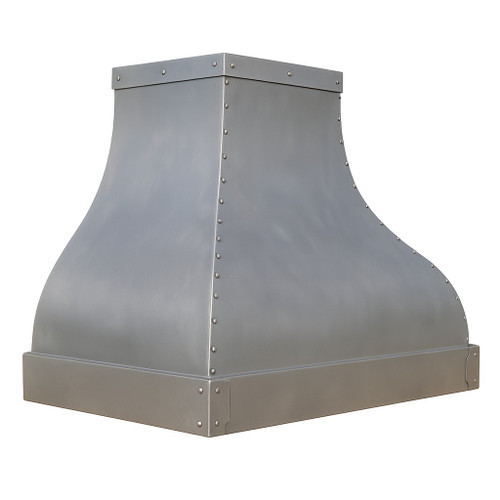
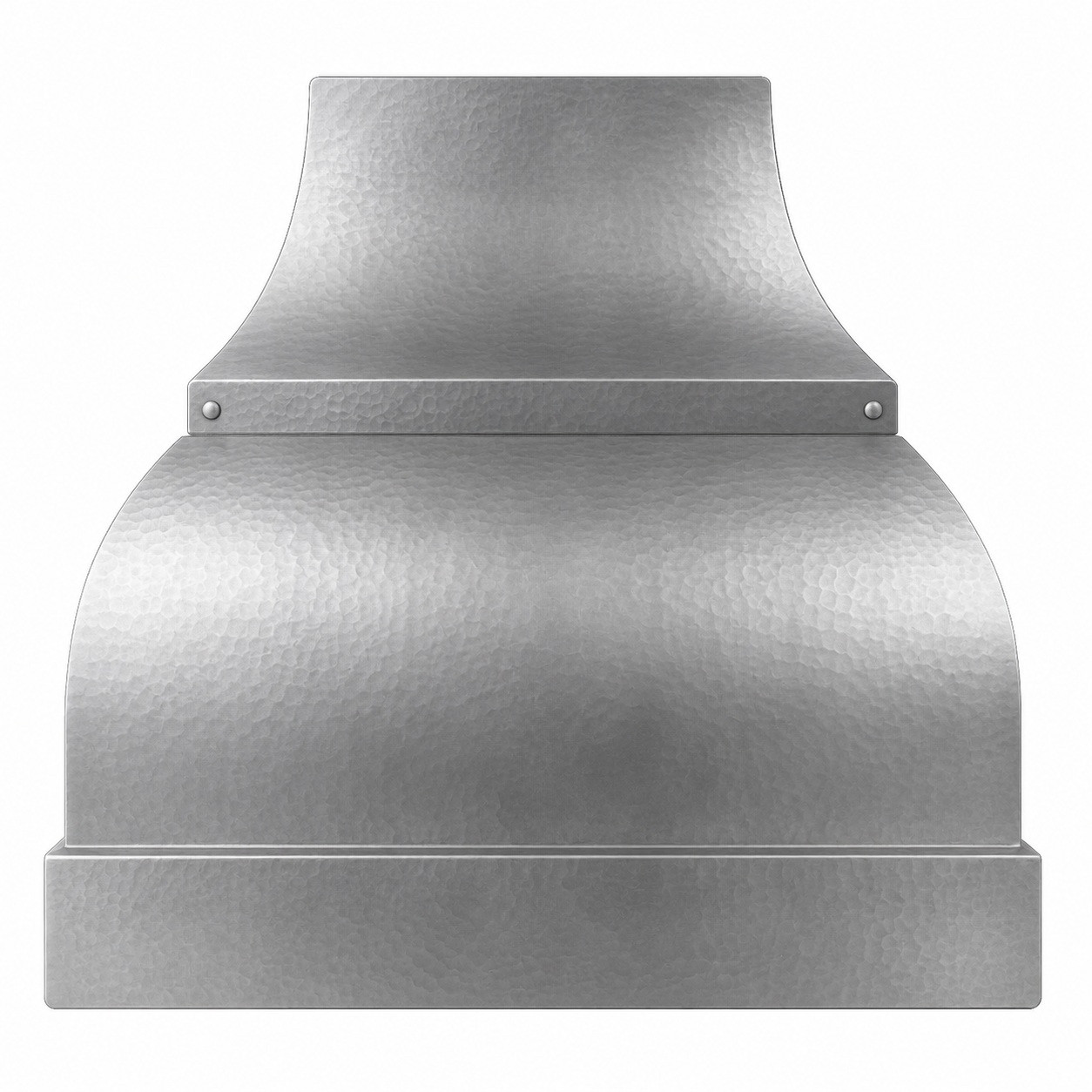
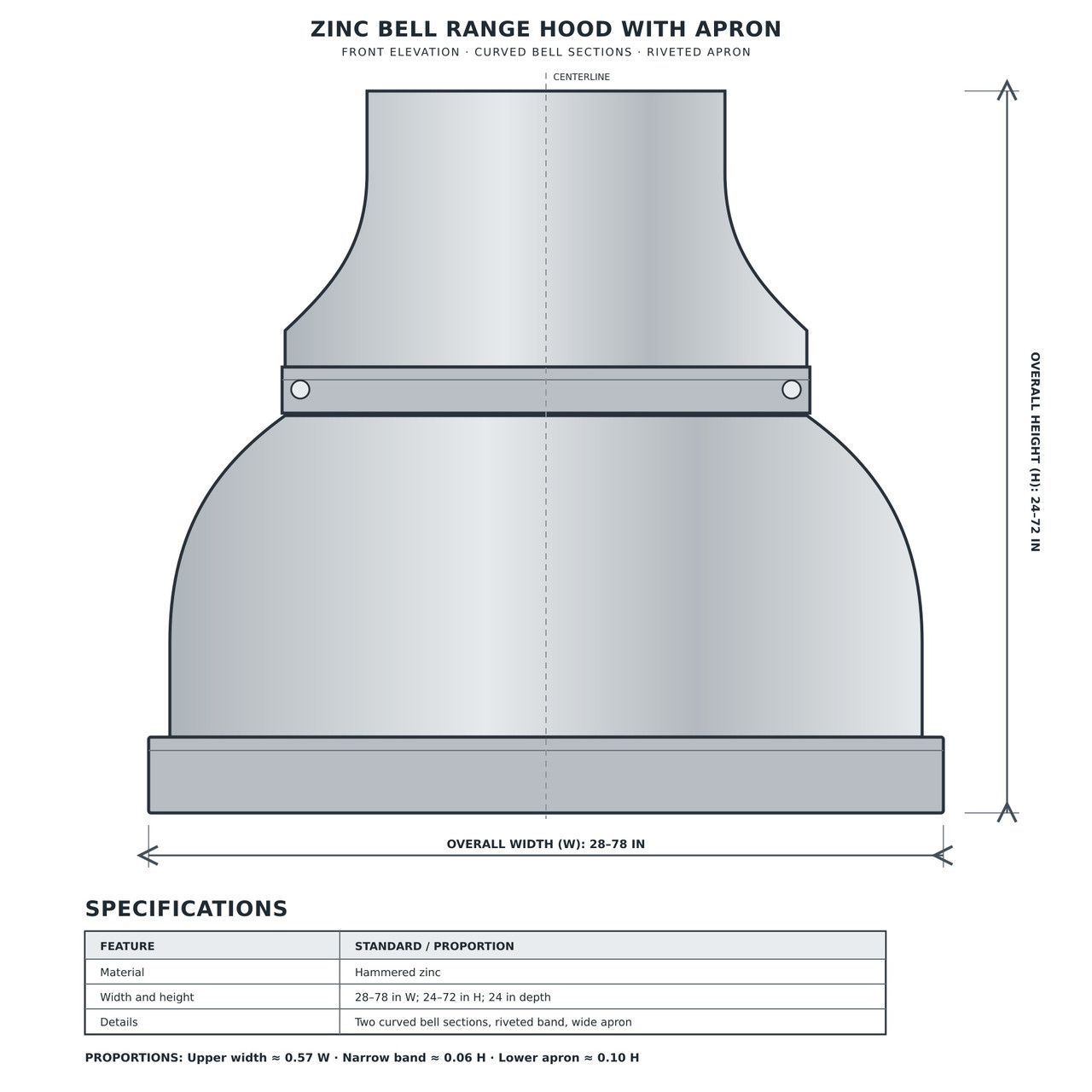
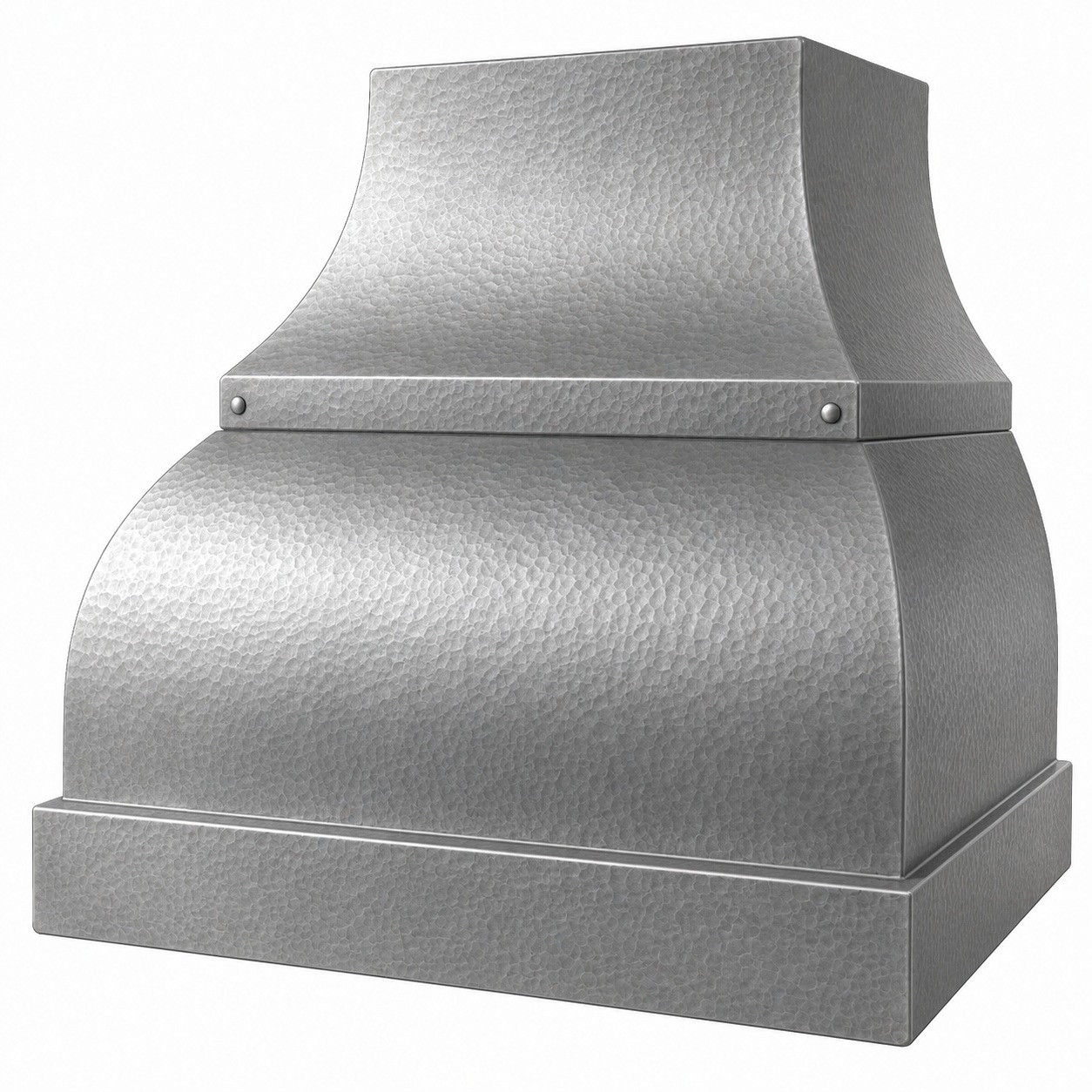
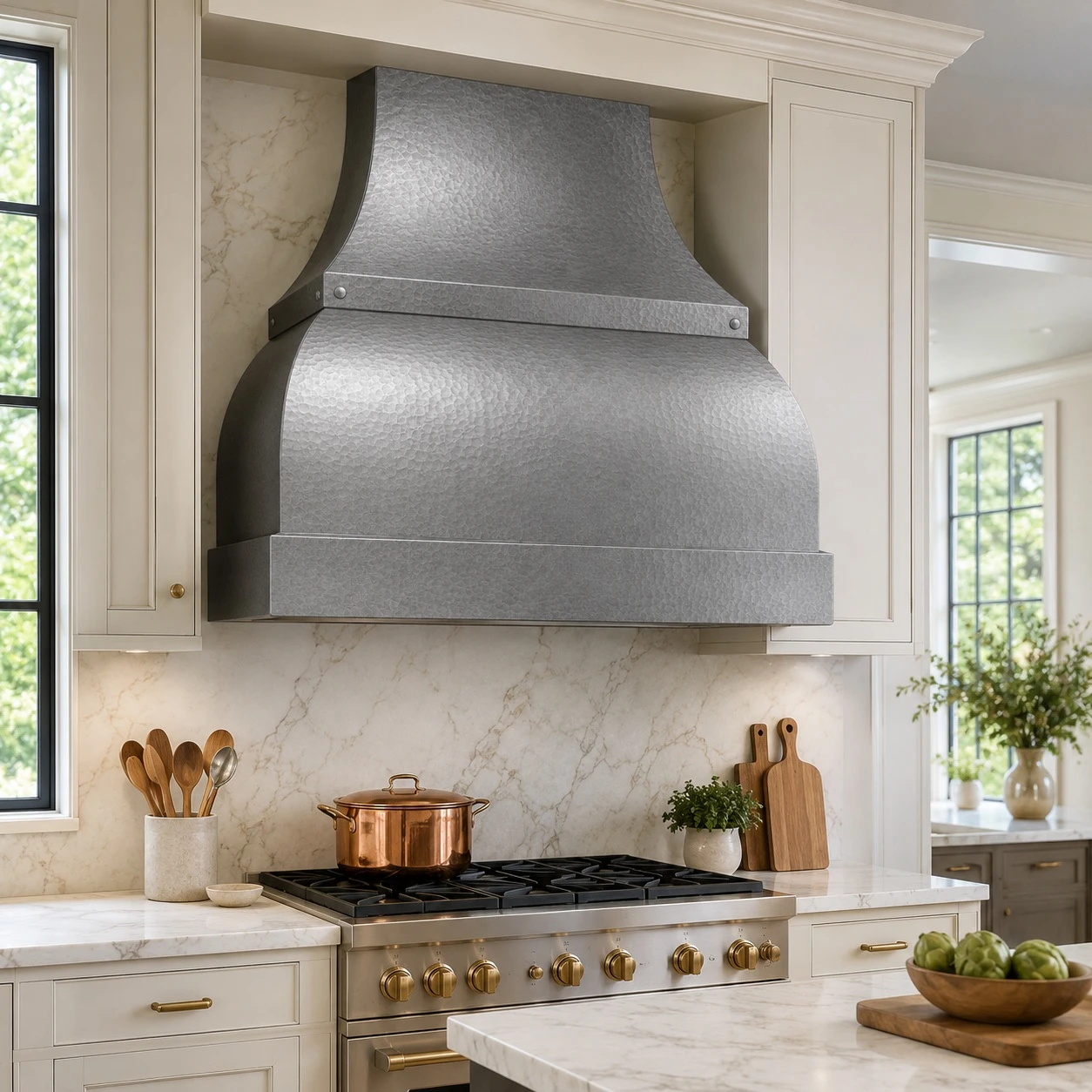
This hammered zinc bell range hood with band and boxed apron is handcrafted from 16-gauge zinc for wall-mount or kitchen-island installation. Its distinctive two-stage silhouette begins with a compact chimney that curves outward toward a straight horizontal waist band with restrained round rivets. Below the band, a fuller bell-shaped capture body settles into a deep squared apron that gives the hood a substantial architectural foundation. Widths range from 28 to 78 inches, heights from 24 to 72 inches, and the standard depth is 24 inches, with custom dimensions available. Soft hand hammering diffuses reflected light, while a sprayed clear varnish helps protect the selected zinc tone and reduce rapid surface change. Each hood is built to order with an estimated eight-week production lead time after dimensions, finish, ventilation specifications, and the buyer’s technical drawing are approved. For technical information about bell proportions, band placement, boxed apron construction, and ventilation compatibility, see our zinc bell range hood boxed apron technical guide. Customize the size, mounting format, finish, apron proportions, and ventilation preparation for your kitchen project.
Product Summary
- Handcrafted from 16-gauge zinc
- Two-stage curved bell silhouette
- Soft hand-hammered surface
- Protective sprayed clear varnish
- Riveted horizontal waist band
- Deep furniture-style boxed apron
- Wall or island configuration
- Custom metal and patina options
- Eight-week production lead time
- Buyer drawing approval required
- Multiple blower configurations
- Free protective shipping crate
Two-Stage Bell Architecture
The defining feature of this hood is the separation between its upper chimney and lower capture body. The compact chimney expands through a controlled concave curve before meeting the horizontal waist band. Below that transition, the lower canopy develops a fuller bell profile and gradually straightens as it approaches the apron. This divided construction creates greater architectural definition than a zinc hood shaped from one continuous taper.
Riveted Waist Band
A straight zinc band separates the upper and lower curves. Restrained round rivets reinforce the handcrafted appearance without giving the hood a heavily industrial character. The band can be positioned or proportioned to suit the total hood height, provided the requested change is reviewed before the production drawing is approved.
Deep Boxed Apron
The squared apron is a structural part of the design rather than a narrow strip of decorative trim. Its depth visually anchors the rounded canopy and creates a furniture-like lower edge above the cooktop. The apron can be adjusted within practical fabrication limits, but changing its height or projection affects the total hood dimensions and must be confirmed during drawing review.
Hand-Hammered Zinc Surface
Closely spaced hammer impressions break reflected light into soft silver-gray highlights and irregular tonal movement. The texture is intentionally restrained so the canopy curves, waist transition, and squared apron remain clearly visible. Because each zinc panel is hammered and shaped by hand, the density and direction of individual hammer marks will vary slightly from one hood to another.
16-Gauge Construction
The hood is formed from substantial 16-gauge zinc rather than lightweight decorative sheet metal. Individual panels are measured, cut, hammered, shaped, joined, and aligned around an internal support structure. The boxed apron requires additional forming and assembly, while the divided bell canopy must be balanced so the upper and lower curves meet the waist band evenly.
The product price reflects the quantity of metal, 16-gauge construction, hand shaping, custom dimensions, apron fabrication, finish application, technical drawing preparation, ventilation adaptation, workshop labor, quality review, and protective insured crating. It is a custom architectural metal enclosure made for a specific kitchen rather than a standard factory-produced appliance cover.
Handmade in Mexico
Each hood is made to order by experienced metal artisans in Mexico. The work involves hand forming rather than automated stamping, allowing the dimensions, proportions, apron, finish, mounting format, and ventilation opening to be adapted for an individual project. Small differences in seams, hammer marks, edge alignment, rivet placement, and zinc tone are natural characteristics of handmade custom work and are not manufacturing defects.
Custom Finish Choices
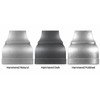
Choose natural, dark, or hand-polished zinc according to the desired contrast and room palette. Custom metal accents, band treatments, apron details, and patina tones may also be considered when requested before production. Any mixed-metal modification should be identified during the quotation and drawing stages because it may change the fabrication method, final appearance, and price.
After the selected zinc appearance is completed, the surface is sprayed with a clear protective varnish. The coating helps preserve the intended tone, limits direct contact with moisture and cooking residue, and slows rapid oxidation. Zinc remains a handcrafted metal surface, however, and gradual tonal variation may still develop because of heat, humidity, cleaning methods, fingerprints, airborne cooking oils, and normal use.
Finish Samples
Request or order metal samples before approving the final finish when precise coordination with cabinetry, stone, tile, lighting, or hardware is important. Samples represent the general material and patina direction. Handmade hammering, workshop conditions, sheet variation, and the scale of the completed hood can cause the finished product to appear somewhat different from a small sample.
Wall & Island Configurations
Wall-Mount Hood
A wall-mount configuration is fabricated with the rear positioned against the wall or backsplash. The front and side proportions are developed around the cooktop width, ceiling height, mounting height, and selected insert. Structural wall blocking should be prepared before installation, and the final duct position must correspond with the approved technical drawing.
Kitchen-Island Hood
The island version is finished on all visible sides and requires structural ceiling support. Its depth, canopy balance, chimney placement, duct route, and insert access must be planned before fabrication. Island installations may require a different overall depth or width than wall installations to provide effective capture around an open cooking surface.
Best Kitchen Styles
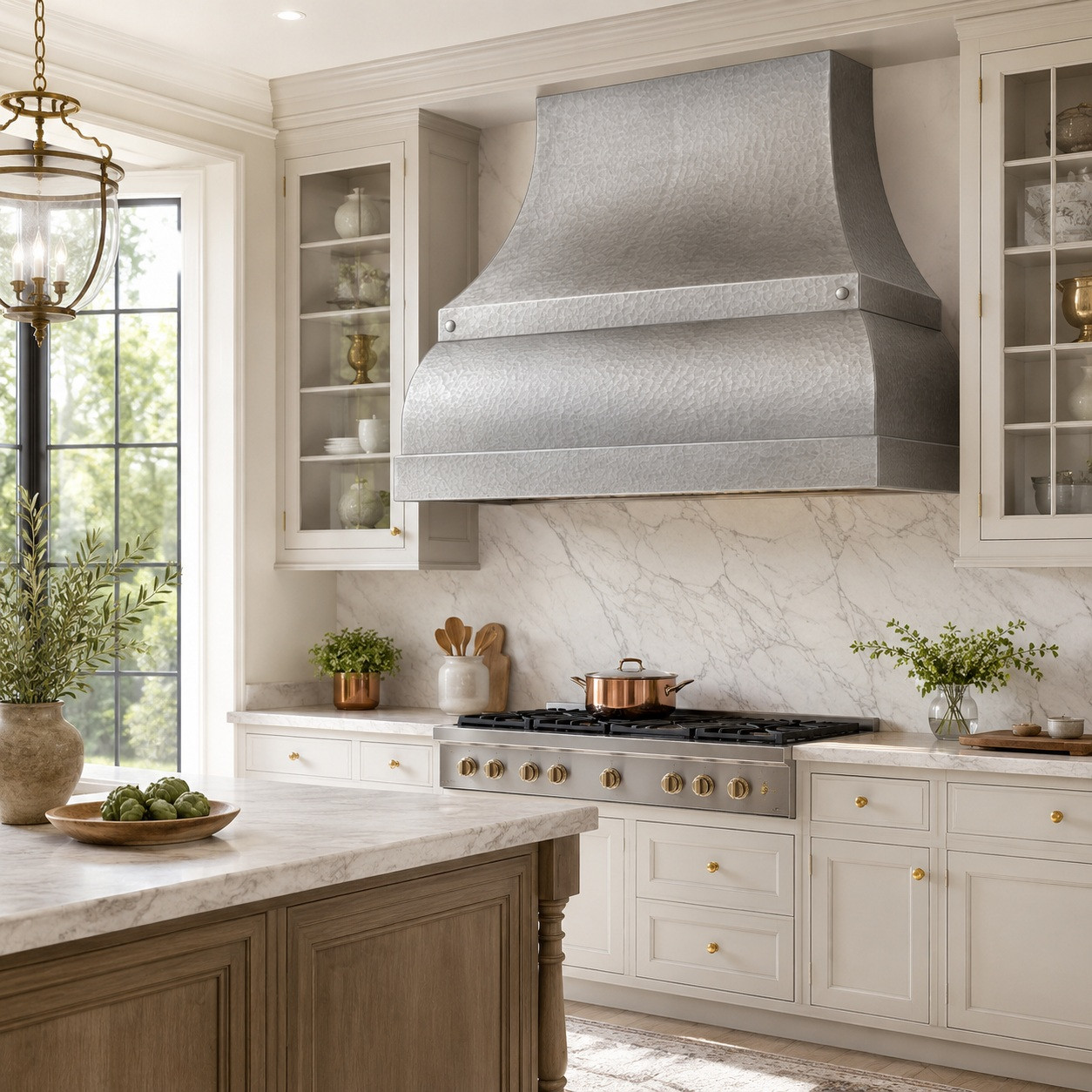
Examine how the bell-shaped canopy, horizontal band, and deep boxed apron integrate into finished kitchens in our hammered zinc bell range hood lifestyle gallery.
- European kitchen: Painted cabinetry, natural stone, aged timber, plaster walls, and traditional architectural details complement the rounded bell canopy, riveted waist band, and substantial boxed apron while the hammered zinc introduces an authentic handcrafted metal element.
- Modern kitchen: Clean cabinetry, simple stone surfaces, restrained hardware, and uncluttered layouts provide contrast to the handcrafted zinc texture. The defined waist band and deep squared apron give the hood architectural presence without requiring elaborate surrounding decoration.
- Transitional kitchen: Shaker cabinetry, natural stone, warm wood, and understated traditional detailing balance the hood’s curved bell profile. The zinc surface adds material character while the structured apron creates a visual connection between contemporary simplicity and more traditional furniture-inspired proportions.
- Minimalist kitchen: Flat-panel cabinetry, limited materials, neutral colors, and simple architectural lines allow the two-stage bell silhouette to become the primary focal point. Restrained rivets and soft hammering provide subtle surface interest without introducing excessive decorative detail.
Other Kitchen Styles
- Modern farmhouse
- Rustic contemporary
- Industrial loft
Size and Kitchen Planning
| Planning | What to confirm | Why it matters |
|---|---|---|
| Cooktop width | Exact appliance dimensions | Determines capture width |
| Hood width | Cooktop and installation type | Supports effective coverage |
| Ceiling height | Finished floor to ceiling | Controls total hood height |
| Mounting height | Insert and code requirements | Affects safety and capture |
| Wall or island | Final installation location | Changes finished surfaces |
| Insert model | Brand and specifications | Controls internal preparation |
| Duct size | Diameter and discharge route | Prevents airflow restrictions |
| Apron depth | Desired lower proportion | Affects height and visual mass |
The hood should be proportioned around the actual cooking appliance rather than cabinetry alone. Wall hoods are commonly selected at least as wide as the cooktop, while larger island installations may benefit from additional capture width. Final sizing must also account for the insert manufacturer’s instructions, cooking output, mounting clearance, cabinetry, ceiling conditions, and applicable building requirements.
Insert and Blower Planning
Rustica House can supply the optional 200 CFM insert only. This basic two-speed unit includes integrated lighting and washable filters and is intended for lighter cooking requirements and compatible hood sizes. Buyers who need greater airflow, different controls, specialized lighting, quieter operation, or another filter arrangement should select a buyer-supplied ventilation system.
This range hood supports buyer-supplied internal inserts up to 1,260 CFM and external blower systems up to 1,500 CFM. Depending on the selected equipment, the hood may be prepared for model-specific internal, inline, remote, or external blower arrangements. Complete specifications must be supplied and approved before production. Review the metal range hood insert and ventilation guide before choosing a system.
Information Required Before Production
- Insert manufacturer and model
- Overall liner dimensions
- Required opening or cutout
- Duct diameter and location
- Vertical or rear discharge
- Blower type and capacity
- Control placement
- Lighting configuration
- Filter removal clearance
- Service access requirements
Ventilation equipment varies widely in CFM capacity, controls, finishes, lighting, blower type, ducting, noise level, and price. Allowing a buyer-supplied system gives the owner, designer, contractor, and appliance specialist greater flexibility to match the hood with the cooking equipment and local installation requirements.
What Is Included
- Custom 16-gauge zinc hood shell
- Internal supporting framework
- Selected wall or island build
- Selected zinc finish and varnish
- Approved band and apron details
- Insert opening preparation
- Approved mounting provisions
- Optional 200 CFM insert if purchased
- Protective insured shipping crate
- Buyer-approved technical drawing
Buyer-Supplied Items
Unless specifically included in the order, the buyer or installer supplies the ventilation insert or blower, ductwork, transitions, roof or wall cap, electrical wiring, switches, structural blocking, ceiling support, fasteners required by site conditions, installation labor, permits, and final appliance connections. All site measurements and installation conditions remain the buyer’s responsibility.
Ordering and Approval
- Select the hood width, height, depth, finish, and wall or island configuration.
- Provide the cooktop, ceiling, mounting, duct, and ventilation information.
- Submit the complete specifications for a buyer-supplied insert or blower.
- Review the technical drawing showing the approved hood dimensions and openings.
- Approve the drawing and finish details before fabrication begins.
- Allow approximately eight weeks for made-to-order production after approval.
- Receive shipping information when fabrication, inspection, and crating are complete.
Changes requested after drawing approval may require revised engineering, additional fabrication, a price adjustment, or a new production schedule. Appliances, inserts, and site dimensions should therefore be finalized before the hood drawing is approved.
Compare Zinc Hood Designs
| Zinc hood | Shape and surface | Metalwork and apron | Suitable kitchens | Installation |
|---|---|---|---|---|
| This hammered zinc bell hood | Two-stage bell with soft hammering | Riveted waist band and deep boxed apron | European, transitional, minimalist, organic modern | Wall or island |
| Smooth zinc bell hood | Continuous bell form with smooth panels | Minimal hardware and restrained lower edge | Modern, transitional, Scandinavian, European | Wall or island |
| Tall-chimney zinc bell hood | Elongated chimney with bell-shaped base | Vertical emphasis and simpler apron | High-ceiling, traditional, European, transitional | Wall or island |
| Minimalist tapered zinc hood | Straight tapered planes with smooth surface | Little ornament and squared lower edge | Minimalist, contemporary, transitional, industrial | Wall or island |
| Zinc hood with copper apron | Hammered zinc with strong tonal contrast | Copper straps and contrasting copper apron | Spanish, Mediterranean, rustic, warm industrial | Wall or island |
Rnage Hood Specifications
- Material: 16-gauge zinc
- Construction: Handmade to order
- Width: 28–78 inches or custom
- Height: 24–72 inches or custom
- Depth: 24-inch standard
- Profile: Two-stage bell canopy
- Texture: Soft hand hammering
- Band: Horizontal riveted zinc band
- Apron: Deep rectangular boxed base
- Finish: Natural, dark, or polished
- Protection: Sprayed clear varnish
- Configuration: Wall or island
- Lead time: Approximately eight weeks
- Insert: Optional 200 CFM unit
- Internal insert: Up to 1,260 CFM
- External blower: Up to 1,500 CFM
- Origin: Handmade in Mexico
- SKU: RH47Y4B92
PDF and CAD Downloads
The proportional PDF drawing and CAD file support cabinetry coordination, hood sizing, mounting preparation, ventilation planning, and project review before fabrication. Use these files as design references and confirm the final width, height, depth, insert opening, duct position, and custom apron proportions on the buyer-approved technical drawing before production.
FAQ – Product Planning
A: Yes. The boxed apron is included within the hood’s total approved height. A deeper or taller apron changes the proportions of the lower body and must be included in the technical drawing.
A: The band can be resized, repositioned, or potentially removed as a custom modification. Because it separates the upper and lower curves, changing it may alter the hood’s visual identity and fabrication requirements.
A: Zinc can develop tonal variation over time. This hood is sprayed with clear varnish to help preserve the selected appearance and slow rapid oxidation, but gradual changes may still occur through heat, humidity, cleaning, fingerprints, and normal kitchen use.
A: Yes. The hood can be prepared for a compatible buyer-supplied insert or blower when the complete manufacturer, model, dimensions, cutout, duct, control, lighting, filter, and access specifications are supplied before production.
A: Provide the cooktop dimensions, ceiling height, mounting height, wall or island configuration, hood dimensions, finish, insert model, duct size, discharge direction, blower details, and relevant installation drawings.
A: Yes. The island configuration is fabricated with finished visible surfaces around the canopy and chimney. It also requires structural ceiling support and a confirmed overhead duct route.
A: A sloped-ceiling condition may be accommodated when the ceiling angle, mounting position, structural support, and duct route are provided before the technical drawing is prepared.
A: The estimated production lead time is eight weeks after the buyer approves the hood dimensions, finish, mounting configuration, ventilation specifications, and technical drawing.
A: Its value reflects 16-gauge zinc, custom dimensions, hand hammering, two-stage canopy shaping, boxed-apron fabrication, finish work, protective varnish, drawing approval, ventilation preparation, artisan labor, inspection, and protective crating.
Customize Your Zinc Hood
Provide the cooktop width, ceiling height, wall or island placement, preferred dimensions, zinc finish, apron proportions, and complete ventilation specifications. Rustica House will use the approved information to prepare the technical drawing and fabricate your hammered zinc bell range hood with band and boxed apron. Finalize the project details before drawing approval to begin the estimated eight-week production schedule.
Related Resources
- Zinc bell hood design guide
- Zinc bell hood kitchen images
- Insert and ventilation guide
- Wall and island hood planning
- Artisan metalworking tradition
- Zinc range hood collection
Installation Guide
Installation must follow the approved drawing, ventilation manufacturer’s instructions, and applicable building requirements. Wall models require structural blocking, while island hoods require engineered ceiling support. Confirm mounting height, duct diameter, discharge direction, electrical access, insert service clearance, and all site dimensions before installation. Review the wall and island range hood guide during project planning.
Shipping and Returns
The made-to-order hood is packed in a protective insured crate for freight delivery. Inspect the crate and product at delivery, record visible damage, and follow the carrier and Rustica House reporting procedures. Custom-order conditions, shipping procedures, delivery responsibilities, and return eligibility are explained on the shipping and returns page.
Warranty
Rustica House provides lifetime coverage against manufacturing defects for zinc range hoods, subject to the policy’s terms, exclusions, installation requirements, finish conditions, and claim procedures. Buyer-supplied ventilation equipment is not covered by the Rustica House product warranty. Review the complete Rustica House warranty before ordering.
Cleaning and Maintenance
Clean the varnished zinc surface with mild soap, water, and a soft cloth, then dry it promptly. Do not use abrasive pads, acidic cleaners, ammonia, solvents, metal polish, or harsh degreasers. Avoid scrubbing through the protective varnish. Cooking residue should be removed gently so oils and moisture do not remain on the surface or collect along seams, rivets, and apron edges.
Disclaimer: This product is individually handcrafted. Variations in zinc tone, hammer marks, seams, rivet placement, edge alignment, apron dimensions, patina, and artisan surface movement are expected characteristics of custom metalwork and are not defects. Lifestyle images may show optional dimensions, finishes, ventilation equipment, or custom configurations. Final production follows the buyer-approved specifications and technical drawing.