US Dollar
 Euro
Euro
 Australian Dollar
 Canadian Dollar
 Polish Zloty
 British Pound









Product Description
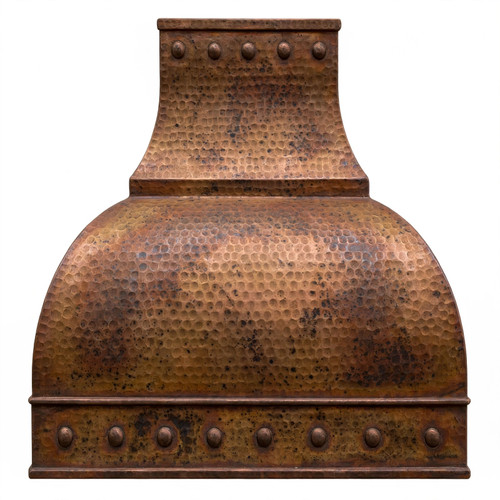
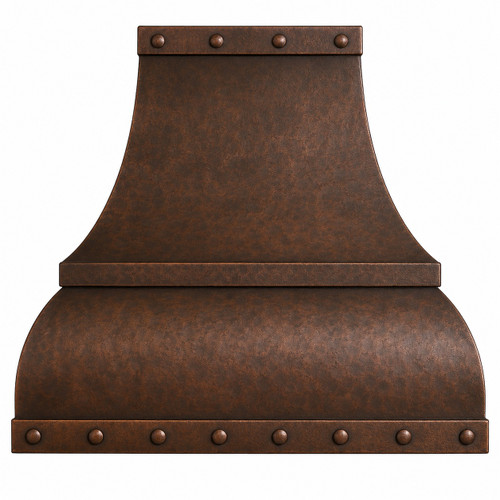
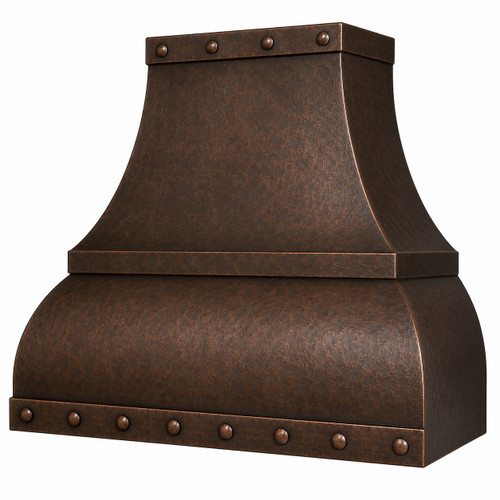
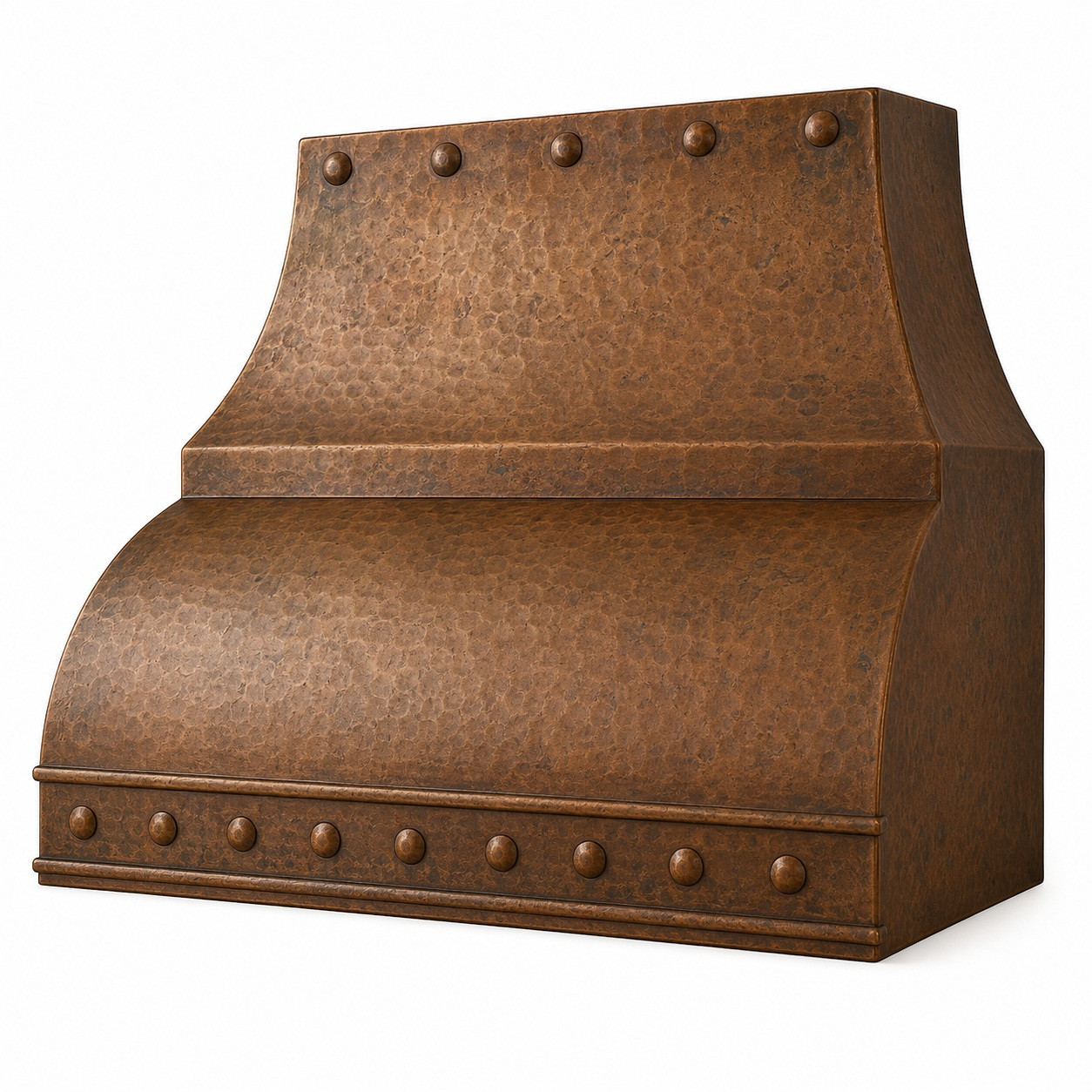
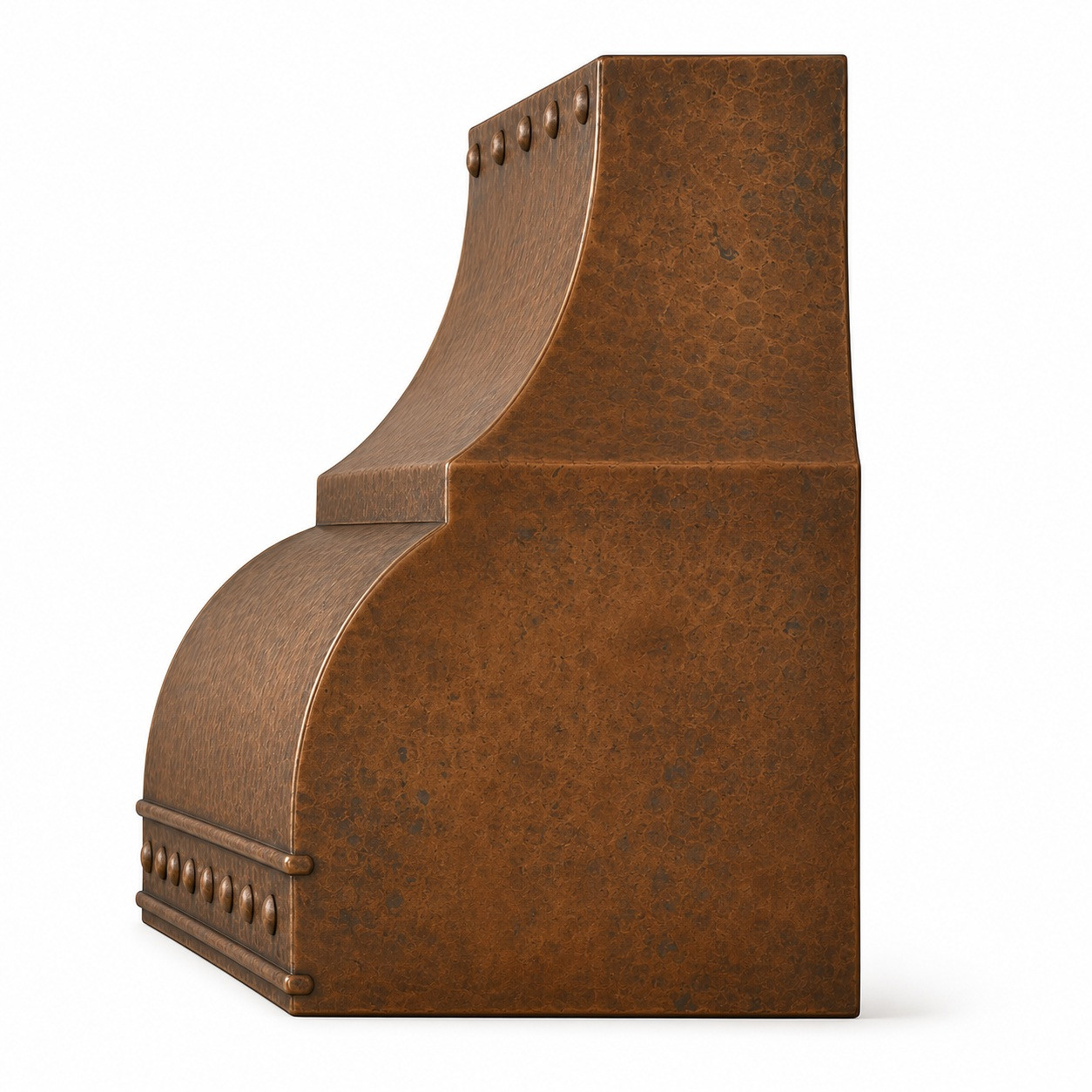
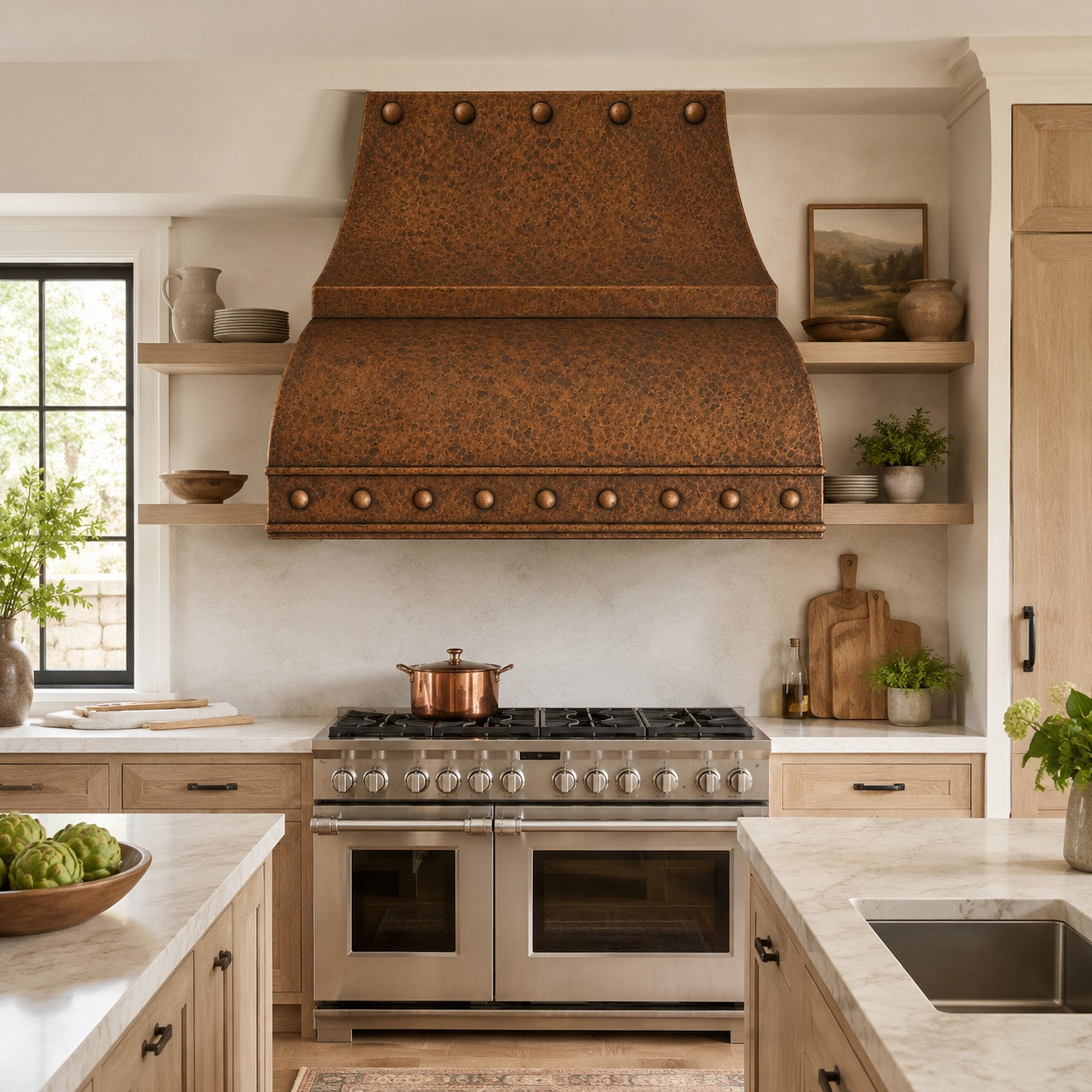
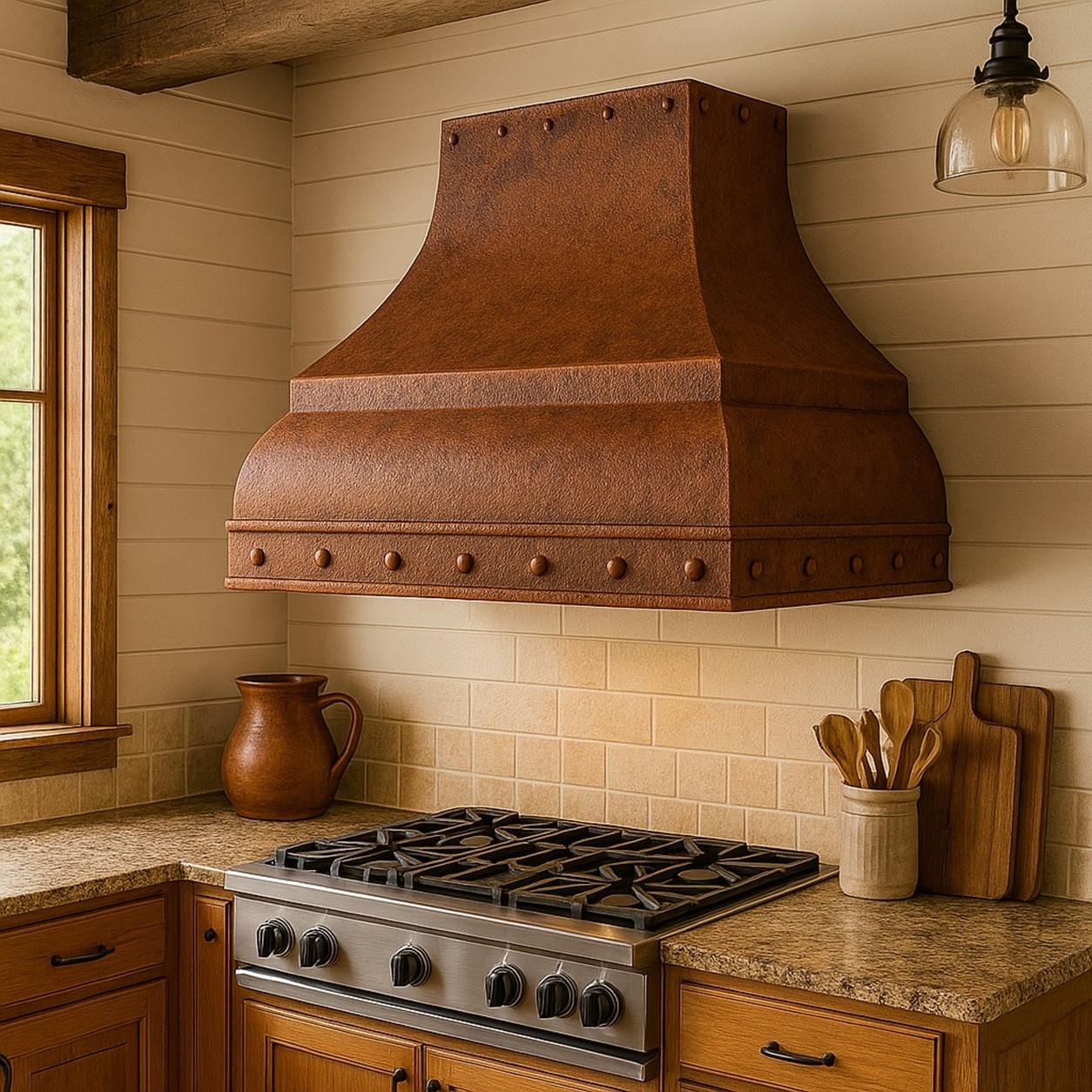
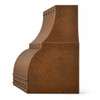
The double-curved copper range hood brings sculptural depth and substantial architectural character to a custom cooking wall. Handcrafted from 16-gauge copper, the body begins with a short concave neck, pauses at a thick rectangular collar, and expands through a broad convex lower canopy. A deep boxed apron anchors the composition with rounded bead moldings and oversized dome rivets inspired by traditional clavos. A restrained upper rivet row adds detail without vertical straps, decorative panels, or side bands. Choose smooth or hand-hammered copper in coffee, antique, natural, honey, green oxidized, or hand-polished finish. Widths range from 28 to 78 inches, heights from 24 to 72 inches, and the standard depth is 24 inches. Examine the concave upper transition, convex lower canopy, and riveted apron configuration in our double-curved copper range hood design guide. Request a custom quote for this handcrafted copper range hood with riveted apron.
Product Summary
- Product: custom copper wall hood
- Profile: two-stage ogee canopy
- Upper body: concave flared neck
- Lower body: convex projecting dome
- Transition: rectangular midpoint collar
- Apron: deep riveted boxed base
- Material: 16-gauge copper
- Texture: smooth or hand-hammered
- Sizes: 28 to 78 inches wide
- Ventilation: up to 1,500 CFM
Hood Architecture
Double-Curved Copper Range Hood
The hood is composed as a sequence of defined architectural masses rather than one uninterrupted curve. The narrow upper neck creates vertical lift, the midpoint collar establishes a strong horizontal division, the projecting lower dome supplies sculptural volume, and the boxed apron forms a stable base above the cooking surface.
Concave Upper Neck
The upper section begins with nearly vertical sides that flare outward as they descend. This controlled concave movement gives the chimney presence without competing with the fuller canopy below. A short row of dome rivets finishes the face without requiring a separate decorative strap.
Midpoint Collar
A thick rectangular collar separates the opposing curves and produces one of the hood’s strongest shadow lines. It prevents the profile from appearing overly soft while giving the enclosure the assembled character of traditional architectural metalwork and custom furniture.
Convex Lower Canopy
Below the collar, the copper projects outward through a broad convex curve before returning toward the apron. This rounded volume gives the two-stage copper canopy pronounced depth from front, angled, and profile views while maintaining a balanced wall-mount silhouette.
Riveted Boxed Apron
The deep apron is framed by rounded bead moldings along its upper and lower edges. Oversized dome rivets create a measured rhythm across the base. Its squared geometry contrasts with the flowing canopy and gives the copper range hood with riveted apron a firm architectural foundation.
Unlike curved hoods formed around one continuous sweep or covered with vertical straps, this design depends on opposing curves, a pronounced midpoint collar, an unstrapped body, and selectively placed rivets. The hardware reinforces the structure without covering the copper surfaces or distracting from the ogee profile.
Custom Dimensions
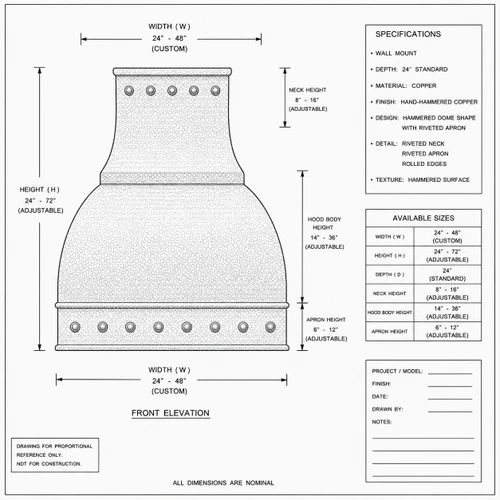
Widths include 28, 30, 36, 42, 48, 54, 60, 66, 72, and 78 inches. Heights range from 24 to 72 inches, with a standard 24-inch depth. The neck, collar, lower projection, apron, moldings, and rivet spacing may be proportioned around the selected dimensions while preserving the balance between the opposing curves.
Texture & Finishes
Choose smooth copper when the precision of the compound curves, collar, moldings, and apron edges should remain visually dominant. Select hand hammering for greater tonal movement and artisan character. Shallow hammer impressions interrupt reflections and allow the concave neck and projecting lower body to respond differently as surrounding light changes.
Six Artisan Finishes
Available treatments include coffee, antique, natural, honey, green oxidized, and hand-polished copper. Coffee produces deep brown coloration, while antique creates aged medium-brown variation. Natural preserves reddish copper tones, and honey introduces brighter golden notes. Green oxidation adds historic character, while hand polishing creates clearer highlights and a more formal appearance.
Main Image Finish
The illustrated hood is shown in hand-hammered copper with antique patina. Medium-brown coloration covers the main surfaces, deeper tones settle inside the hammer marks and around the moldings, and brighter copper highlights appear across the projecting curves. The treatment contains no green or verdigris coloration.
Insert & Ventilation
Provide the cooking-surface width, desired hood width, available wall height, backsplash thickness, ceiling height, cabinet clearances, and selected depth before production. Ventilation information should include the manufacturer, model, body dimensions, cutout, duct size, outlet position, controls, lighting, filters, electrical requirements, and service access.
This range hood supports buyer-supplied internal inserts up to 1,260 CFM and external blower systems up to 1,500 CFM. Rustica House can supply the optional 200 CFM insert only. Any other insert, liner, blower, controls, or ventilation components must be supplied by the buyer.
Complete equipment specifications must be submitted before fabrication so the copper shell can be prepared for the approved system. Ventilation equipment varies widely in CFM capacity, controls, finishes, lighting, blower type, ducting, filter access, and price. Supporting buyer-supplied systems provides greater flexibility for project-specific performance requirements. Review the range hood insert guide before ordering.
Support & Duct Route
Wall framing and attachment points must support the copper shell, liner, blower equipment, and duct components. Ductwork normally travels vertically through the upper neck, although the final route depends on the approved equipment and building conditions. Coordinate structural blocking, electrical service, duct alignment, and maintenance access before fabrication.
Buyer Planning
| Planning | What to Confirm | Why It Matters |
| Hood width | Range and wall dimensions | Sets coverage and visual scale |
| Total height | Wall and ceiling clearance | Balances neck and lower dome |
| Upper curve | Neck width and flare | Creates vertical lift |
| Lower curve | Projection and dome depth | Defines sculptural volume |
| Midpoint collar | Thickness and projection | Separates the two curves |
| Apron height | Base and insert clearance | Grounds the canopy |
| Rivet layout | Head size and spacing | Maintains proper visual scale |
| Ventilation | Insert and duct details | Guides internal preparation |
Product Specifications
- Type: custom copper range hood
- Mount: wall installation
- Profile: double-curved ogee form
- Upper body: concave flared neck
- Lower body: convex projecting dome
- Collar: rectangular midpoint band
- Apron: deep boxed base
- Moldings: rounded bead edges
- Rivets: oversized dome heads
- Vertical straps: none
- Material: 16-gauge copper
- Textures: smooth or hammered
- Finishes: six artisan treatments
- Shown finish: antique patina
- Widths: 28 to 78 inches
- Height: 24 to 72 inches
- Depth: 24 inches standard
- Custom sizes: reviewed
- Ventilation: insert-ready shell
- Supplied insert: optional 200 CFM
- Buyer insert: up to 1,260 CFM
- External blower: up to 1,500 CFM
- Lead time: about 8 weeks
- Delivery: free delivery included
- Shell warranty: 12 months
- Insert parts: 12 months
- Care: mild soap and soft cloth
- Production: made to order
- Origin: Santa Clara del Cobre
- Country: handcrafted in Mexico
- SKU: LC35R7H29
Craft & Origin
Creating the opposing curves requires separate cutting, shaping, fitting, and joining stages. The upper neck must expand evenly toward the collar, while the lower copper panels must project outward and return accurately to the apron. The collar and bead moldings provide crisp horizontal references between the individually formed sections.
Artisan Testimony
The compound curves, collar alignment, hammer depth, rivet placement, and hand-aged color reflect the work of experienced Santa Clara del Cobre artisans. Learn more about copper artisan Juan Carlos Hernández and the regional methods used to create custom architectural copperwork.
Handcrafted Variation
Canopy curves, collar alignment, hammer impressions, rivet spacing, seams, molding profiles, and patina tones may vary slightly between completed hoods. These handmade imperfections, tool marks, seam variations, and natural finish differences add authentic artisan character and are not manufacturing defects.
Styles & Placement
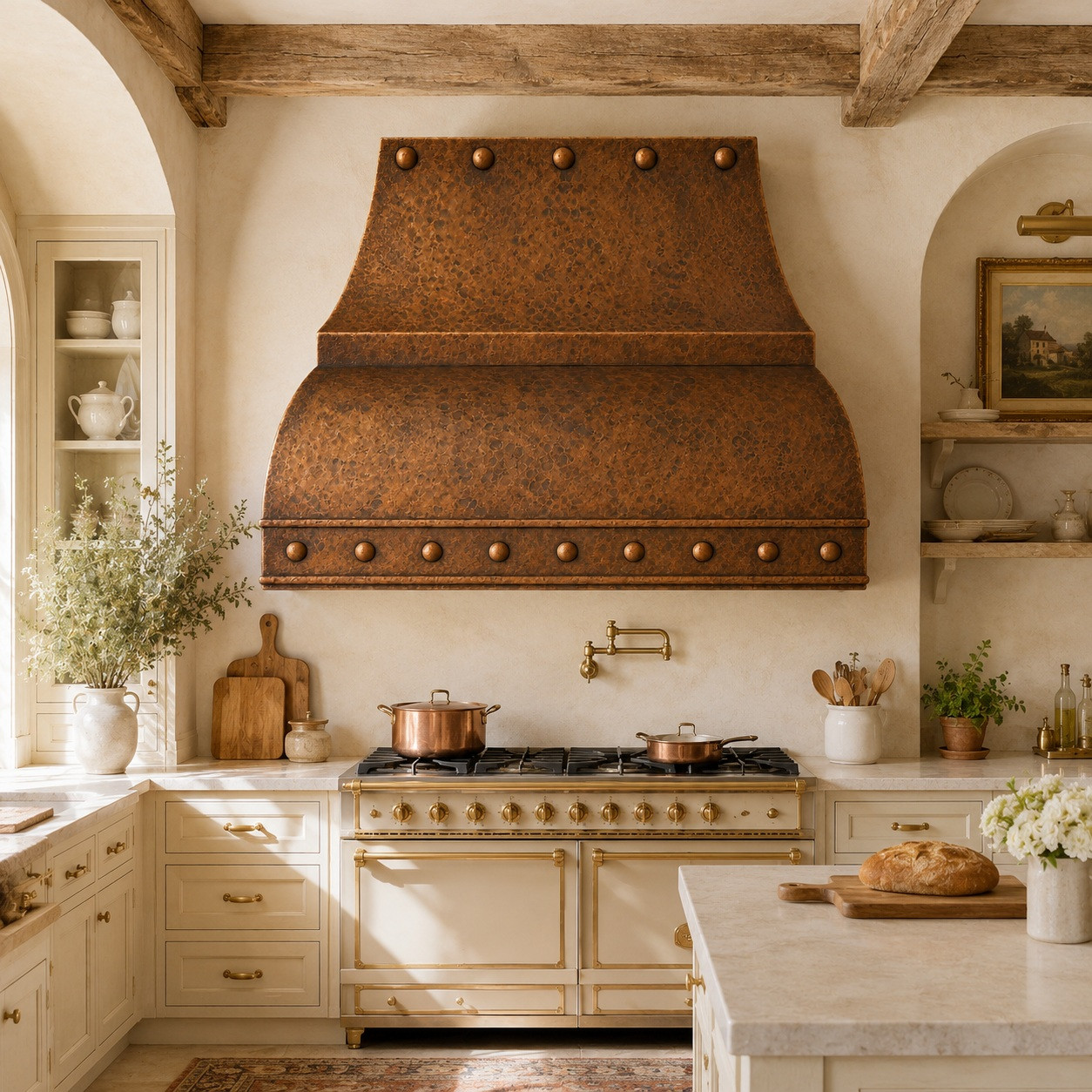
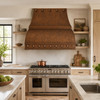
The four strongest settings for this copper range hood are Spanish Colonial, French Country, Tuscan Old World, and rustic transitional kitchens. Textured plaster, Saltillo tile, limestone, travertine, dark wood, painted cabinetry, oak beams, white oak, lightly veined stone, unlacquered brass, and forged iron complement the double-curved canopy and riveted apron. The design also works well in Mediterranean, Hacienda, European farmhouse, and traditional kitchens where substantial architectural forms and handcrafted metalwork are appropriate. Smooth copper creates a more refined appearance, while hand-hammered antique copper adds deeper rustic character and stronger tonal movement. Evaluate the compound curved geometry, riveted apron detailing, and architectural proportions across completed interiors in our double-curved copper range hood lifestyle gallery.
FAQ - Double-Curved Hood
A: The double-curved copper range hood combines a concave upper neck and convex lower dome separated by a substantial rectangular collar. A deep riveted apron grounds the canopy, while the main body remains free from vertical straps and applied decorative panels.
A: An ogee profile combines opposing inward and outward curves. On this hood, the upper section flares toward the collar, while the lower body bows forward before returning to the boxed apron.
A: Yes. Choose smooth copper for clearer architectural lines or hand hammering for additional texture and tonal variation. Both surfaces are available with the listed patinas and hand-polished finish.
A: The main configuration uses hand-hammered copper with antique patina. It displays medium-brown coloration, darker recesses, brighter curved highlights, and darkened details around the rivets and moldings without green oxidation.
A: Widths range from 28 to 78 inches, heights from 24 to 72 inches, and the standard depth is 24 inches. Project-specific proportions may be reviewed before production.
A: Rustica House may supply an optional 200 CFM insert. Buyer-provided internal inserts up to 1,260 CFM and external blower systems up to 1,500 CFM require complete specifications and physical-fit approval before fabrication.
Customize Your Hood
Plan the hood around the cooking surface, available height, cabinetry, backsplash, structural blocking, and approved ventilation equipment. Confirm the upper flare, lower projection, midpoint collar, apron depth, rivet layout, texture, finish, and final dimensions before production. Request a custom quote for your double-curved copper range hood today.
Related Resources
- dome-shaped copper range hoods
- custom copper range hoods
- range hood insert guide
- copper hood size guide
- copper patina options
- copper range hood FAQ
Shipping, Returns & Warranty
Review insured freight delivery, inspection requirements, custom-order conditions, and warranty coverage before production. Visit shipping and returns and the Rustica House warranty page for current terms, exclusions, and buyer responsibilities.
Disclaimer: Handmade dimensions, canopy curves, collar alignment, hammer marks, rivet spacing, molding profiles, seams, finish tones, and other artisan details may vary slightly. These expected characteristics are not manufacturing defects. Lifestyle images may show optional features. Product images may not be reproduced without written permission from Rustica House.