 US Dollar
 Euro
Euro
 Australian Dollar
 Canadian Dollar
 Polish Zloty
 British Pound

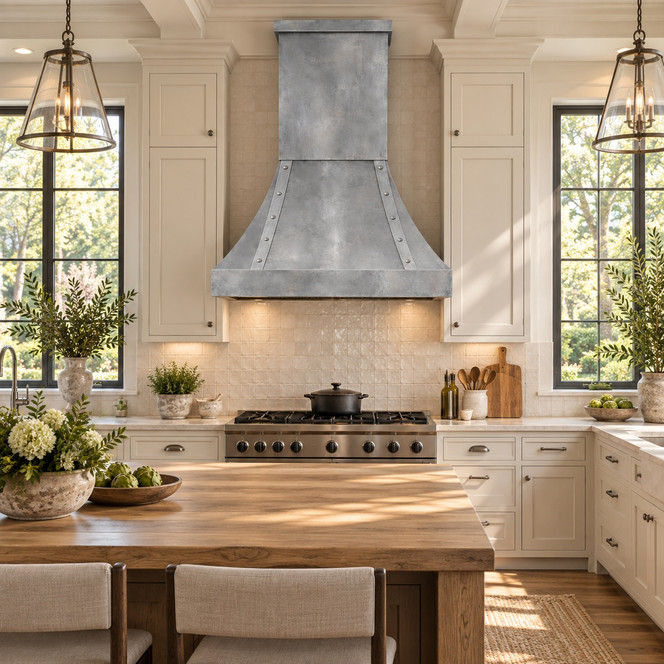
Zinc Bell Range Hood with Twin Straps and Plain Apron Guide explains how a handcrafted zinc hood can combine a sculptural bell canopy with restrained industrial detailing. This zinc bell range hood with twin straps and plain apron features a tall square chimney, sweeping concave body, two riveted zinc straps, simple projecting cap, and uninterrupted lower apron. The monochromatic zinc construction keeps the design cleaner than mixed-metal or heavily paneled hoods. Its architectural form works well in Rustic European, transitional, modern farmhouse, and industrial-inspired kitchens. Because each hood is handmade, natural tonal movement, forming marks, seam character, rivet placement, and subtle surface variation should be expected. No two pieces are identical. See how the bell profile, twin straps, and plain apron work with surrounding kitchen materials in our zinc bell range hood twin straps kitchen images.
Blog Summary
- Material: Handcrafted zinc
- Shape: Bell-shaped canopy
- Straps: Twin riveted bands
- Apron: Plain lower band
- Finish: Six zinc options
- Planning: Custom insert-ready hood
Design Guide Overview
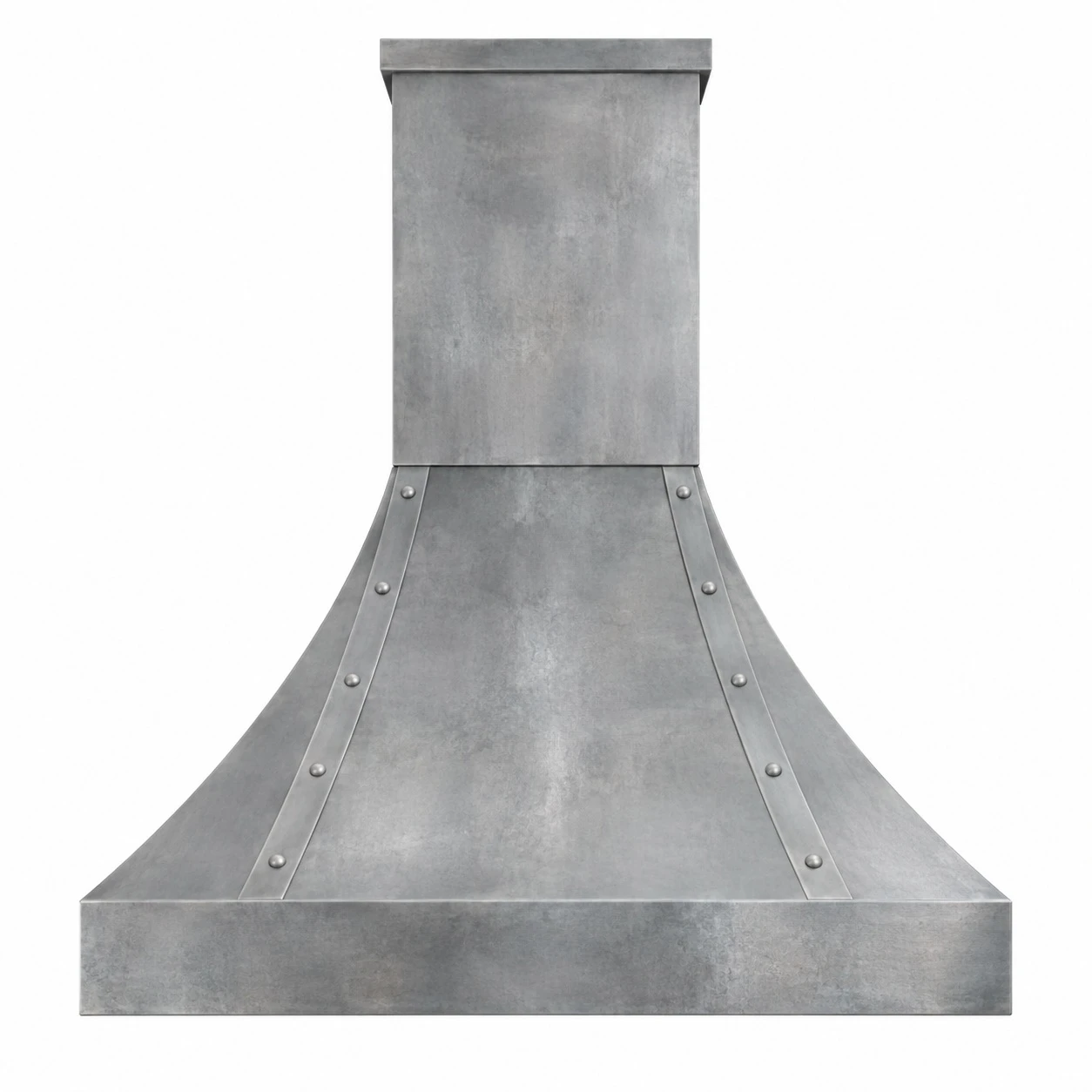
This zinc range hood balances traditional curvature with simpler metal detailing. The tall chimney establishes vertical presence, while the bell canopy curves outward toward the cooking surface. Two zinc straps follow the front contour and add visible rivets without dividing the hood into many panels. A plain apron keeps the lower section visually quiet. This combination makes the hood suitable for kitchens that need an architectural focal point without elaborate molding, mixed-metal accents, or dense decorative grids. Before ordering, confirm range width, cabinet spacing, ceiling height, hood dimensions, backsplash layout, insert specifications, and duct routing.
Bell-Shaped Canopy
The bell-shaped canopy is the defining architectural feature. Its upper body begins narrow and gradually sweeps outward toward the apron. This concave movement gives the hood more softness than a straight tapered enclosure while retaining enough structure for transitional and industrial interiors. The curve also creates changing highlights across the zinc surface as kitchen lighting moves across the body. In a large room, the bell form gives the range wall visual weight. In a smaller kitchen, careful sizing keeps the canopy proportional to nearby cabinetry and the cooking appliance.
Twin Riveted Straps
Two vertical zinc straps run along the front of the hood and reinforce its bell profile. Their riveted construction introduces handcrafted detail without overwhelming the broad zinc surfaces between them. Because the straps are zinc rather than iron, brass, or copper, the hood maintains a consistent monochromatic appearance. This makes the design easier to coordinate with gray stone, brushed nickel, pewter, black hardware, stainless appliances, and natural wood. Small differences in strap alignment or rivet placement are normal characteristics of handmade metalwork.
Plain Apron Design
The plain apron distinguishes this hood from designs with raised panels, decorative frames, multiple bands, or elaborate molded borders. Its uninterrupted surface keeps visual emphasis on the bell curve and twin straps. This restrained lower band can work especially well above patterned backsplashes because it does not introduce additional competing geometry. It also supports transitional kitchens where the owner wants handcrafted metal character without a heavily historical appearance. The simple apron gives the hood a tailored finish while preserving its substantial lower edge.
Custom Hood Specifications
- Material: Handcrafted zinc
- Shape: Bell-shaped canopy
- Texture: Smooth or hammered
- Straps: Twin riveted zinc bands
- Apron: Plain lower section
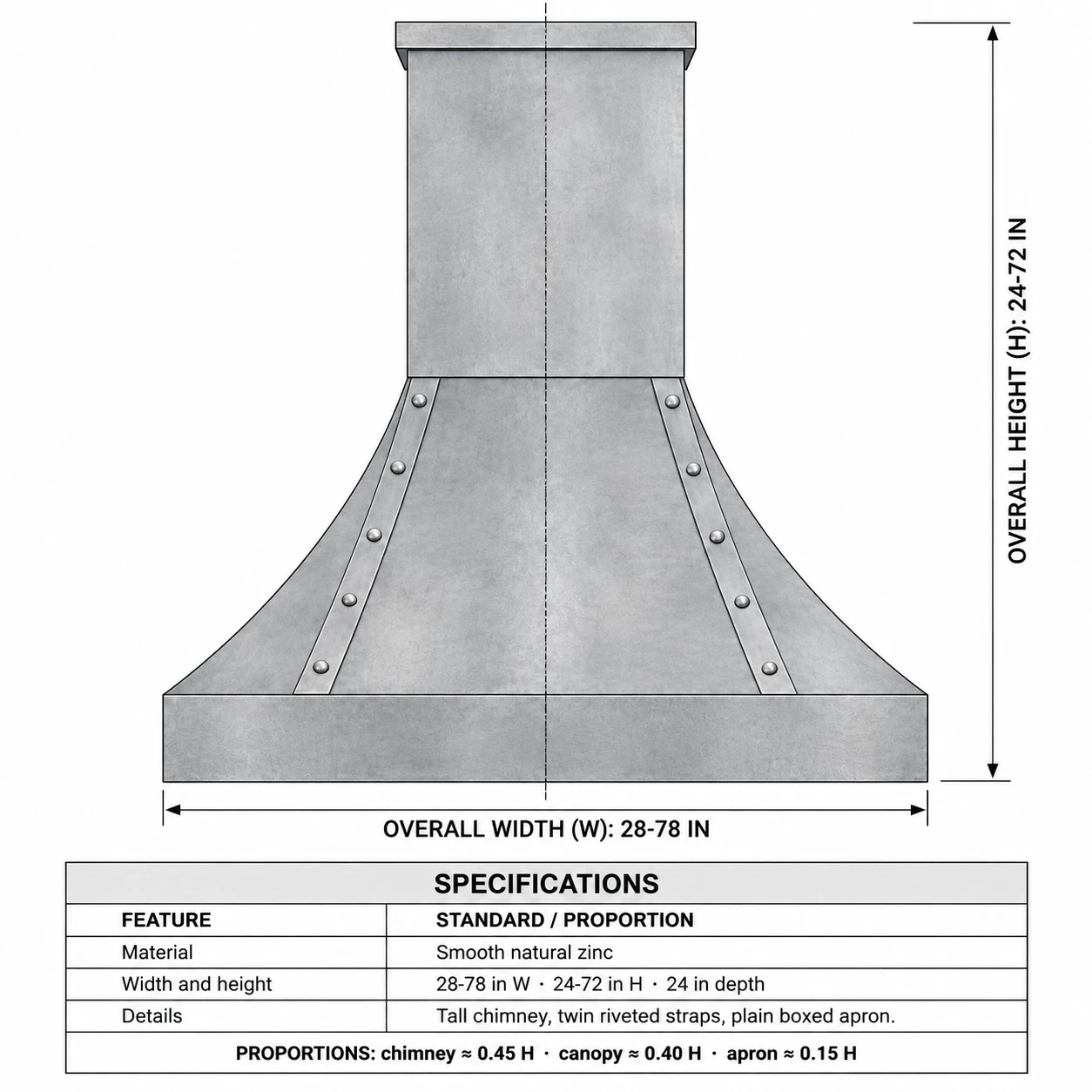
- Widths: 28 to 78 inches
- Heights: 24 to 72 inches
- Depth: Standard 24 inches
- Mounting: Wall or island planning
- Insert: Custom preparation
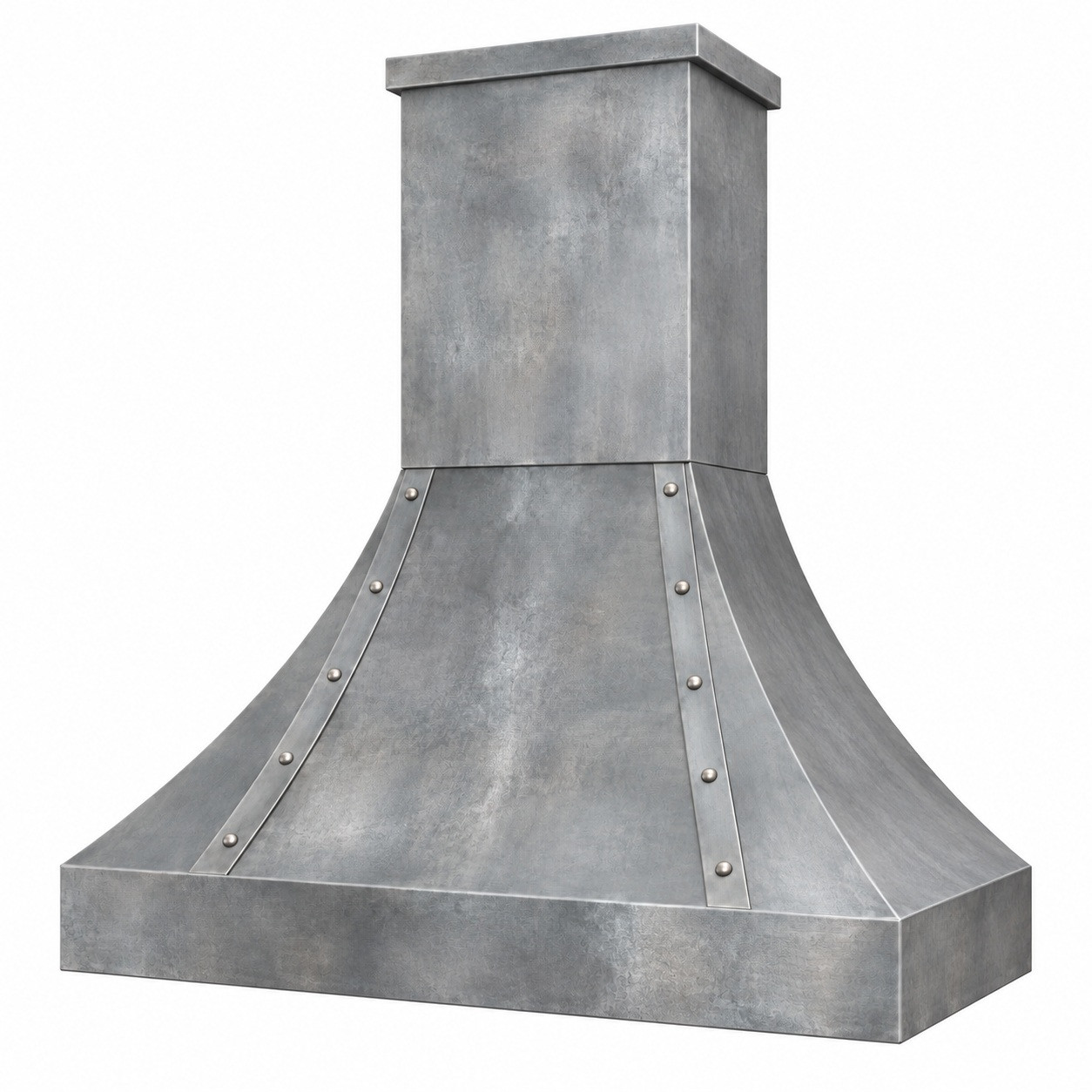
Angled View Planning
The angled view shows how the twin straps follow the concave canopy and how the plain apron wraps around the lower body. This perspective is important because a wall-mounted hood is often visible from an island, breakfast area, or adjoining room. It helps buyers judge projection, side depth, chimney proportion, and the transition between the curved canopy and straight apron. Review this profile with upper cabinetry, backsplash thickness, range depth, and nearby circulation paths before confirming dimensions.
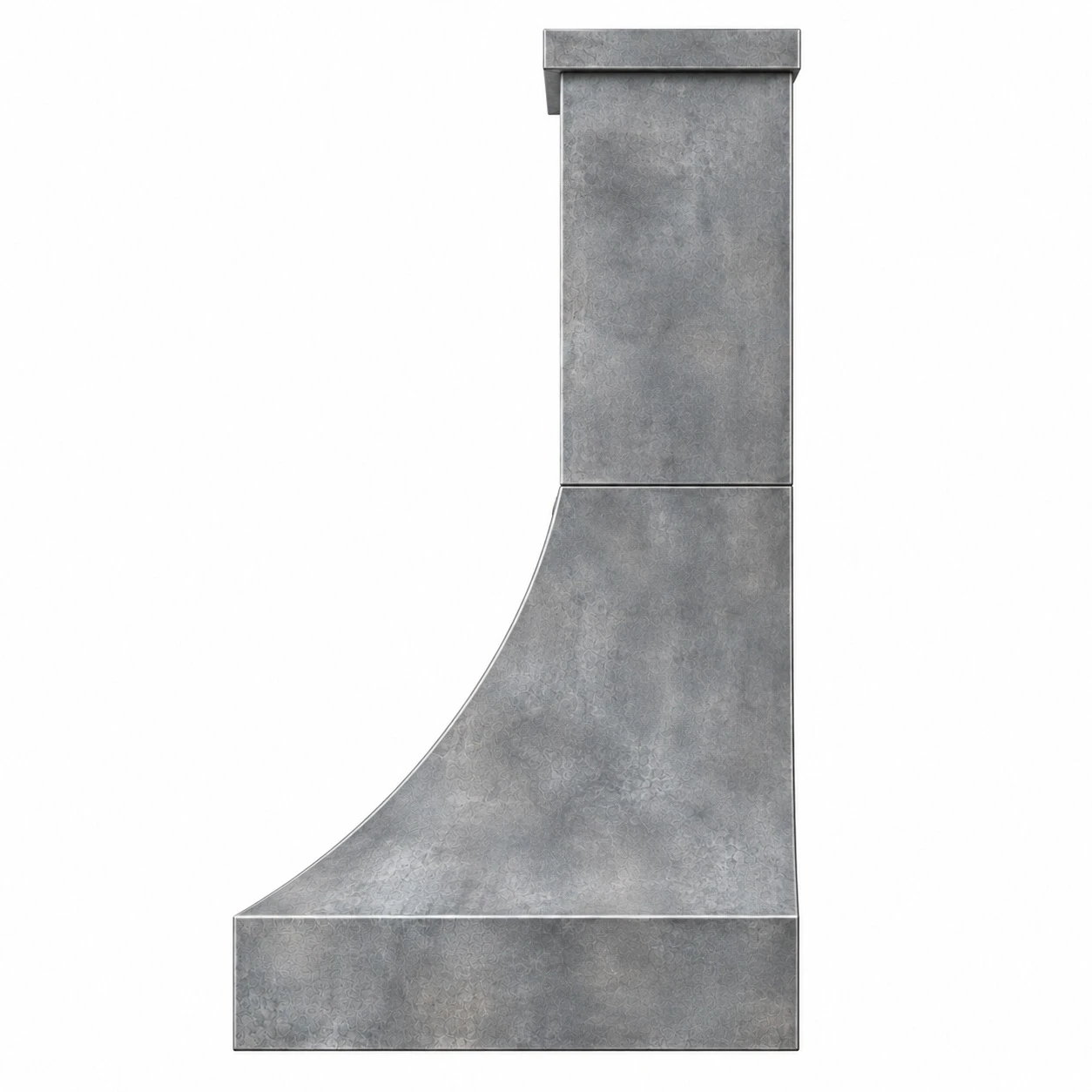
Side Profile
The side profile reveals the canopy projection more clearly than the front view. The body moves outward as it approaches the cooking surface, creating the characteristic bell silhouette. This depth affects both visual proportion and ventilation planning. A hood that projects too little may feel visually weak and may reduce capture effectiveness, while excessive depth can interfere with comfortable access to the cooking area. Final dimensions should be coordinated with the selected insert, appliance depth, cabinetry, and installation clearance requirements.
Technical Drawing
The technical drawing helps confirm the hood’s width, height, depth, chimney proportions, bell curve, apron location, and strap placement before fabrication. These dimensions should be compared with the finished range wall rather than rough framing alone. Cabinetmakers, designers, contractors, and installers can use the drawing to coordinate cabinet openings, backsplash limits, ceiling conditions, mounting support, and ventilation equipment. Any buyer-supplied insert should be selected before production so the internal opening and support structure can be prepared correctly.
Width Planning
Hood width should be selected around the appliance, available wall space, cabinet opening, and desired visual scale. Wider models can create greater architectural presence and may provide more capture area when appropriately configured. However, the hood should not crowd adjacent cabinets, shelves, windows, or decorative wall elements. Because the twin straps and plain apron create a relatively simple composition, changes in width are easy to notice. Review the spacing on both sides of the range before ordering.
Height Planning
Height should be coordinated with ceiling conditions, mounting clearance, cabinetry, and the proportion of the range wall. A taller hood emphasizes the square chimney and creates stronger vertical presence. A shorter version can work where ceiling space is limited, but the bell curve still needs enough height to develop naturally. Installation clearance must follow the appliance and ventilation equipment manufacturer’s requirements. Do not determine hood height from aesthetics alone.
Depth Planning
A standard 24 inch depth gives the hood substantial projection over many cooking surfaces, but final depth should be checked against the appliance and room layout. Depth influences capture area, side profile, cooking comfort, and insert compatibility. In kitchens with unusually deep ranges or custom cabinetry, additional planning may be needed. The selected insert, liner, or blower system should be reviewed together with the hood dimensions before fabrication begins.
Insert and Ventilation Planning
This zinc hood is a custom metal enclosure prepared around ventilation equipment. Rustica House can supply a 200 CFM insert only. Other internal inserts, liners, blowers, filters, lights, controls, and recirculating systems must be buyer-supplied with complete specifications before fabrication. Buyer-supplied internal inserts up to 1,260 CFM and external blowers up to 1,500 CFM may be supported when full technical details are provided before production. Final compatibility depends on hood dimensions, insert size, duct routing, mounting method, and local installation requirements.
CFM and Insert Fit
Required airflow depends on the cooking appliance, total heat output, cooking habits, duct length, duct diameter, number of elbows, blower location, and applicable codes. The insert must physically fit inside the enclosure while allowing access to filters, controls, lights, and service components. Buyers should review the range hood insert guide before selecting the final ventilation system. Complete technical information should be supplied before the hood enters production.
Duct Routing
Duct routing should be planned before fabrication because it can affect chimney dimensions, framing, ceiling penetrations, and blower performance. Vertical ducting through the ceiling is common, but some kitchens require horizontal routing through an exterior wall. Long runs, multiple elbows, restrictive transitions, and undersized ducts can reduce airflow. A recirculating configuration requires compatible filtration and discharge planning. The ventilation system should be designed first so the hood can be fabricated around actual mechanical requirements.
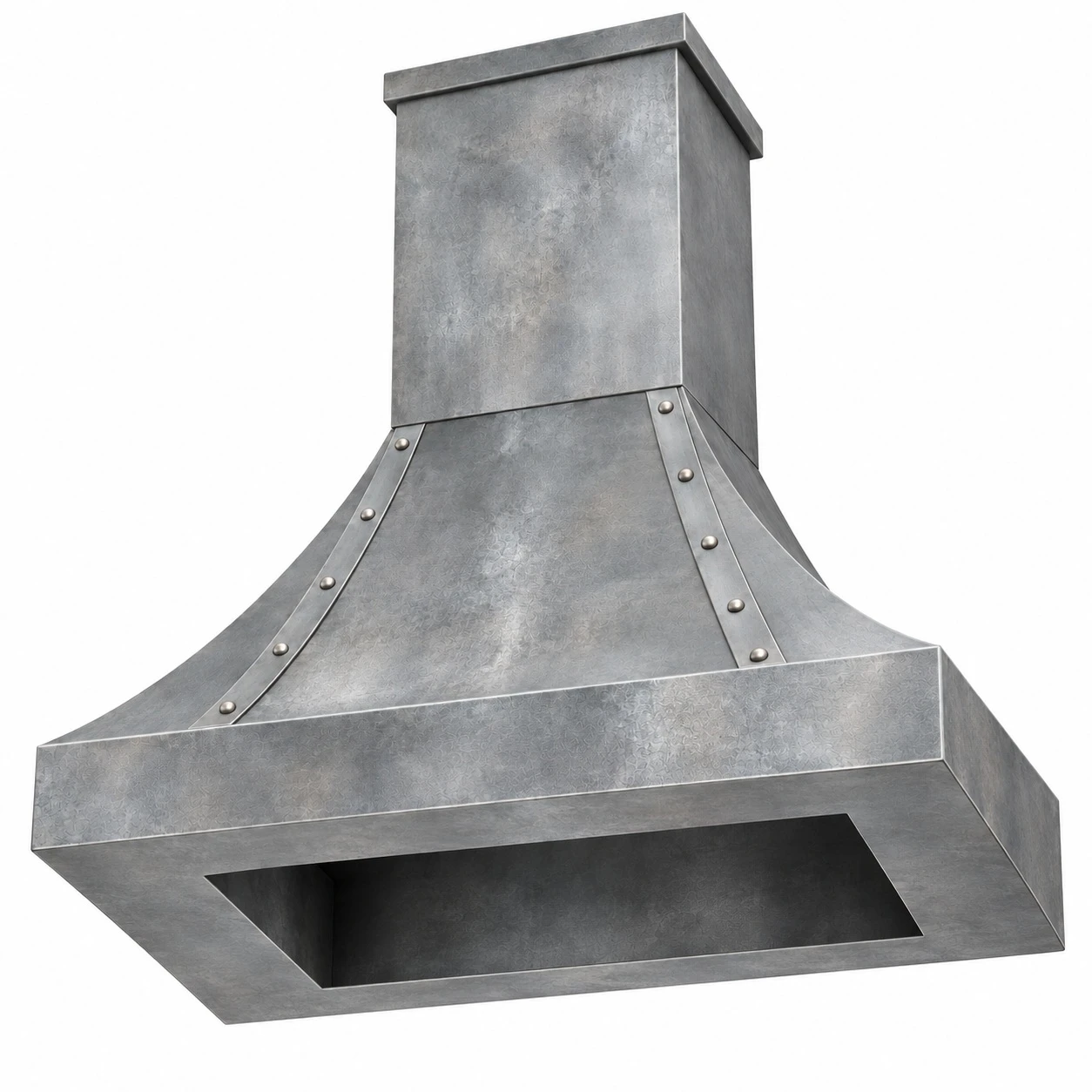
Underside Preparation
The underside view helps buyers understand where the ventilation equipment will sit and how much internal space is available. Insert dimensions, liner size, fastening points, filter removal direction, lighting, controls, duct position, and electrical connections all need to be considered. When a buyer supplies the ventilation equipment, complete manufacturer drawings should be provided before production. Internal preparation cannot be planned accurately from CFM rating alone.
Zinc Finish Options
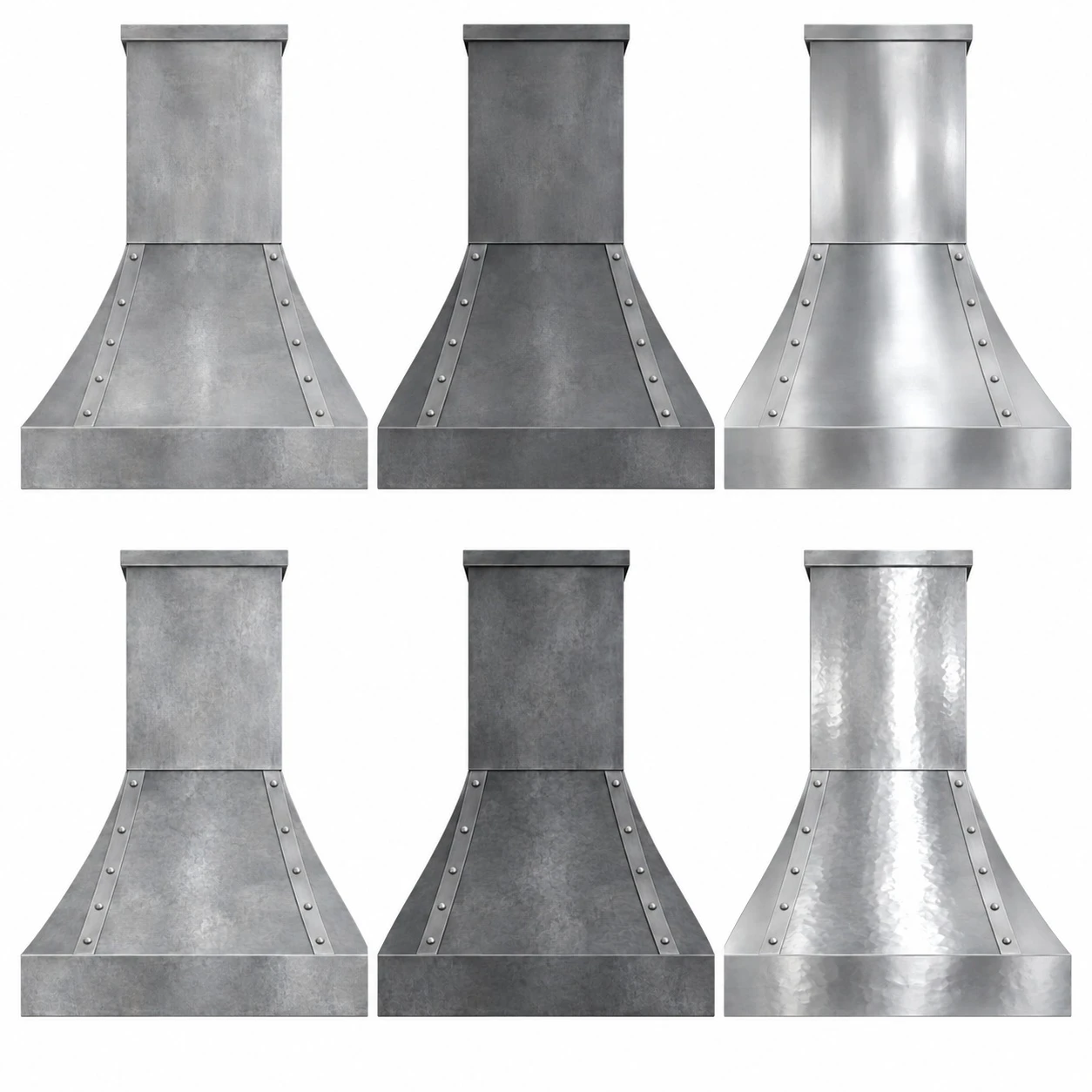
This hood can be customized in six zinc finish and texture combinations. Smooth Natural preserves a restrained gray surface. Smooth Dark creates deeper contrast. Smooth Polished adds more reflected light. Hammered Natural introduces visible hand-worked texture. Hammered Dark combines stronger tonal depth with artisan surface variation. Hammered Polished adds brighter highlights across the hammered metal. Finish images should be treated as visual references because handcrafted zinc can vary naturally in tone, sheen, texture, and surface movement.
Rustic European Kitchens
A Rustic European kitchen can pair this hood with aged plaster, limestone, weathered oak, handmade tile, and muted cabinetry. The cool gray zinc provides contrast against warm natural materials without introducing the reddish tone of copper. Its tall chimney and generous bell form establish a clear focal point, while the plain apron keeps the design from becoming excessively ornate. Dark or natural zinc can both work depending on the surrounding stone and wood tones.
Transitional Kitchens
Transitional kitchens benefit from the hood’s balance of traditional curvature and simpler detailing. Shaker cabinetry, restrained stone, uncomplicated tile, and balanced hardware can work naturally with the bell profile. The twin straps add enough metalwork character to distinguish the hood from a plain enclosure, while the unpaneled apron avoids the stronger historical appearance of elaborate framed designs. Smooth zinc can make the overall presentation feel especially tailored.
Modern Farmhouse Kitchens
Modern farmhouse kitchens can use this hood with painted cabinetry, natural oak, handmade ceramic tile, plaster, and stone. The bell shape brings traditional warmth, while the zinc-on-zinc straps and plain apron keep the design cleaner than a heavily decorated farmhouse hood. Natural or polished zinc can provide contrast against white cabinetry, while a darker zinc finish can coordinate with black windows, hardware, or lighting.
Industrial Kitchens
Industrial-inspired kitchens can pair the hood with steel windows, concrete-look surfaces, reclaimed wood, black hardware, and simple stone counters. Zinc gives the range wall authentic metal character without the uniform appearance of stainless steel. Riveted straps contribute workshop influence, while the bell canopy prevents the design from feeling too mechanical. Hammered or dark zinc can strengthen the industrial character, while smooth natural zinc creates a more refined interpretation.
Other Kitchen Styles
- Mountain lodge kitchens
- French country kitchens
- Old-world kitchens
- Urban loft kitchens
Backsplash Planning
The plain apron allows more flexibility with backsplash design than a heavily decorated lower band. Limestone, marble, plaster, zellige, handmade ceramic tile, brick, and simple field tile can all work depending on the room. Patterned tile should be used carefully so it does not compete with the twin straps. A quiet backsplash can emphasize the hood’s shape, while a handcrafted tile surface can reinforce its artisan character. Consider the backsplash height before finalizing the apron position.
Cabinet Coordination
Warm white, greige, charcoal, oak, walnut, muted green, and natural wood cabinetry can all coordinate with zinc. Lighter cabinetry makes the hood appear darker and more sculptural. Dark cabinetry creates a quieter tonal transition. Hardware can repeat zinc, pewter, black iron, aged bronze, or brushed metal tones. Because the hood already contains rivets, additional decorative hardware should be selected with restraint so the range wall remains balanced.
Zinc Care and Maintenance
Zinc should be cleaned gently with mild soap, warm water, and a soft cloth. Dry the surface after cleaning when water spotting is a concern. Avoid abrasive pads, steel wool, bleach, ammonia, acidic cleaners, and aggressive polishing products because they can scratch or alter the finish. Grease should be removed before heavy buildup develops around rivets, seams, straps, and the apron. For more detailed ownership guidance, review the zinc range hood care guide.
Handmade Finish Expectations
Handcrafted zinc is not intended to look perfectly uniform. Natural tonal changes, small forming marks, subtle seam character, texture differences, rivet variation, and minor changes in sheen may be visible. Hammered versions will show additional irregularity because the surface is intentionally worked by hand. These qualities are part of the material’s artisan character rather than defects. Light, humidity, cooking residue, handling, and cleaning practices can also influence how zinc develops over time.
Measurements Before Ordering
Before ordering, confirm appliance width, cabinet opening, ceiling height, hood width, hood height, hood depth, backsplash thickness, mounting clearance, duct route, insert dimensions, blower type, electrical requirements, and framing conditions. Photos and elevation drawings of the range wall can help identify proportion issues before production. If the project uses a buyer-supplied ventilation system, provide complete specifications before fabrication so the hood can be prepared around the actual equipment.
Common Questions
What makes this zinc hood unique?
The bell-shaped body, twin riveted zinc straps, tall square chimney, and plain unpaneled apron create its restrained architectural character.
What materials are used?
The exterior is handcrafted from zinc, including the twin front straps and lower apron.
Can the dimensions be customized?
Yes. Width, height, depth, mounting preparation, finish, texture, and ventilation opening can be planned before production.
What finish options are available?
Options include Smooth Natural, Smooth Dark, Smooth Polished, Hammered Natural, Hammered Dark, and Hammered Polished zinc.
Does Rustica House supply an insert?
Rustica House can supply a 200 CFM insert. Other ventilation equipment must be buyer-supplied with complete specifications.
What blower capacity can be supported?
Buyer-supplied internal inserts up to 1,260 CFM and external blowers up to 1,500 CFM may be supported with complete technical details.
Why choose a plain apron?
The plain apron keeps attention on the bell silhouette and twin straps while avoiding the heavier appearance of paneled or molded designs.
Will zinc change over time?
Yes. Zinc can develop tonal and sheen variation from air, humidity, heat, touch, cooking residue, and cleaning practices.
How should the hood be cleaned?
Use mild soap, warm water, and a soft cloth. Avoid abrasive, acidic, ammonia-based, or harsh chemical cleaners.
Why are insert specifications needed early?
Insert dimensions affect the internal opening, mounting support, lighting, filter access, duct routing, and overall hood construction.
Final Design Guidance
Zinc Bell Range Hood with Twin Straps and Plain Apron Guide shows how a curved bell canopy, twin riveted bands, plain apron, zinc finish, custom proportions, and ventilation preparation work together. Choose this hood when the range wall needs handcrafted metal character without elaborate paneling or contrasting trim. Confirm appliance width, cabinet spacing, ceiling height, hood dimensions, insert specifications, duct routing, mounting conditions, and backsplash design before production. Explore the zinc bell range hood, compare modern zinc range hoods, and review the metal range hood installation guide before finalizing the project.