 US Dollar
 Euro
Euro
 Australian Dollar
 Canadian Dollar
 Polish Zloty
 British Pound

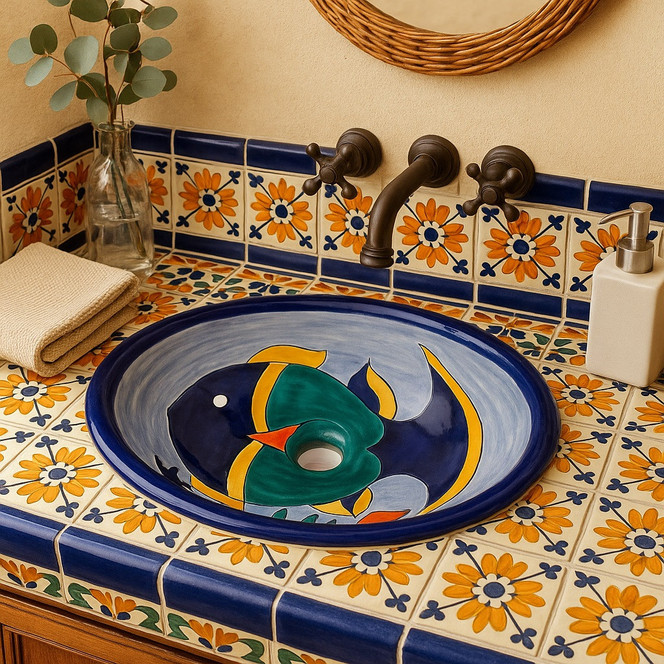
Talavera Sinks with Mexican Symbols: Hand-Painted Ceramic Art with Cultural Meaning
Talavera sinks with Mexican symbols bring together vibrant color, handcrafted ceramic tradition, and meaningful cultural imagery in one unforgettable bathroom fixture. Painted by skilled artisans in Mexico, these sinks may feature motifs inspired by the sun and moon, native plants, folk art, pre-Hispanic symbolism, or the visual traditions associated with celebrations such as Día de los Muertos. Whether installed in a powder room, guest bathroom, restaurant, or Spanish Colonial home, a Talavera sink with Mexican symbols becomes a functional work of art that introduces history, personality, and authentic artisan character into the space.
Blog Summary
- Product: Hand-painted Talavera sinks
- Design: Traditional Mexican symbols
- Best For: Bathrooms and powder rooms
- Material: Glazed ceramic
- Craft: Handmade in Mexico

More Than a Bathroom Fixture
A Talavera sink does more than provide a place to wash. Its hand-painted surface becomes the focal point of the vanity, adding color, movement, and cultural depth to an area that is often treated as purely functional.
Because the design is applied by hand rather than printed by machine, every sink carries subtle differences in brushwork, glaze, and color that make it unique.
The Heritage of Mexican Talavera
Talavera ceramics developed through the meeting of Spanish pottery traditions and Indigenous Mexican artistic expression. Ceramic techniques brought to New Spain during the 16th century were gradually transformed through local materials, regional colors, and motifs inspired by Mexican culture.
Over time, Talavera became one of the most recognizable forms of Mexican decorative art, appearing in tiles, tableware, architectural panels, fountains, and hand-painted bathroom sinks.
Handcrafted by Skilled Artisans
Each sink is individually formed, dried, fired, glazed, painted, and fired again. The artisan applies every decorative element by hand, carefully building the composition through outlines, floral details, symbols, and color fields.
The final firing permanently bonds the glaze and decoration to the ceramic body, creating a durable surface designed for everyday use.
Artisan Characteristics
- Hand Formed: Individually shaped ceramic
- Hand Painted: Applied by local artisans
- Kiln Fired: Durable glazed finish
- Unique: Natural artistic variation
- Authentic: Mexican ceramic tradition
Symbols That Tell a Story
Mexican decorative art often uses recognizable symbols to communicate ideas about nature, life, memory, spirituality, and cultural identity. When incorporated into a Talavera sink, these motifs turn the basin into a visual narrative rather than a purely decorative pattern.
The exact meaning may vary according to the artisan, region, and composition, but many symbols are connected to traditions that have shaped Mexican art for generations.
Sun and Moon Motifs
The sun and moon appear frequently in Mexican folk art and pre-Hispanic-inspired design. Together, they may represent balance, the passage of time, day and night, masculine and feminine energy, or the relationship between natural cycles.
On a Talavera sink, celestial motifs create a dramatic focal point that works especially well in eclectic, Southwestern, and Mexican Colonial bathrooms.
Celestial Themes
- Sun: Energy and vitality
- Moon: Reflection and mystery
- Stars: Guidance and imagination
- Day and Night: Natural balance
- Celestial Faces: Folk-art expression
Calaveras and Día de los Muertos
Calaveras, or decorative skulls, are strongly associated with Día de los Muertos. Rather than representing fear, they often reflect remembrance, family connection, and the celebration of life.
When painted on ceramic, these motifs are usually surrounded by flowers, scrollwork, bright colors, and playful ornamentation that emphasize joy rather than mourning.
La Catrina as an Artistic Icon
La Catrina is one of the most recognizable figures in Mexican visual culture. Her elegant clothing, elaborate hat, and skeletal face combine humor, sophistication, and social commentary.
A Talavera sink featuring La Catrina creates a bold artistic statement suited to eclectic interiors, hospitality projects, restaurants, themed powder rooms, and collectors of Mexican folk art.
Cacti and Agave Plants
Cacti and agave plants connect Talavera design to the landscapes of Mexico. Their sculptural forms and strong silhouettes make them ideal decorative motifs for ceramic art.
These symbols pair naturally with terracotta, desert colors, turquoise, green, cobalt blue, and warm earth tones, creating designs that feel rooted in the natural environment.
Nature-Inspired Symbols
- Cactus: Strength and resilience
- Agave: Mexican landscape heritage
- Flowers: Beauty and renewal
- Birds: Movement and freedom
- Leaves: Growth and vitality
Floral and Geometric Patterns
Not every Talavera sink uses figurative imagery. Many designs combine symbolic flowers, stars, rosettes, medallions, and geometric borders influenced by Moorish and Spanish Colonial decorative traditions.
These patterns create cultural character while remaining versatile enough for traditional, Mediterranean, farmhouse, and transitional bathrooms.
Pre-Hispanic Design Influence
Some Talavera patterns draw inspiration from pre-Hispanic visual language, including stepped geometry, stylized suns, animal forms, ceremonial imagery, and symmetrical arrangements.
These motifs are often interpreted through bright Talavera colors, blending ancient references with the later ceramic traditions introduced during the Colonial period.
Choose the Right Sink Shape
The shape of the sink influences how the artwork is displayed. Round and oval basins allow circular medallions and radial patterns to remain centered, while rectangular sinks provide more surface area for narrative scenes, borders, and repeated motifs.
The best choice depends on the vanity dimensions, countertop shape, and visual style of the room.
Popular Shapes
- Round: Balanced radial patterns
- Oval: Traditional bathroom form
- Rectangular: Larger painted scenes
- Vessel: Full exterior visibility
- Drop-In: Classic countertop design
Vessel Sinks as Decorative Art
Vessel sinks sit above the countertop, allowing both the interior and exterior ceramic surfaces to remain visible. This makes them especially suitable for highly detailed designs with symbols that continue around the sides of the basin.
Because the sink becomes more prominent, the surrounding vanity and backsplash can remain relatively simple.
Drop-In and Undermount Options
Drop-in sinks reveal the decorative rim and interior pattern while integrating easily into many countertop materials. Undermount installation creates a cleaner edge, although some of the hand-painted exterior may become less visible.
Before ordering, confirm the preferred installation style with the countertop fabricator and installer.
Ideal for Powder Rooms
Powder rooms are perfect locations for expressive fixtures because a single decorative sink can define the entire space. A symbolic Talavera basin may be paired with a simple vanity, handcrafted mirror, and warm lighting to create a memorable guest bathroom.
The smaller scale of the room allows the sink to make a strong visual impact without requiring extensive decoration.
Master and Guest Bathroom Applications
In larger bathrooms, Talavera sinks can be used individually or as matching pairs in a double vanity. The surrounding materials should support the design rather than compete with it.
Neutral plaster, natural wood, stone countertops, and restrained wall colors create a balanced background for vivid ceramic artwork.
Popular Applications
- Powder Room: Bold focal fixture
- Guest Bath: Memorable artisan detail
- Double Vanity: Coordinated sink pair
- Restaurant: Cultural design feature
- Hotel: Boutique bathroom character
Pairing Talavera Sinks with Tile
A symbolic sink can be coordinated with solid-color Talavera tile, decorative borders, or carefully selected patterned accents. The surrounding tile should repeat one or two colors from the sink to create continuity.
High relief tiles may also be used sparingly around the vanity to add texture without overwhelming the painted basin.
Pairing with Natural Wood
Wood vanities provide warmth and balance against colorful ceramic. Dark stained wood reinforces a Spanish Colonial or Hacienda appearance, while light oak or pine creates a more relaxed transitional setting.
Because both materials are handcrafted and naturally varied, the combination feels authentic and welcoming.
Pairing with Stone Countertops
Limestone, travertine, marble, granite, and quartz can all support a Talavera sink. Neutral stone allows the painted design to remain dominant, while dark countertops create stronger contrast.
For heavily patterned sinks, a simpler countertop is generally the most balanced choice.
Recommended Pairings
- Wood Vanity: Warm artisan balance
- Stone Counter: Timeless foundation
- White Plaster: Clean visual contrast
- Iron Mirror: Spanish Colonial detail
- Copper Fixture: Warm metal accent
Coordinate with Handcrafted Mirrors
A wrought iron, copper, or tin mirror frame can reinforce the artisan character of the vanity. The mirror should complement the sink without introducing too many competing patterns.
Simple metal frames work well with highly figurative sinks, while more decorative mirrors can accompany restrained floral or geometric basin designs.
Faucet Selection
The faucet should be selected according to the basin depth, rim height, installation style, and countertop configuration. A faucet with excessive height or incorrect reach may create splashing.
Oil-rubbed bronze, antique brass, black iron, and copper-toned fixtures often coordinate beautifully with traditional Talavera colors.
Bathroom Styles That Work with Symbolic Talavera
Talavera sinks with Mexican symbols feel especially natural in Spanish Colonial, Hacienda, Southwestern, Mediterranean, eclectic, and rustic interiors. They can also work in contemporary rooms when used as the primary artistic feature.
The final style depends on the sink motif, color palette, vanity design, and surrounding materials.
Compatible Styles
- Spanish Colonial: Traditional warmth
- Hacienda: Authentic Mexican character
- Southwestern: Desert-inspired color
- Eclectic: Expressive global design
- Contemporary: Artistic focal contrast
Commercial and Hospitality Interiors
Restaurants, boutique hotels, wineries, cultural spaces, and themed hospitality projects often use Talavera sinks to create memorable restroom interiors. Symbolic designs reinforce the identity of the space while offering guests an unexpected artisan detail.
Explore additional ideas for handmade Talavera sinks for restaurants and commercial bathroom projects.
Understanding Handmade Variation
Because every sink is formed and painted by hand, slight differences in color, brushwork, glaze, dimensions, and pattern placement are expected. These variations are characteristics of authentic artisan production rather than manufacturing defects.
Homeowners should appreciate the finished sink as an individual piece of ceramic art rather than expecting factory-level uniformity.
Daily Cleaning
Clean the sink using mild soap, warm water, and a soft cloth or sponge. The glazed surface is designed for routine bathroom use and generally does not require aggressive cleaning products.
Avoid abrasive powders, steel wool, harsh acids, and bleach that may dull the glaze or affect the grout and sealant around the installation.
Care Tips
- Clean: Mild soap and water
- Use: Soft cloth or sponge
- Avoid: Abrasive products
- Rinse: Remove cosmetic residue
- Protect: Prevent heavy impacts
Countertop and Installation Planning
Handmade ceramic sinks may vary slightly in final dimensions. Whenever possible, the countertop opening should be based on the actual finished sink rather than a generic template.
The installer should verify the rim, drain opening, support, sealant, faucet placement, and countertop thickness before cutting or mounting.
Installation Checklist
- Sink Size: Confirm finished piece
- Cutout: Use actual dimensions
- Drain: Verify compatibility
- Faucet: Confirm reach
- Sealant: Use ceramic-safe product
Why Choose a Sink with Cultural Meaning?
A symbolic Talavera sink offers more than color. It creates a direct connection to Mexican art, history, nature, and popular tradition. The design may celebrate family memory, cultural pride, landscape, spirituality, or simply the joy of handcrafted decoration.
This meaning gives the fixture a deeper identity than a standard bathroom sink while making the room feel more personal.
A Functional Work of Art
Hand-painted Talavera sinks combine two roles that are rarely united so successfully: durable everyday function and original visual storytelling. Each basin can be used daily while remaining an expressive piece of ceramic art.
This balance makes Talavera especially valuable for homeowners who want their interiors to communicate personality rather than simply follow temporary trends.
Ordering and Project Planning
Before ordering, confirm the sink shape, dimensions, installation method, symbol or pattern, countertop material, faucet placement, drain type, and surrounding color palette. These details help ensure the finished vanity feels balanced and functions properly.
Visit the artistic Talavera sink product page or explore more handmade Talavera sink designs for additional cultural and decorative inspiration.
Conclusion
Talavera sinks with Mexican symbols combine vivid ceramic color, meaningful imagery, and traditional artisan craftsmanship in a bathroom fixture designed to be both practical and expressive. From celestial faces and native plants to floral geometry and Día de los Muertos-inspired art, every motif brings part of Mexico's cultural heritage into the home. Handmade, kiln-fired, and individually painted, these sinks transform vanities, powder rooms, restaurants, and hospitality interiors into spaces filled with personality, history, and authentic artistic character.