 US Dollar
 Euro
Euro
 Australian Dollar
 Canadian Dollar
 Polish Zloty
 British Pound

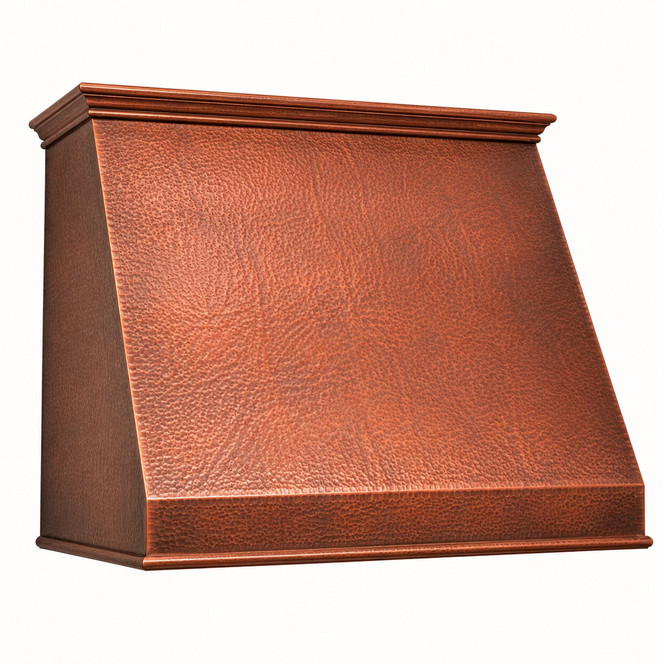
A sloping copper range hood combines a gradually angled canopy with the warmth and surface variation of handcrafted copper. The shape can feel lighter than a deep bell or dome while still creating a strong architectural focal point above a cooktop. Depending on its proportions, texture, patina, crown, apron, and decorative details, a sloping hood can work in farmhouse, transitional, rustic, Mediterranean, traditional, or contemporary kitchens. The design should be planned as both architecture and ventilation equipment: width, height, depth, mounting location, insert specifications, duct routing, and clearances all affect the final result. This guide focuses on the visual geometry of sloping copper hoods, finish choices, kitchen-style integration, artisan fabrication, ventilation planning, installation, and long-term care.
Blog Summary
- Shape: Angled sloping canopy
- Material: Handcrafted copper
- Texture: Smooth or hammered
- Patina: Six finish directions
- Styles: Rustic to contemporary
- Mounting: Wall or island planning
- Insert: Match before fabrication
- Care: Mild soap and soft cloth
What Defines a Sloping Copper Range Hood?
The defining feature of a sloping hood is the gradual transition from a wider lower capture area to a narrower upper chimney or crown. Instead of relying on the pronounced outward curve of a bell-shaped hood, the body is formed through angled or gently inclined planes.
This geometry can create a strong sense of upward movement. The lower portion visually relates to the cooktop and cabinetry, while the narrowing upper body leads the eye toward the ceiling. The result can make a large hood feel more disciplined without eliminating its architectural presence.
The Geometry of a Sloping Hood
Proportion determines whether a sloping hood appears rustic, refined, substantial, or contemporary. A relatively shallow slope produces a quieter transition between the apron and chimney, while a wider base combined with a narrow upper section creates a more dramatic taper.
Designers should consider the hood in relation to ceiling height, cabinet width, cooktop dimensions, nearby windows, beams, and open shelving. The same copper finish can look entirely different when applied to a broad low hood versus a tall narrow design.
Visual Effects of the Sloping Shape
- Creates upward visual movement
- Connects broad apron to narrow chimney
- Works with tall or vaulted ceilings
- Balances substantial cooktop areas
- Supports simple or decorative detailing
For comparison with other profiles, see the copper range hood shapes guide.
Smooth and Hammered Copper Surfaces
Surface texture strongly influences how a sloping hood is perceived. Smooth copper emphasizes the uninterrupted planes of the canopy and can make the slope appear cleaner and more architectural. It is especially effective when the design relies on geometry rather than ornament.
Hammered copper introduces small variations that break reflected light across the angled body. The changing plane of a sloping hood can make these highlights particularly visible because different sections receive light at different angles.
Hand hammering is not mechanically uniform. Variations in individual hammer impressions, tool marks, seams, and tonal movement are expected characteristics of artisan fabrication. The copper hammering techniques article explains how surface texture changes the appearance of finished metalwork.
Copper Patina Options
Patina can shift a sloping hood from bright and contemporary to dark and rustic without changing its underlying shape. Rustica House copper range hoods can be considered in six principal finish directions: Natural Fired, Dark Coffee, Antique, Honey, Oxidized, and Hand Polished.
| Patina | Visual Character | Useful Design Direction |
|---|---|---|
| Natural Fired | Varied reddish-brown copper | Farmhouse and rustic |
| Dark Coffee | Deep brown surface | Traditional and Old World |
| Antique | Aged traditional character | Mediterranean and rustic |
| Honey | Warm golden-brown copper | Transitional interiors |
| Oxidized | Green-blue aged appearance | Rustic statement kitchens |
| Hand Polished | Bright reflective copper | Contemporary applications |
Because computer displays reproduce copper colors differently, physical samples can be useful when coordinating a hood with stone, cabinetry, tile, flooring, and hardware. See the copper patina finish guide for additional comparisons.
Crown and Apron Design
The crown and lower apron can change the character of a sloping hood almost as much as the canopy itself. A simple squared crown reinforces clean geometry, while molded crown trim can connect the hood to more traditional cabinetry.
The apron establishes the visual base. A narrow plain apron keeps the hood restrained, while a thicker molded or layered apron increases architectural weight. Decorative straps, rivets, or metal accents can be added where appropriate, but they should reinforce the kitchen style rather than compete with the slope.
Decorative Copper Details
Sloping copper hoods can range from almost completely unornamented to highly decorative. Straps and rivets emphasize vertical movement, while embossed or relief details create stronger historical or regional character.
A decorative hood should be considered together with backsplash pattern, cabinet hardware, lighting, and surrounding millwork. When several elements already contain ornament, a simpler copper hood may create better balance. In a relatively plain kitchen, decorative details can give the cooking wall more visual identity.
Best Kitchen Styles for Sloping Copper Hoods
Farmhouse Kitchen
Painted cabinetry, apron-front sinks, handmade tile, pale stone, open shelves, and natural timber provide a natural setting for a gently sloping copper hood. Natural Fired, Honey, or Antique patina adds warmth without requiring elaborate ornament.
Transitional Kitchen
A clean sloping silhouette can bridge traditional cabinetry and contemporary finishes. Soft hammering, restrained apron details, and a Honey or Natural Fired finish keep the hood architectural without making it overly rustic.
Mediterranean Kitchen
Plaster walls, stone, terracotta, patterned tile, dark wood, and iron details pair especially well with Antique or Dark Coffee copper. A substantial sloping canopy can echo the strong architectural forms common in Mediterranean interiors.
Rustic Kitchen
Hammered copper, reclaimed wood, stone walls, exposed beams, and forged hardware create a richly textured environment. Dark Coffee, Antique, Natural Fired, or Oxidized finishes can reinforce the aged material palette.
Other Kitchen Styles
- Spanish Colonial kitchen
- Rustic contemporary kitchen
- French country kitchen
- Organic modern kitchen
Using a Sloping Hood in a Modern Kitchen
Although copper is often associated with traditional interiors, the sloping form can work effectively in a modern kitchen when unnecessary ornament is removed. Smooth copper, simple planes, restrained seams, and a minimal apron allow the geometry to become the dominant design feature.
Against flat-panel cabinetry, plaster walls, limestone, concrete, or pale oak, copper introduces warmth without requiring a historic decorative vocabulary. Honey or Hand Polished finishes can strengthen this cleaner direction.
Sloping Hood Dimensions and Proportions
The hood should be sized according to the cooking appliance, kitchen architecture, mounting conditions, and ventilation insert rather than selected solely for appearance. Width, total height, depth, chimney dimensions, and apron proportions work together to determine both visual scale and internal space.
A wider hood can create a stronger architectural frame around the cooking area, while a tall sloping body can be useful where ceiling height permits a more vertical composition. Custom dimensions should preserve the relationship between lower width and upper chimney rather than simply stretching one section of the design.
Wall-Mount and Island Applications
Sloping copper hoods can be planned for either wall-mounted or island configurations when the specific design supports the intended installation. Wall hoods visually connect to the cooking wall and may coordinate with cabinetry, tile, or architectural niches.
Island installations are visible from more directions, making symmetry, backside finishing, ceiling connection, and duct routing especially important. Island hoods generally vent vertically, while wall-mounted installations may permit vertical or, depending on the selected insert and layout, rearward duct routing.
The wall and island range hood guide explains how these mounting conditions differ.
Insert and Ventilation Planning
The decorative copper shell and ventilation insert should be planned together before fabrication. The shell establishes the exterior architecture, while the insert supplies airflow, filters, lights, and controls.
Rustica House can supply an optional 200 CFM insert with a two-speed fan, lighting, and filters. Custom shells can also accommodate buyer-supplied internal inserts up to 1,260 CFM or external blower systems up to 1,500 CFM when complete specifications are provided before production.
Insert Information Needed Before Fabrication
- Manufacturer and model
- Housing dimensions
- Required cutout dimensions
- Mounting flange dimensions
- Duct outlet location and size
- Control configuration
- Lighting requirements
- Filter access requirements
CFM requirements depend on the cooking equipment, hood dimensions, installation conditions, duct system, and applicable codes. A sloping shape by itself does not determine ventilation performance or allow the hood to be mounted arbitrarily higher. For detailed planning, review the range hood insert guide.
Duct Routing and Installation
Duct routing should be confirmed before the hood is produced. Excessive bends, undersized ductwork, restrictive transitions, or long runs can reduce system performance regardless of the decorative shell shape.
The installer should also confirm blocking, attachment points, finished ceiling height, hood mounting height, insert access, electrical requirements, and surrounding cabinet clearances. Because handcrafted metal hoods can be large and substantial, professional installation is recommended.
For general preparation steps, see the copper range hood installation guide.
Cleaning and Patina Care
Routine cleaning should be gentle. Use mild soap, warm water, and a soft cloth, then dry the copper after cleaning. Avoid abrasive pads, steel wool, bleach, ammonia, acidic cleaners, and aggressive degreasers that can scratch the surface or alter an established patina.
Wax may be used when appropriate to help slow natural patina changes, but it is not mandatory for every hood or finish. Owners who prefer a living surface can allow copper coloration to evolve naturally with time. Filters should be cleaned or replaced according to the ventilation insert manufacturer's instructions.
The copper range hood care guide provides more detailed maintenance recommendations.
Coppersmith Perspective
A sloping hood appears simple because its main lines are visually clear, but those lines make proportion especially important. Small changes to the lower width, chimney width, height, or slope angle can noticeably alter the silhouette. When custom dimensions are required, the entire geometry should therefore be adjusted as a composition rather than treating each measurement independently.
Hand fabrication also leaves subtle evidence of the forming process. Hammer impressions, tool marks, seams, slight dimensional differences, and patina movement are normal characteristics of handcrafted copper. These variations give each finished hood individual character while preserving the intended architectural form.
FAQ - Sloping Copper Range Hoods
A: It is a copper hood with an angled or gradually tapered canopy that transitions from a wider lower section to a narrower chimney or upper section.
A: Sloping designs can work in farmhouse, transitional, Mediterranean, rustic, Spanish Colonial, French country, contemporary, and other kitchens depending on detailing and patina.
A: Yes. Hammering adds surface variation and emphasizes changing highlights across the angled copper planes.
A: Yes. Smooth copper emphasizes the geometry of the slope and is especially appropriate for restrained transitional or contemporary designs.
A: Natural Fired, Dark Coffee, Antique, Honey, Oxidized, and Hand Polished finishes can all work. The best choice depends on surrounding cabinetry, stone, tile, flooring, and lighting.
A: Some sloping designs can be configured for island installation when ceiling support, symmetry, insert dimensions, and vertical duct routing are planned before fabrication.
A: No. Ventilation performance depends on the insert, hood dimensions, capture area, mounting height, ductwork, blower configuration, cooking equipment, and installation conditions.
A: Rustica House can supply an optional 200 CFM insert. Buyer-supplied internal inserts up to 1,260 CFM and external blowers up to 1,500 CFM can also be accommodated when complete specifications are provided.
A: Use mild soap, warm water, and a soft cloth, then dry the surface. Avoid acids, bleach, ammonia, abrasive pads, steel wool, and aggressive chemical cleaners.
A: No. Handmade copper naturally varies in hammer marks, tool impressions, seams, dimensions, tonal movement, and patina, so each hood has individual surface character.
Designing with a Sloping Copper Range Hood
A sloping copper range hood offers a useful middle ground between highly curved traditional forms and strictly rectangular modern designs. Its angled canopy creates architectural movement while leaving room for very different interpretations through texture, crown molding, apron treatment, straps, rivets, and patina.
Begin with the proportions of the kitchen and cooking area, then coordinate the hood shape with cabinetry, ceiling height, backsplash, lighting, and surrounding materials. Before fabrication, confirm the exact insert, mounting configuration, duct route, dimensions, and clearances. Explore sloping copper range hood designs or browse the complete Rustica House copper range hood collection for additional shapes and finish options.