 US Dollar
 Euro
Euro
 Australian Dollar
 Canadian Dollar
 Polish Zloty
 British Pound

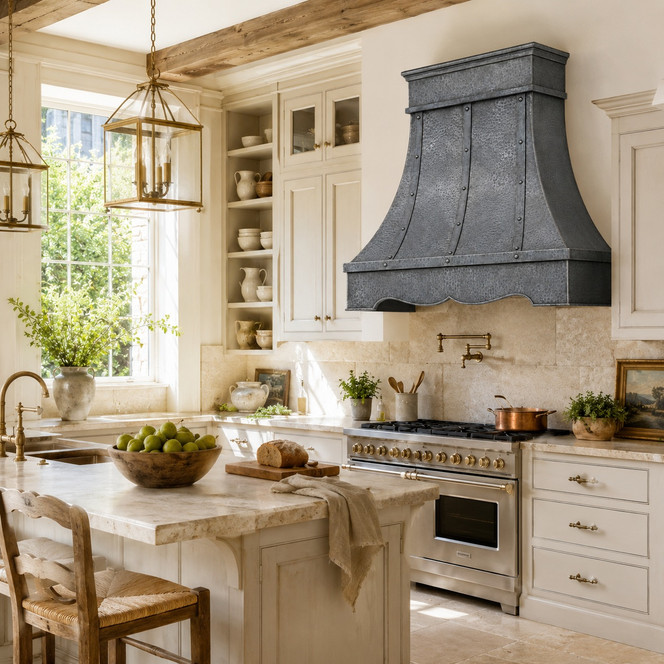
French-style range hoods combine graceful proportions, handcrafted metalwork, restrained ornament, and architectural forms inspired by French Provincial homes, château interiors, country estates, and refined European kitchens. Although copper is one of the most traditional choices, French-inspired hoods can also be handcrafted from zinc, brass, tin, or iron, with each material changing the mood of the same bell, barrel, dome, tapered, or curved-apron silhouette. Copper introduces warmth, zinc creates quiet gray character, brass adds refined golden tones, tin offers a lighter silvery surface, and iron provides stronger architectural contrast. Explore the complete metal range hood collection to compare these materials and made-to-order configurations. For additional regional inspiration, review the French-style kitchen range hood guide.
Blog Summary
- Influence: Provincial and château
- Metals: Copper, zinc, brass, tin, iron
- Shapes: Bell, barrel, dome, tapered
- Details: Crowns, arches and scrolls
- Finishes: Light to dark artisan tones
- Mounting: Wall or kitchen island
French Kitchen Character
French kitchen design combines refinement with comfort rather than relying on one rigid historical formula. Painted cabinetry, inset doors, limestone, marble, plaster, aged timber, iron lighting, and traditional moldings may appear together without making the room excessively formal. The range hood should reinforce this balance by providing enough architectural presence above the cooking surface while remaining proportional to the cabinetry and ceiling. The French range hood design guide offers additional examples of Provincial and château influences.
French-inspired hoods often rely on graceful transitions. A canopy may flare gently from a narrow chimney, curve outward through a bell profile, form a barrel-like front, or terminate in a softly shaped apron. Decorative details are usually concentrated along crowns, lower borders, or selected panels rather than applied across every visible surface.
French Hood Silhouettes
French Provincial
A French Provincial hood usually combines a gently flared or bell-shaped body with modest crown molding and a softly shaped lower apron. These forms complement cream, warm white, pale blue, muted green, and natural wood cabinetry. A lightly textured metal surface keeps the hood handcrafted without making it overly rustic. Additional room ideas can be found in the French country range hood kitchen images.
Château Style
Château-inspired hoods have stronger scale and formality. Tall tapered chimneys, layered crowns, deeper aprons, or more substantial moldings can balance high ceilings, large cooking appliances, broad stone surfaces, and formal cabinetry. Copper and brass emphasize warmth and luxury, while iron creates stronger contrast against pale plaster or limestone.
Barrel and Dome
Barrel and dome shapes reference vaulted European architecture through rounded surfaces. The curved body can transition into a rectangular chimney, creating a controlled contrast between soft and straight geometry. Zinc and tin are particularly effective when a lighter gray or silvery interpretation is desired, while hammered copper produces a warmer country character.
French Bell Hood
The bell silhouette remains one of the most adaptable French profiles. It narrows near the chimney and expands gradually toward the apron, creating a graceful focal point that can range from very simple to highly decorative. Buyers comparing curved and straight shapes can use the range hood shape guide for additional proportional ideas.
Copper Range Hoods
Copper provides the warmest and most traditional appearance among common French hood metals. Hammered copper pairs naturally with limestone, aged timber, painted cabinetry, terracotta, and farmhouse-style materials. Smooth copper produces a cleaner result suited to Parisian, transitional, or luxury French interiors.
Natural, Honey, Antique, and Coffee patinas change the hood substantially. Lighter finishes support Provence-inspired rooms, while dark copper adds contrast to white plaster, cream cabinets, and pale marble. The copper patina finish guide explains how these finishes affect handcrafted hood surfaces.
Zinc Range Hoods
Zinc offers a quieter French interpretation through soft gray, pewter-like, charcoal, and aged silver tones. It works particularly well with limestone floors, white oak, painted cabinetry, marble, plaster walls, and antique brass hardware. Smooth or gently hammered zinc can feel sophisticated without the brighter warmth of copper.
A zinc bell or curved-apron hood suits a French country kitchen where the surrounding room already contains warm timber and colorful fabrics. Darker aged zinc can also support a more formal château interior when paired with carved cabinetry or stone architectural details.
Brass Range Hoods
Brass introduces a more formal and luxurious character. Brushed, antique, or softly aged brass works especially well in French interiors with marble, dark wood, cream cabinetry, decorative molding, and traditional lighting. Highly polished brass creates a stronger statement and may be better suited to Parisian or sophisticated transitional kitchens.
A simple bell or tapered silhouette usually prevents the golden metal from becoming overly decorative. Brass can also be used selectively for straps, apron bands, rivets, or crown trim rather than covering the entire hood.
Tin Range Hoods
Tin provides a lighter silver-gray surface that can suit relaxed French country or European farmhouse interiors. Hammered tin adds subtle artisan variation, while smoother finishes emphasize the hood shape and molding. It pairs naturally with pale cabinetry, limestone, weathered oak, nickel hardware, and handmade ceramic tile.
Tin can be especially effective where copper would introduce too much warm color and iron would appear too heavy. Its softer visual weight allows a broad hood to remain substantial without dominating a smaller kitchen.
Iron Range Hoods
Iron creates the strongest architectural contrast among these materials. Dark matte, charcoal, and aged finishes pair naturally with white plaster, limestone, exposed timber, cream cabinetry, and wrought-iron lighting. A simple iron bell hood can feel authentically European, while riveted bands or scrollwork create stronger château or historical character.
The surrounding room should provide enough light and visual space for a large dark hood. In smaller kitchens, a restrained apron and cleaner crown may prevent the iron from becoming too visually heavy.
Comparing French Hood Metals
| Metal | French Character | Best Pairing |
|---|---|---|
| Copper | Warm and traditional | Provincial and country |
| Zinc | Quiet and aged | French farmhouse |
| Brass | Refined and luxurious | Château and Parisian |
| Tin | Light and understated | Country and farmhouse |
| Iron | Bold and architectural | Château and old-world |
Decorative French Details
French hoods often use ornament selectively. Fleur-de-lis motifs, scalloped edges, scrolls, layered crowns, shaped aprons, narrow bands, beaded trim, and subtle rivets can strengthen the regional reference. These details work best when the backsplash and cabinetry leave enough visual space around the hood.
Highly patterned tile or heavily carved cabinets usually benefit from a simpler hood. Conversely, a quiet marble slab, limestone wall, or plain plaster surface can support more elaborate crown molding or apron detail without creating competition.
French Country Kitchens
French country interiors favor surfaces that appear relaxed and naturally aged. Copper and tin work especially well with painted cabinetry, limestone, oak beams, farmhouse sinks, natural stone, and antique hardware. Zinc offers a cooler alternative when the room already contains warm wood or terracotta.
Hammering should generally remain moderate rather than aggressively rustic. The goal is visible craftsmanship combined with graceful proportion. A softly aged finish usually integrates more naturally than a highly polished metal surface.
Parisian and Transitional Kitchens
Urban French interiors often use cleaner cabinetry, marble slabs, restrained moldings, and more polished architectural surfaces. Brass, smooth copper, dark zinc, or refined iron can introduce metal without turning the room rustic. A simple bell or tapered form often works better than heavy scrollwork in these spaces.
Customization and Sizing
Made-to-order French-style hoods can be customized for width, height, depth, crown proportion, apron geometry, texture, finish, straps, rivets, and ventilation preparation. Common metal range hood dimensions vary by model, and final proportions should reflect the cooking appliance, available wall space, ceiling height, cabinet layout, and insert specifications.
The hood should generally be at least as wide as the range. Larger professional appliances may benefit from additional side coverage, while a compact French kitchen may require a hood carefully fitted between cabinetry. Ceiling height should be considered together with the chimney so the silhouette remains balanced.
Ventilation Planning
The decorative metal shell provides the French architecture, while the insert performs the ventilation. Rustica House can supply the optional 200 CFM insert for lighter residential use. A custom hood can also be prepared for buyer-supplied internal inserts up to 1,260 CFM and external blowers up to 1,500 CFM when complete specifications are provided before fabrication. The custom range hood insert guide explains how to coordinate the equipment with the shell.
Provide the exact insert manufacturer, model, dimensions, cutout, duct outlet, mounting flange, controls, lighting, and filter access before production. Changing equipment after fabrication begins may require modifications to the internal support, opening, or duct position.
Wall and Island Installation
A wall-mounted French hood has a flat rear surface and typically anchors a plaster, tile, stone, or marble backsplash. Structural framing should support the hood rather than decorative finish materials alone. The metal hood installation planning guide provides useful principles for wall support, duct routing, and mounting preparation.
An island version must be finished on all four sides and supported from reinforced ceiling framing. The hood should be centered on the cooking appliance and reviewed from adjoining dining and living areas because every side remains visible.
Care and Maintenance
Routine maintenance depends on the selected metal and finish. Copper, zinc, brass, tin, and iron should generally be cleaned with mild soap, warm water, and a soft cloth. Abrasive pads, acidic cleaners, ammonia, bleach, and aggressive degreasers can alter artisan finishes.
Natural copper, zinc, and unlacquered brass may continue changing with age. Iron requires protection from prolonged moisture, while tin generally needs gentle cleaning to preserve its surface. Filters should always be maintained according to the insert manufacturer’s instructions.
FAQ - French Style Range Hoods
A: Graceful curves, balanced proportions, shaped aprons, refined crowns, restrained ornament, and traditional metal finishes are the main characteristics.
A: Copper, zinc, brass, tin, and iron all work well, with each creating a different interpretation of Provincial, château, country, or Parisian design.
A: Bell, barrel, dome, tapered, and gently curved-apron silhouettes are among the most suitable forms.
A: Yes. Hammered or softly aged copper pairs naturally with painted cabinetry, limestone, aged wood, marble, and farmhouse materials.
A: Zinc works well when a cooler, softer gray metal is preferred or when the surrounding room already contains significant warm wood and stone.
A: Yes. Brushed or aged brass is particularly effective in château, Parisian, and luxury transitional interiors.
A: Yes. Scrolls, fleur-de-lis motifs, scalloped edges, crown details, bands, and rivets can be incorporated when appropriate for the design.
A: Yes. Island versions can be finished on every side and prepared for reinforced ceiling mounting and vertical ducting.
A: Yes. Internal inserts up to 1,260 CFM and external blower systems up to 1,500 CFM can be accommodated when complete specifications are provided before production.
A: Yes. Texture, patina, seams, tool marks, rivet placement, and subtle tonal differences are natural characteristics of artisan metalwork.
Create a French Kitchen Focal Point
A French-style range hood can be interpreted through several metals without losing its regional character. Copper emphasizes warmth, zinc creates restrained gray elegance, brass brings luxury, tin provides a lighter European surface, and iron adds bold architectural definition. The silhouette, proportion, finish, and surrounding materials ultimately determine whether the hood feels Provincial, château, Parisian, farmhouse, or transitional.
Choose the hood shape first, then coordinate metal, texture, finish, crown, apron, decorative details, mounting type, ventilation insert, and duct route. When these elements are planned together, a handcrafted French-style metal range hood can become both an effective ventilation enclosure and the architectural centerpiece of the kitchen.