 US Dollar
 Euro
Euro
 Australian Dollar
 Canadian Dollar
 Polish Zloty
 British Pound

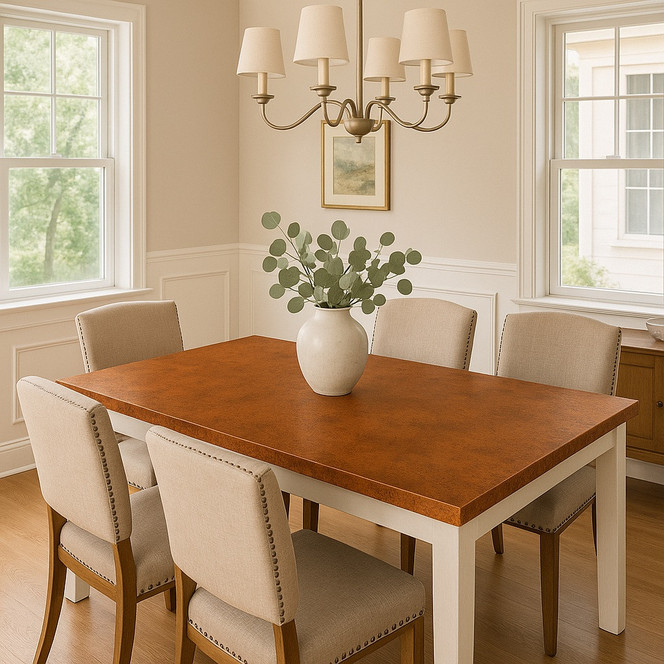
Copper Table for Dining and Eat-In Kitchens: Handcrafted Warmth for Everyday Gathering
A copper table for dining and eat-in kitchens combines a durable serving surface, custom dimensions, and the warm character of handcrafted Mexican metalwork. Available in compact sizes for breakfast areas or larger formats for formal dining rooms, these tables can be produced in round, square, rectangular, and made-to-order shapes. The copper-wrapped tabletop may feature a smooth or hand-hammered surface and a patina selected to coordinate with cabinetry, flooring, lighting, and nearby furniture. Supported by a hand-forged iron base, a custom copper dining table becomes a practical gathering place and a distinctive focal point for farmhouse, Hacienda, Spanish Colonial, rustic, transitional, and contemporary interiors.
Blog Summary
- Product: Custom copper dining table
- Uses: Dining and eat-in kitchens
- Shapes: Round, square, rectangular
- Base: Hand-forged iron
- Finish: Custom copper patinas

A Table Designed Around Everyday Life
The dining table often becomes one of the most frequently used furnishings in the home. It supports family meals, conversations, homework, entertaining, food preparation, and informal gatherings throughout the day.
A custom copper table can be sized and configured according to these routines rather than selected only for its appearance.
Dining Room or Eat-In Kitchen
A larger copper table can anchor a formal dining room, while a more compact version may fit inside a breakfast nook or open eat-in kitchen. The same material can therefore support both ceremonial meals and relaxed daily use.
The ideal design depends on the available floor area, seating requirements, room circulation, and relationship with nearby cabinetry or appliances.
Common Applications
- Dining Room: Formal gathering table
- Eat-In Kitchen: Everyday family meals
- Breakfast Nook: Compact seating area
- Open Kitchen: Shared living environment
- Restaurant: Artisan commercial furniture
Why Choose a Copper Table?
Copper introduces a warm metallic tone that differs significantly from ordinary wood veneer, glass, laminate, and factory-painted furniture. Its reddish, brown, honey, and bronze tones create visual depth while remaining compatible with many natural materials.
The metal also develops tonal variation through time and use, allowing the tabletop to become more individual rather than appearing permanently uniform.
Warmth and Visual Character
Copper reflects light softly across the tabletop, especially when the surface is hammered. Natural daylight may reveal reddish and golden areas, while evening lighting deepens the brown and bronze tones.
This changing appearance gives the table a stronger architectural presence than a flat printed or painted surface.
Handmade Rather Than Mass-Produced
Each tabletop is formed and finished individually by experienced artisans. Small differences in hammering, patina, seams, edges, and dimensions are expected and distinguish the piece from standardized furniture.
The result is a table that belongs to the selected design family without looking identical to every other example.
Copper Table Benefits
- Warm Finish: Rich natural metal tones
- Custom Size: Adapted to available space
- Artisan Texture: Handmade surface variation
- Durability: Designed for regular use
- Versatility: Traditional or modern styling
Hand-Hammered Copper Tabletops
A hand-hammered surface features small impressions created manually across the copper. These marks introduce texture, shadow, and movement while reinforcing the artisan character of the table.
Hammering is especially appropriate for rustic, Spanish Colonial, Hacienda, farmhouse, Southwestern, and Mediterranean interiors.
Why Hammering Works for Dining Furniture
The irregular texture helps the tabletop feel less formal and can visually incorporate minor scratches and natural patina changes. It also prevents the metal from appearing flat under large areas of overhead light.
The depth and density of the hammering can influence whether the table feels subtly handcrafted or strongly rustic.
Smooth Copper Tabletops
A smoother surface creates a cleaner and more contemporary appearance. It allows the shape, patina, edge profile, and table base to become the primary design features.
Because the top is still handmade, slight forming marks and tonal differences may remain visible.
Surface Options
- Hammered: Traditional artisan texture
- Smooth: Refined metal appearance
- Light Hammering: Subtle movement
- Deep Hammering: Strong rustic character
- Custom Texture: Project-specific finish
How the Copper Tabletop Is Constructed
The tabletop is produced with a structural wood core shaped according to the selected dimensions. Copper sheeting is applied over the upper surface, wrapped around the sides, and finished along the lower edge.
This method combines the visual and tactile qualities of copper with the internal support required for residential dining furniture.
Residential Tabletop Core
A standard residential tabletop may use an engineered wood core that maintains the selected shape and thickness. The core provides a stable foundation for the copper and creates attachment points for the base.
The final thickness should remain proportionate to the tabletop dimensions and intended style.
Commercial-Grade Core
Tables intended for restaurants, cafés, bars, hotels, or other high-traffic interiors may use a stronger plywood core. Commercial construction provides additional support for frequent service, cleaning, movement, and heavier daily use.
The intended application should be confirmed before production so the internal construction can be selected appropriately.
Construction Features
- Core: Structural wood foundation
- Copper: Wrapped metal sheeting
- Edges: Finished side profile
- Underside: Prepared for base attachment
- Thickness: Selected by project
Round Copper Tables
A round table creates a social arrangement where every person can participate in conversation. It works well in breakfast rooms, compact dining areas, open kitchens, and restaurant settings.
The absence of sharp corners also improves circulation in smaller spaces.
Round Tables for Eat-In Kitchens
In an eat-in kitchen, a round table can occupy an otherwise difficult corner or open area without creating strong visual barriers. Its curved edge softens kitchens dominated by straight cabinetry, islands, and counters.
A pedestal or compact iron base may provide greater legroom than a traditional four-leg arrangement.
Round Table Benefits
- Conversation: Balanced seating layout
- Circulation: No projecting corners
- Scale: Suitable for smaller rooms
- Balance: Softens straight architecture
- Versatility: Residential or commercial
Rectangular Copper Tables
Rectangular tables provide greater seating capacity and suit long dining rooms, open kitchens, restaurants, and spaces containing benches or coordinated side chairs.
The elongated surface also provides room for serving dishes, centerpieces, and larger family meals.
Rectangular Tables as Kitchen Islands
A rectangular copper tabletop can sometimes be used as part of a kitchen island or worktable configuration. The final structure should be planned according to height, base support, seating, countertop function, and clearance around appliances.
A table-height surface creates a different experience than a standard counter-height island and may be more comfortable for extended dining.
Formal Dining Applications
In a formal dining room, a rectangular copper table can become the primary architectural furnishing. Its length provides enough surface for larger gatherings while displaying the copper patina across a broad visual plane.
The iron base should remain substantial enough to support the top without restricting seating.
Rectangular Table Benefits
- Capacity: Supports larger groups
- Length: Fits long dining rooms
- Serving: Generous tabletop area
- Benches: Compatible seating option
- Island Use: Adaptable kitchen surface
Square Copper Tables
Square tables create equal proportions on all four sides and work well in breakfast areas, compact dining rooms, game rooms, and restaurant settings.
The geometry creates a balanced appearance and allows similar seating conditions around the complete perimeter.
Square Tables in Open Kitchens
A square copper table can define the dining portion of an open kitchen without extending too far into adjoining circulation areas. It is especially effective when the surrounding architecture contains repeated square or grid-like forms.
Larger square tables require careful base design so all diners maintain comfortable legroom.
Available Shapes
- Round: Intimate social layout
- Rectangular: Greater seating capacity
- Square: Balanced geometric form
- Oval: Soft elongated profile
- Custom: Made-to-order dimensions
Custom Table Dimensions
A made-to-order copper table can be adapted to the room, family size, chair dimensions, base, and intended use. Custom sizing is especially useful when standard furniture leaves too much unused space or obstructs important circulation paths.
Confirm the complete length, width, diameter, height, tabletop thickness, and preferred seating capacity before production.
Measuring the Room
Measure the entire dining area rather than only the empty space where the table will sit. Include cabinets, walls, doorways, walkways, appliances, and nearby furniture.
Chairs must be able to move backward without striking walls or blocking essential circulation.
Allowing Space Around the Table
The appropriate clearance depends on the chair depth, room layout, and expected traffic. A table that technically fits may still feel uncomfortable if people cannot move behind seated diners.
Open kitchens require particular attention because the dining area often shares circulation with cooking and storage zones.
Measurement Checklist
- Room: Measure complete floor area
- Chairs: Confirm width and depth
- Clearance: Preserve walking space
- Base: Plan legroom carefully
- Access: Check delivery route
Choosing the Correct Seating Capacity
Seating capacity depends on the tabletop shape, dimensions, chair width, armrests, base placement, and desired personal space. Narrow side chairs require less room than large upholstered armchairs.
The table should provide enough space for place settings without forcing diners to sit directly against the base or one another.
Compact Tables for Small Families
A smaller round or square table can serve two to four people comfortably in an apartment, breakfast nook, or compact eat-in kitchen. The base should remain narrow enough to preserve legroom.
Expandable mechanisms are not always practical with copper-wrapped tops, so the final capacity should be considered carefully before ordering.
Large Tables for Entertaining
Long rectangular and large round tables support family celebrations, holiday meals, and commercial dining. The greater surface area also makes the copper finish more visually prominent.
Large tops require appropriately scaled bases and careful delivery planning.
Seating Considerations
- Chair Width: Determines spacing
- Armrests: Require additional room
- Base Placement: Protects legroom
- Table Shape: Influences capacity
- Serving Space: Supports shared dishes
Hand-Forged Iron Bases
The copper tabletop may be paired with a hand-forged iron base finished in black, natural, painted, or oxidized metal. Iron provides structural stability and a strong visual contrast against the warm copper.
The base design can range from ornate Spanish Colonial scrollwork to cleaner geometric frames.
Black Iron Finish
Black-painted iron is one of the most versatile options. It coordinates with lighting, cabinet hardware, doors, windows, railings, and other metal features throughout the room.
The dark finish also allows the copper top to remain the primary visual element.
Natural Iron Finish
Natural iron preserves more of the raw metallic appearance and can suit industrial, transitional, and rustic-modern interiors. Subtle variation in the finish reinforces the handmade construction.
A protective treatment may be used to reduce unwanted oxidation under normal indoor conditions.
Oxidized Iron Finish
Oxidized iron introduces brown and reddish tones that coordinate naturally with antique and coffee copper patinas. This combination is especially effective in Hacienda, Spanish Colonial, farmhouse, and rustic interiors.
The finish should be maintained according to the intended indoor or covered outdoor use.
Iron Base Finishes
- Black: Timeless dark contrast
- Natural: Raw metal character
- Oxidized: Aged rustic appearance
- Painted: Custom color option
- Protected: Clear finished surface
Choosing the Correct Base Size
The base should remain slightly smaller than the tabletop while still providing stable support across the surface. Excessive overhang may make the table feel unstable when pressure is applied near the edges.
The correct difference depends on the top shape, dimensions, thickness, core, and base design.
Legroom and Base Placement
Decorative scrollwork should not interfere with knees, chairs, or movement. The base must support the tabletop while leaving enough usable space for every diner.
Pedestal-style bases often provide greater flexibility around round and square tops, while trestle or four-leg bases may suit rectangular designs.
Base Planning
- Support: Distribute tabletop weight
- Overhang: Maintain stable proportions
- Legroom: Protect seating comfort
- Leveling: Prevent table movement
- Attachment: Use secure hardware
Copper Patina Options
The patina determines whether the table feels bright, aged, rustic, formal, artistic, or contemporary. The finish should be selected together with the base, chairs, cabinetry, floors, lighting, and nearby copper features.
Because each patina is applied by hand, exact color matching cannot be guaranteed.
Natural Copper
Natural copper displays reddish, golden, and lighter brown tones. It works well in transitional, farmhouse, contemporary, and rustic interiors where the tabletop should remain visually bright.
The surface may gradually darken and develop more variation through use.
Antique Copper
An antique patina creates an aged appearance with deeper tones around hammer marks, edges, seams, and surface variation. It suits traditional, Spanish Colonial, Mediterranean, and Old World interiors.
The finish feels established from the beginning while continuing to evolve naturally.
Coffee Patina
Coffee patina creates a rich brown tabletop with subtle warm copper undertones. It is one of the most adaptable finishes for dining spaces containing wood, stone, leather, iron, and neutral walls.
Darker coffee tones produce a more formal and dramatic result.
Oxidized Green Copper
Green and turquoise oxidation creates an artistic surface inspired by naturally weathered copper. It may be applied across the complete tabletop or concentrated around seams, hammered areas, and edges.
This finish can become the primary color feature in a neutral dining room or contemporary kitchen.
Patina Choices
- Natural: Warm reddish metal
- Antique: Traditional aged appearance
- Honey: Lighter golden copper
- Coffee: Rich brown finish
- Oxidized: Green-blue variation
Copper as a Living Finish
Copper responds naturally to air, moisture, fingerprints, food, beverages, cleaners, and everyday contact. The tabletop may darken, lighten, or develop additional tonal variation.
This evolution is part of the material’s character and should not be compared with a permanently uniform painted coating.
Eat-In Kitchen Design
An eat-in kitchen combines cooking, dining, and everyday family activity within one shared room. The table must feel connected to the cabinetry and appliances while remaining comfortable enough for longer meals and conversation.
A copper table can bridge these areas through material, color, and handcrafted detail.
Creating Harmony in Open Kitchens
Open kitchens often expose the dining furniture to living and family areas. The table should therefore coordinate with the complete interior rather than only the cabinets.
Copper works well because its warm tones relate to wood furniture, metal lighting, leather upholstery, and decorative accessories.
Table Height Versus Counter Height
A standard dining-height table provides a more relaxed seating posture than a counter-height island. It can make the kitchen feel more like a shared living environment rather than a purely functional workspace.
The ideal height should be confirmed together with the chairs and intended use.
Eat-In Kitchen Benefits
- Comfort: Relaxed dining-height seating
- Connection: Links cooking and dining
- Conversation: Supports family gathering
- Style: Adds artisan material
- Flexibility: Meals or everyday tasks
Formal Dining Room Design
In a dedicated dining room, the copper table can become the central furnishing around which lighting, rugs, chairs, art, and storage are arranged. Its broad surface creates enough visual interest to support a relatively restrained surrounding design.
A larger table also allows the hammering and patina to be appreciated from a distance.
Choosing Dining Chairs
Wood chairs reinforce traditional and farmhouse character, while iron seating creates a stronger architectural relationship with the base. Leather introduces warmth and formality, and upholstered chairs soften the metal surface.
The chair scale should remain proportionate to the tabletop thickness and base.
Chair Pairings
- Wood: Natural traditional warmth
- Iron: Coordinated metal structure
- Leather: Refined material depth
- Upholstered: Added dining comfort
- Mixed Seating: Eclectic composition
Lighting Above the Copper Table
A chandelier or pendant should be centered according to the tabletop rather than the room alone. Warm lighting enhances reddish and brown tones while revealing the hammered texture.
Forged iron lighting coordinates with the base, while brass, copper, glass, and ceramic fixtures create different material relationships.
Forged Iron Chandeliers
An iron chandelier reinforces Spanish Colonial, Hacienda, farmhouse, and rustic character. Its dark silhouette also creates contrast against the more reflective copper surface.
The fixture should remain proportionate to the table length or diameter.
Pendant Lighting
A row of pendant lights may work above a long rectangular table or kitchen-island configuration. Their spacing should follow the table proportions rather than interrupt the dining view.
Copper or brass accents can repeat the tabletop finish without requiring an exact match.
Lighting Options
- Iron Chandelier: Traditional dark contrast
- Copper Pendant: Warm metal continuity
- Glass Fixture: Lighter visual appearance
- Brass Lighting: Refined golden accent
- Lantern Style: Hacienda character
Pairing with Copper Range Hoods
In an open kitchen, a copper table can coordinate with a custom copper range hood. The two pieces create visual continuity between the cooking and dining zones.
The finishes do not need to match exactly, but they should belong to a compatible family of natural, honey, antique, or coffee tones.
Using Copper Without Overdoing It
Repeating copper across the hood, table, sink, lighting, and hardware can create a strong material theme, but every item does not need to dominate. One or two major copper features are often enough.
Wood, stone, plaster, tile, and iron provide visual rest around the warm metal.
Copper and Talavera Tile
Talavera tile introduces cobalt, yellow, green, terracotta, and white near the copper surface. The combination supports Mexican, Spanish Colonial, and Hacienda interiors.
A patterned backsplash can relate to the table through shared warm colors without being placed directly beside it.
Kitchen Material Pairings
- Copper Hood: Coordinated focal metal
- Talavera Tile: Colorful ceramic contrast
- Wood Cabinets: Warm natural background
- Stone Counters: Architectural foundation
- Iron Lighting: Repeats base material
Farmhouse Interiors
A copper dining table feels natural in farmhouse interiors containing shaker cabinetry, wood floors, open shelving, linen, apron-front sinks, and simple lighting. The metal adds richness without requiring elaborate ornament.
A lightly hammered natural or coffee finish generally works well in this setting.
Spanish Colonial Interiors
Spanish Colonial spaces combine copper, wrought iron, Talavera tile, terracotta, plaster, carved wood, and stone. A copper table connects these materials through one central furnishing.
Dark coffee patina and an ornate iron base strengthen the traditional character.
Hacienda-Style Dining Rooms
Hacienda dining rooms often emphasize substantial furniture, generous seating, and handcrafted finishes. A large rectangular or round copper table supports this atmosphere naturally.
Carved chairs, iron chandeliers, plaster walls, and ceramic accessories can complete the composition.
Traditional Style Pairings
- Farmhouse: Relaxed handcrafted warmth
- Spanish Colonial: Historic material palette
- Hacienda: Mexican artisan character
- Mediterranean: Warm Old World surfaces
- Southwestern: Regional metal and texture
Transitional Interiors
A smooth or lightly hammered copper table can add warmth to transitional rooms containing simple cabinetry, neutral upholstery, marble, quartz, and understated hardware.
A geometric black iron base helps the table feel cleaner and less overtly rustic.
Contemporary Interiors
In a contemporary room, the copper tabletop can serve as the only strongly handcrafted feature. Clean walls, simple seating, and minimal lighting allow the living metal surface to remain the focal point.
Square and rectangular shapes with restrained bases generally work best in modern architecture.
Industrial Interiors
Copper softens concrete, brick, black steel, exposed structure, and open shelving. Visible seams, rivets, and a natural iron base can reinforce the fabricated character of the room.
The warm metal keeps an industrial interior from feeling excessively cold.
Restaurants, Cafés, and Hospitality Spaces
Copper tables can give restaurants, cafés, bars, wineries, hotels, and tasting rooms a distinctive material identity. The surface photographs well and contributes to a memorable guest environment.
Commercial orders should use appropriate internal construction and account for repeated cleaning, daily service, and frequent chair movement.
Commercial Table Layouts
Restaurants may use a mixture of round, square, and rectangular tables while maintaining the same copper finish and base family. This approach creates consistency without forcing every seating area into one format.
Review additional ideas for restaurant and bar copper tabletops before planning a larger commercial order.
Commercial Applications
- Restaurants: Distinctive dining furniture
- Cafés: Artisan gathering surfaces
- Hotels: Custom hospitality interiors
- Wineries: Warm tasting-room tables
- Bars: Durable metal furnishings
Copper Surface Hygiene
Copper is widely valued as a practical architectural metal, but normal cleaning remains necessary on a dining surface. Food, beverages, grease, dust, and everyday residue should be removed regularly.
The table should be maintained according to its finish rather than relying only on the natural characteristics of the metal.
Cleaning the Copper Tabletop
Use mild soap, warm water, and a soft cloth or sponge for routine cleaning. Remove spills promptly and dry the surface gently.
Avoid abrasive pads, bleach, ammonia, strong acids, and aggressive copper cleaners that may remove or alter the patina.
Using Coasters and Trivets
Coasters protect the surface from moisture rings, while trivets reduce direct heat exposure from cookware and serving dishes. Felt or padded protectors may be placed beneath rough decorative objects.
These simple habits help maintain a more consistent finish while still allowing the copper to age naturally.
Care Tips
- Clean: Mild soap and water
- Dry: Use a soft cloth
- Protect: Use coasters and trivets
- Avoid: Harsh chemical products
- Patina: Expect gradual change
Acidic Foods and Beverages
Citrus, vinegar, wine, tomato products, and other acidic substances may affect the patina if left on the tabletop. Clean spills promptly to reduce concentrated discoloration.
Small tonal changes may gradually blend into the surrounding living finish.
Fine Scratches and Daily Wear
Fine scratches may develop through normal dining use. Hammered surfaces generally incorporate these marks more naturally than highly polished copper.
The tabletop should not be expected to retain a permanently untouched factory appearance.
Waxing the Copper Surface
A compatible wax may be applied when recommended for the selected patina. It can provide additional protection and help preserve the sheen.
Do not use random furniture polish, metal cleaner, or automotive products without confirming compatibility.
Assembly and Installation
Large copper tabletops and iron bases may be shipped separately and assembled at the destination. Several people may be required to position the pieces safely.
The base should be centered correctly and attached using suitable hardware that does not damage the copper surface.
Leveling the Table
The completed table should sit securely without rocking. Adjustable feet or appropriate floor protection may be needed when the surface is uneven.
Leveling is especially important for long rectangular tables and commercial installations.
Assembly Checklist
- Base: Center beneath tabletop
- Hardware: Use secure fasteners
- Protection: Pad the copper surface
- Leveling: Prevent table movement
- Helpers: Arrange safe handling
Delivery Route Planning
Measure doors, hallways, staircases, elevators, gates, and turning areas before ordering. A tabletop may fit the room but still be difficult to move through the property.
The shipping crate will be larger than the finished table because protective materials add to the dimensions.
Freight Delivery
Large tables and tabletops may require freight delivery. The buyer should confirm truck access, unloading requirements, driveway conditions, and a protected storage area.
Commercial projects should also plan how several crates will be received and distributed across the installation site.
Inspecting the Shipment
Inspect the crate before signing the freight documentation. Visible damage should be noted on the carrier paperwork and photographed immediately.
Retain the packaging until the tabletop and base have been reviewed fully.
Delivery Checklist
- Access: Confirm freight route
- Unloading: Arrange appropriate help
- Crate: Inspect before signing
- Photos: Document visible issues
- Storage: Protect until assembly
Ordering Only the Copper Tabletop
Homeowners who already own a suitable table base may order only the copper top. The new tabletop can update the appearance of an existing dining table, kitchen table, restaurant base, or custom furniture project.
Before ordering, confirm the base dimensions, support points, attachment method, and required overhang.
Using an Existing Base
Wood, iron, stone, and other structurally suitable bases may support a copper tabletop when their dimensions and load capacity are appropriate. The base should not be selected only for appearance.
A furniture professional can confirm whether the existing structure is stable enough for the new top.
Separate Table Base Options
Rustica House also offers forged iron, stone, and wood bases in rustic, Hacienda, Colonial, and country-inspired styles. Purchasing the top and base separately provides greater flexibility for custom furniture projects.
The components should still be planned together to ensure proper scale and attachment.
Why Custom Copper Furniture Stands Apart
Mass-produced tables are built around fixed dimensions, repeated finishes, and standardized materials. A custom copper table can respond to the actual room, seating requirements, preferred patina, surface texture, and base style.
The finished piece becomes both practical furniture and a lasting example of handmade Mexican metalwork.
Ordering and Project Planning
Before ordering, confirm the tabletop shape, dimensions, thickness, core material, texture, patina, edge profile, base design, base finish, seating capacity, intended use, delivery route, and assembly plan.
Visit the copper table for dining and eat-in kitchens, review more hand-hammered copper dining tables, or compare separate custom copper table designs before finalizing the project.
Conclusion
A copper table for dining and eat-in kitchens provides custom sizing, artisan texture, living patina, forged iron support, and a warm gathering surface for everyday meals, entertaining, and commercial hospitality. Available in round, square, rectangular, oval, and made-to-order shapes, it can be adapted to compact breakfast areas, open kitchens, formal dining rooms, restaurants, cafés, and hotels. With thoughtful measurements, a properly sized base, coordinated seating, careful delivery planning, gentle maintenance, and respect for the evolving copper finish, a handcrafted table becomes a lasting centerpiece where family life, design, and Mexican artisan tradition come together.