 US Dollar
 Euro
Euro
 Australian Dollar
 Canadian Dollar
 Polish Zloty
 British Pound

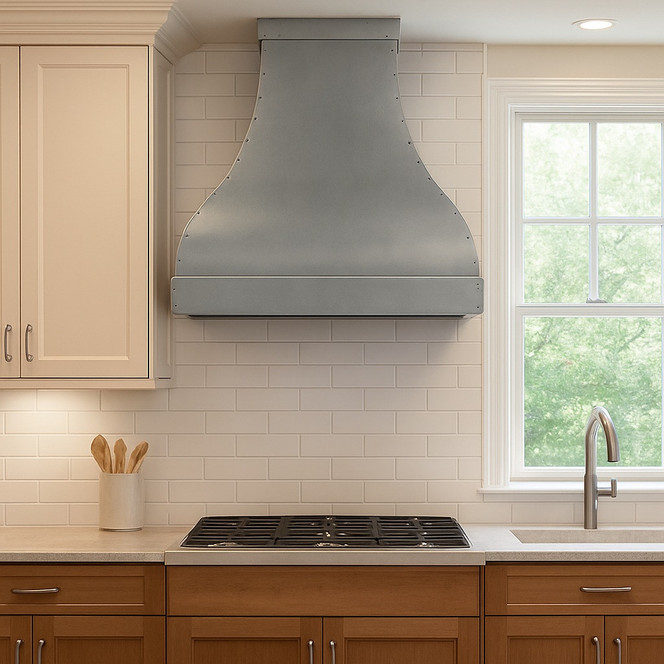
Zinc Range Hood Buying Guide with Curved Apron and Rivet Trim helps homeowners choose the right hood shape, size, finish, mounting style, and ventilation setup for transitional, Mediterranean, Spanish Revival, and rustic-modern kitchens. This handcrafted zinc hood features a flared bell body, squared crown, matte brushed surface, riveted seams, and a wide curved apron that adds sculptural weight above the cooking area. Its soft blue-gray finish works with stone, plaster, wood, tile, and iron accents. For size options and custom planning, explore the curved apron zinc range hood.

Guide Overview
Choosing a zinc range hood begins with understanding how it will function in the kitchen. Some hoods are designed to blend into cabinetry, while others become the main architectural feature above the stove. This model belongs to the second group. Its curved apron, riveted trim, and matte zinc finish create a strong focal point without heavy ornament. The design is ideal for buyers who want a handcrafted metal hood with softness, structure, and restrained industrial character. Before selecting size or finish, review the room layout, cooktop width, ceiling height, backsplash material, ventilation insert needs, and preferred mounting style.
Why Choose Zinc
Zinc is a strong choice for kitchens that need metal character without the red warmth of copper or the dark weight of iron. Its matte gray tone feels quiet, refined, and adaptable. Natural zinc can show soft blue undertones, brushed movement, and subtle tonal variation across the surface. This makes it useful in kitchens with white cabinets, gray stone, limestone, plaster, marble, walnut, oak, or black iron details. Zinc also works in both rustic and contemporary spaces because it has an aged quality while still feeling clean. Buyers who want understated metalwork often find zinc easier to coordinate than brighter metals.
Zinc Design Benefits
- Soft gray metal tone
- Matte brushed texture
- Subtle blue undertones
- Quiet industrial character
- Works with warm and cool rooms
Curved Apron Guide
The curved apron is one of the main reasons to choose this hood. It gives the lower body more presence and creates a graceful transition above the cooking surface. In Spanish Revival kitchens, the curve can echo arched openings, rounded niches, plaster details, and traditional hearth forms. In transitional kitchens, the apron softens straight cabinetry and adds movement to a clean range wall. This shape is especially useful when the kitchen needs a hood that feels substantial but not boxy. The apron creates visual weight at the base while the upper body tapers toward the squared crown.
Rivet Trim Guide
Riveted trim changes the hood from a simple zinc shell into a structured metal feature. The rivets create rhythm, define the seams, and give the surface a handcrafted industrial quality. Instead of hiding construction lines, the design uses them as part of the visual composition. This works well in kitchens with black hardware, iron lighting, stone counters, concrete surfaces, or rustic wood shelves. Rivets also help break up larger metal surfaces on wider hoods. Buyers who want a cleaner look may prefer minimal trim, but those who want architectural detail will benefit from the defined seam pattern.
Rivet Trim Benefits
- Adds surface rhythm
- Frames zinc panels
- Supports industrial style
- Shows artisan detail
- Balances curved forms
Choosing the Size
Correct sizing affects both performance and appearance. The hood should feel balanced above the cooktop and wide enough to support effective capture. Common widths include 30, 36, 42, 48, and 60 inches, with custom sizing available for larger or unusual layouts. Height can be adjusted to suit the ceiling and chimney proportion, while depth is often planned around the cooking surface and insert requirements. A taller kitchen may need a longer chimney to prevent the hood from looking short. A compact kitchen may need a more restrained height so the hood does not overwhelm the wall.
Width Planning
Width should be chosen after measuring the cooktop, surrounding cabinetry, and available wall space. Many buyers prefer a hood slightly wider than the cooking surface because it improves capture and creates better visual balance. This is especially helpful for gas ranges, frequent cooking, and open kitchens where steam and odors can move into nearby rooms. If the hood sits between upper cabinets, check the exact opening before ordering. If it sits on an open wall, the design can be wider and more dramatic. The goal is to make the hood look intentional, centered, and proportional.
Size Planning Checks
- Measure cooktop width
- Check cabinet spacing
- Review ceiling height
- Confirm hood depth
- Plan chimney length
Wall Mount Use
A wall mount installation is ideal when the cooktop or range sits against a kitchen wall. In this layout, the front face of the hood becomes the main visual feature, while the backsplash provides the background. The curved apron can frame the cooking area, and the riveted seams can connect with cabinet hardware, lighting, or nearby metal accents. Before ordering, confirm mounting support, backsplash height, duct route, and insert dimensions. The hood should be centered above the range and aligned with the overall cabinet or wall composition. A well-planned wall mount hood can define the entire range area.
Island Hood Use
An island version works when the cooktop sits on a kitchen island instead of against a wall. This option needs more careful planning because the hood will be visible from every side. The curved apron is especially effective in an island layout because its shape can be appreciated from multiple angles. The squared crown and riveted seams also need to look balanced from the kitchen, dining area, and surrounding living space. Island installation requires ceiling support, duct planning, and correct alignment above the cooktop. Buyers should confirm these details early so the hood is built for open visibility.
Mounting Guide
- Wall mount for range walls
- Island use for cooktops
- Plan ceiling support
- Confirm duct location
- Center above the range
Ventilation Planning
The decorative zinc body should be planned around the ventilation insert. The insert controls airflow, lighting, filter access, fan speed, and daily cooking performance. This hood can work with a range of insert strengths depending on cooking style and kitchen layout. Light cooking may need modest airflow, while frequent high heat cooking may require a stronger unit. Buyers should also decide between ducted ventilation and recirculating operation. A ducted system moves air outdoors, while a recirculating setup filters air and returns it to the room. Selecting the insert early prevents fit issues during production.
Ducted or Recirculating
The choice between ducted and recirculating ventilation depends on the kitchen structure and project goals. Ducted ventilation is often preferred when an exterior route is available because it removes air from the home. Recirculating systems can be useful when ducting is difficult or impossible, but they depend on filters to clean and return air. The selected insert must fit the hood body and allow access for filter maintenance. Buyers should check local codes, appliance requirements, and installer recommendations before ordering. Good ventilation planning protects both the hood’s appearance and its long-term function.
Insert Planning Checks
- Choose insert early
- Confirm fan strength
- Check filter access
- Plan lighting position
- Review duct route
Finish Selection
The matte brushed zinc finish gives this hood its quiet industrial appeal. It reflects light softly without looking shiny or polished. The finish can show gray and blue-gray shifts, helping the hood coordinate with stone, marble, plaster, black metal, cool woods, and neutral cabinetry. In rustic kitchens, the brushed surface adds age and texture. In modern kitchens, it provides a softer alternative to stainless steel. Buyers should compare the zinc tone with cabinet samples, tile, countertops, flooring, and lighting. Since kitchen light changes throughout the day, the finish may look warmer or cooler depending on the setting.
Kitchen Style Matching
This hood works best in kitchens where shape, texture, and material are important. In Spanish Revival spaces, it supports arched forms, plaster walls, terra cotta floors, hand-painted tile, and iron details. In Mediterranean kitchens, it pairs well with stone counters and warm architectural surfaces. In transitional interiors, the hood can soften shaker cabinets and honed countertops. In rustic-modern designs, the matte zinc finish contrasts nicely with reclaimed wood shelves and industrial pendant lights. The key is to let the hood serve as the main range wall feature while surrounding it with materials that support its tone.
Best Kitchen Styles
- Spanish Revival kitchens
- Mediterranean interiors
- Transitional spaces
- Rustic modern homes
- Industrial kitchen designs
Backsplash Pairings
The backsplash should support the curved apron and riveted trim without competing for attention. Hand-painted tile can work beautifully in Spanish-inspired kitchens if the colors coordinate with the zinc surface. Stone backsplashes add permanence and make the hood feel architectural. Plaster walls create a softer old-world setting. Simple white or neutral tile can make the gray metal stand out more clearly. In modern kitchens, large-format stone or a clean slab backsplash can emphasize the hood’s sculptural profile. The best backsplash gives the hood a strong background while preserving visual balance.
Cabinet and Counter Pairings
Cabinetry and countertops should be chosen with the hood’s matte zinc tone in mind. White cabinets create contrast and make the hood stand out. Walnut, oak, or reclaimed wood adds warmth against the cooler metal. Gray cabinetry can create a quiet tonal palette, while black accents give the hood more structure. Countertops in marble, limestone, soapstone, honed granite, quartz, or concrete can all work depending on the desired mood. The hood should not feel isolated. Repeating gray, black, stone, or brushed metal tones elsewhere in the room helps it feel integrated.
Material Pairings
- Plaster kitchen walls
- Honed stone counters
- Reclaimed wood shelves
- Terra cotta floors
- Black iron lighting
Specifications Guide
This zinc hood can be planned for many residential kitchen layouts. It is handcrafted from natural zinc with a matte brushed finish and subtle patina movement. The raised curved apron, squared crown, and riveted seams create the main visual structure. Widths may include 30, 36, 42, 48, and 60 inches, with custom sizes available. Heights can be adjusted from 24 to 60 inches, and depth is often planned around a 24 inch standard with project adjustments when needed. The hood can be configured for wall mount or island use and planned for ducted or recirculating ventilation.
Quick Specifications
- Handcrafted natural zinc
- Matte brushed patina
- Curved apron trim
- Wall or island use
- Ducted or recirculating
Care and Maintenance
Zinc should be cleaned gently to preserve the surface tone. Use mild soap, water, and a soft cloth for routine cleaning. Avoid abrasive pads, acidic cleaners, harsh chemicals, and rough scrubbing because they can affect the finish. Grease should be wiped away regularly, especially near the apron, underside, and filter area. The matte brushed surface may develop slight tonal changes over time, which can add character to the metal. Filters and mechanical parts should be maintained according to the insert instructions. A simple care routine keeps the hood attractive and functional.
Care Guidelines
- Use mild soap only
- Avoid harsh cleaners
- Dry with soft cloth
- Wipe grease promptly
- Maintain filters often
Buying Guide Summary
When buying a zinc range hood with a curved apron and rivet trim, begin by reviewing the kitchen layout. Decide whether the hood should be wall mounted or built for an island. Measure the cooktop, wall space, cabinet spacing, ceiling height, and duct location before selecting size. Choose the insert before production so the hood body can be prepared correctly. Then compare the zinc finish, rivet detail, apron shape, and surrounding materials. The best result comes from matching the hood’s tone, scale, and structure to the full kitchen design.
Final Design Guidance
Zinc Range Hood Buying Guide with Curved Apron and Rivet Trim shows how size, mounting style, finish, ventilation, and material coordination shape the final kitchen result. This hood combines Spanish Revival curvature, industrial joinery, and natural zinc character in one sculptural feature. The flared bell body brings movement, the squared crown adds structure, and the riveted seams define the handcrafted surface. When planned with the right insert, proportions, and surrounding materials, the hood becomes more than a ventilation cover. It becomes the architectural focal point above the cooking space.