 US Dollar
 Euro
Euro
 Australian Dollar
 Canadian Dollar
 Polish Zloty
 British Pound

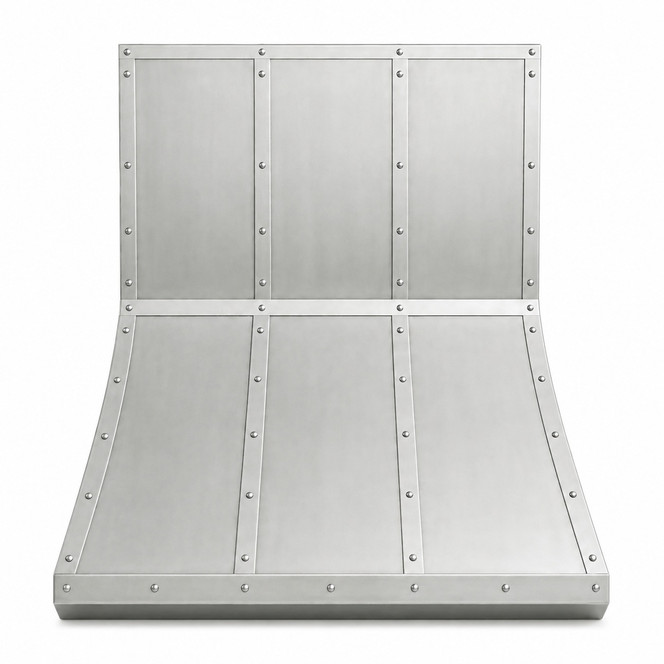
The Riveted Three-Bay Zinc Range Hood with Projecting Apron is shown in these kitchen lifestyle images as a precise architectural focal point for Bauhaus, high-tech modern, Japanese modern, and modern Prairie kitchens. Its rectangular front, three recessed zinc bays, exposed rivets, continuous frame rails, crown-free chimney, sharply angled canopy, and projecting beveled apron create a disciplined range-wall feature with strong horizontal and vertical control. The monochromatic zinc construction keeps the hood cool and restrained, while the riveted framework gives it fabricated metal character. Explore the riveted three-bay zinc range hood with projecting apron to compare its panel layout, apron, finish, and kitchen style applications. For product-specific design context, read the riveted three-bay zinc range hood projecting apron guide.
Blog Summary
- Focus: kitchen lifestyle images
- Product: three-bay zinc hood
- Feature: projecting apron
- Finish: monochromatic zinc
- Scenes: four modern kitchens
- Look: precise and architectural
Riveted Three-Bay Zinc Hood Images
Lifestyle images help show how this riveted three-bay zinc range hood looks inside finished kitchens rather than as a standalone product photo. Cabinet geometry, backsplash material, counter selection, wall plane, lighting, appliance finish, flooring, and surrounding architectural lines all affect how the zinc framework appears. In one kitchen, the hood can feel Bauhaus and geometric. In another, the same projecting-apron design can support high-tech modern, Japanese modern, or modern Prairie interiors.
This hood stands out because the design is built around order. The front is divided into three recessed bays, while the rails continue across the canopy and lower apron. The projecting beveled apron gives the bottom edge more weight than a simple flat band, and the rivets reinforce the fabricated metal character. For broader zinc material inspiration, browse the zinc range hoods collection.
Design Highlights
- three-bay zinc panel layout
- projecting beveled lower apron
- continuous riveted framework
- flat crown-free chimney
- sharply angled canopy planes
- monochromatic zinc construction
- modern architectural compatibility
Bauhaus Kitchen Image
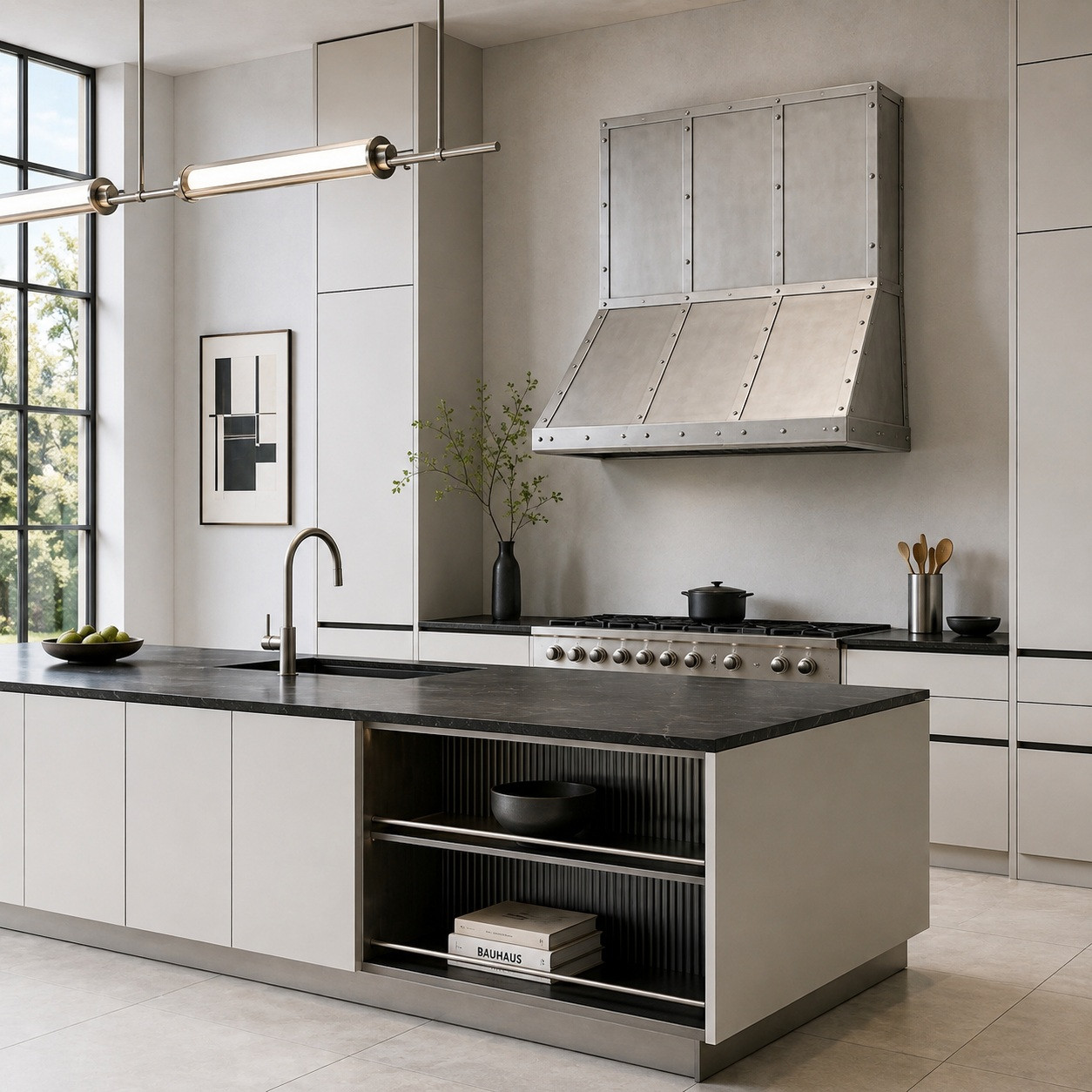
In a Bauhaus kitchen, the riveted zinc hood works through clarity, proportion, and visible construction. Bauhaus-inspired interiors often favor straight lines, functional geometry, flat surfaces, honest materials, limited decoration, and careful alignment. This hood fits that language because its three-bay front reads as a deliberate grid rather than an applied decorative pattern. The rivets, rails, and recessed panels make the metalwork visible without becoming ornate.
The projecting apron is especially useful in this scene because it creates a strong horizontal base. That lower band can relate to cabinet rails, counter edges, window lines, appliance faces, and other rectangular elements in the room. The zinc finish supports a restrained palette of white, black, gray, natural wood, stone, and steel. Instead of softening the range wall with curves, the hood reinforces architectural discipline and gives the kitchen a measured focal point.
High-Tech Modern Kitchen Image
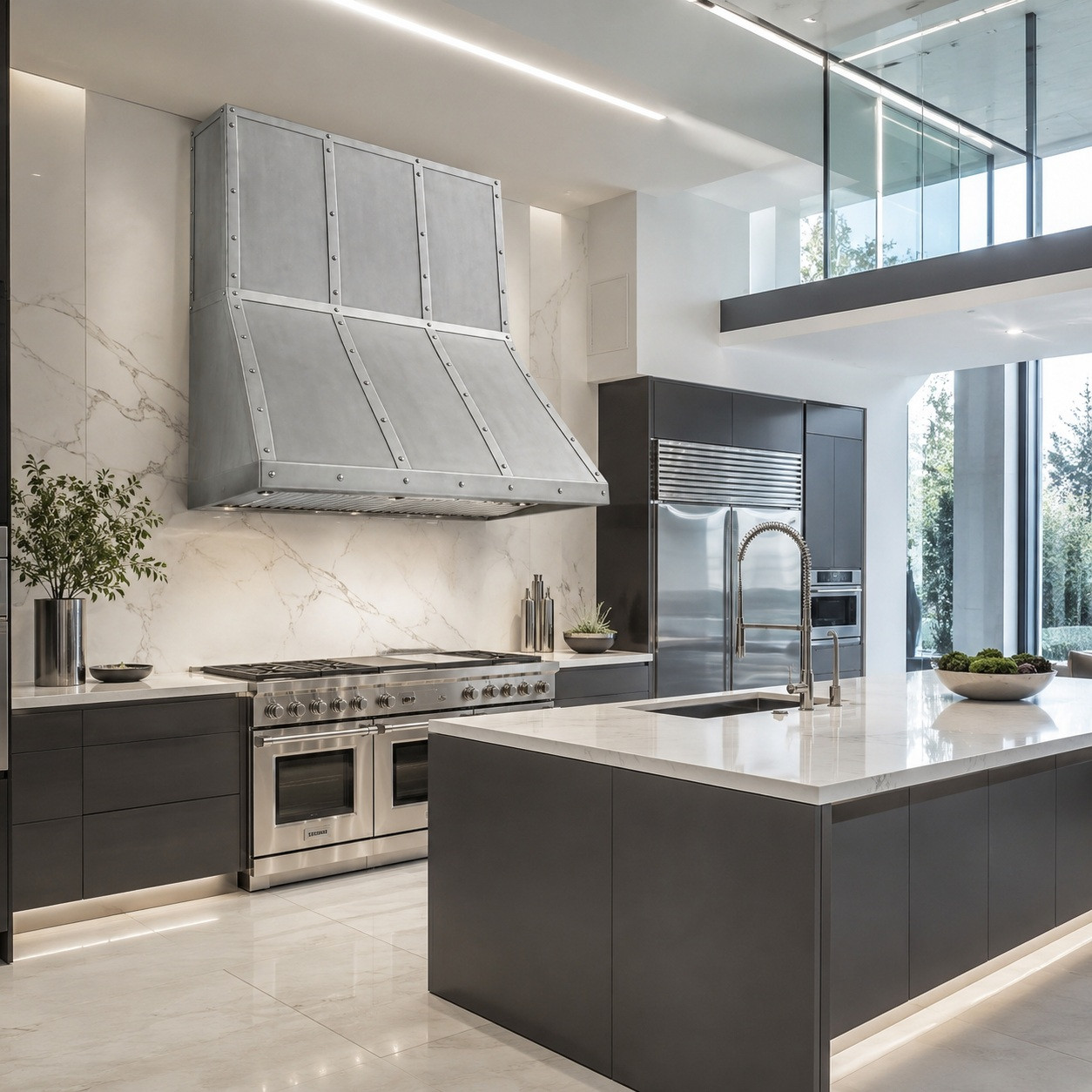
In a high-tech modern kitchen, the hood can be treated as an intentionally exposed piece of fabricated equipment. High-tech interiors often use stainless appliances, structural glass, dark slab cabinetry, large porcelain surfaces, integrated lighting, precise hardware, and strong mechanical lines. The zinc hood fits because its riveted framework, angled canopy, and projecting apron look engineered rather than decorative.
The monochromatic zinc finish coordinates naturally with stainless steel, brushed metal, gray stone, black hardware, and darker appliance panels. The three recessed bays help the hood avoid looking like a plain box, while the crown-free chimney keeps the top profile clean and technical. In this style, the hood does not need warmth or ornament to be successful. Its value comes from visible fabrication, sharp geometry, and a disciplined relationship to the surrounding equipment and surfaces.
Japanese Modern Kitchen Image
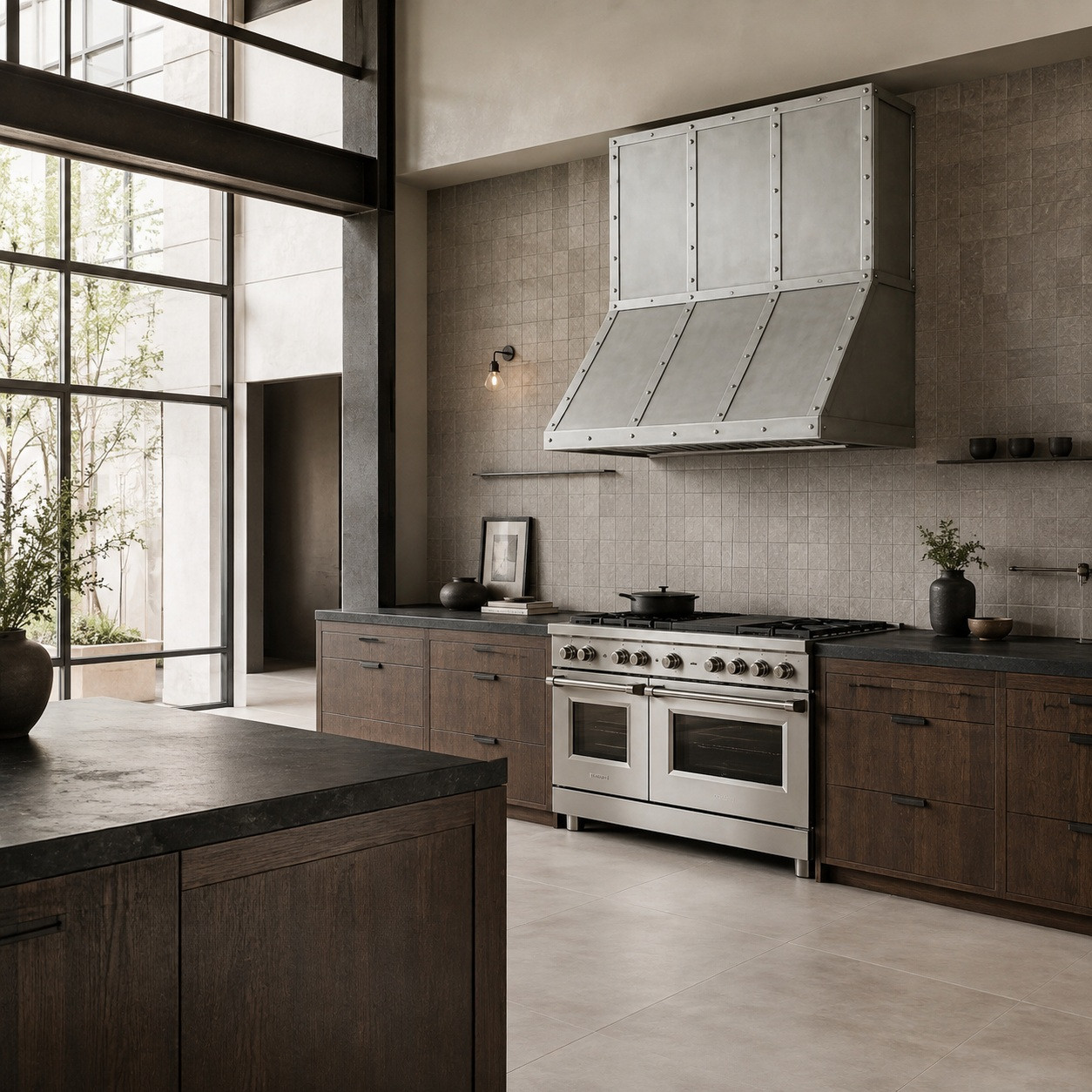
In a Japanese modern kitchen, this zinc hood works through restraint, rhythm, and material honesty. Japanese modern interiors often use dark-stained wood, simple slab cabinetry, charcoal stone, handmade gray tile, blackened steel shelving, soft indirect light, and generous negative space. The hood’s monochromatic zinc construction is important here because contrasting metals or ornate trim would make the composition too active.
The three-bay layout can relate to shoji-like divisions, cabinet spacing, wall panels, shelving, or tile rhythm without directly imitating traditional details. The projecting apron gives the hood a grounded lower edge, while the straight chimney and flat rear plane preserve a calm wall-mounted presence. The rivets add just enough fabrication detail to make the hood feel handcrafted and real, but the overall design remains quiet. For care and finish planning, review the zinc range hood care and maintenance guide.
Modern Prairie Kitchen Image
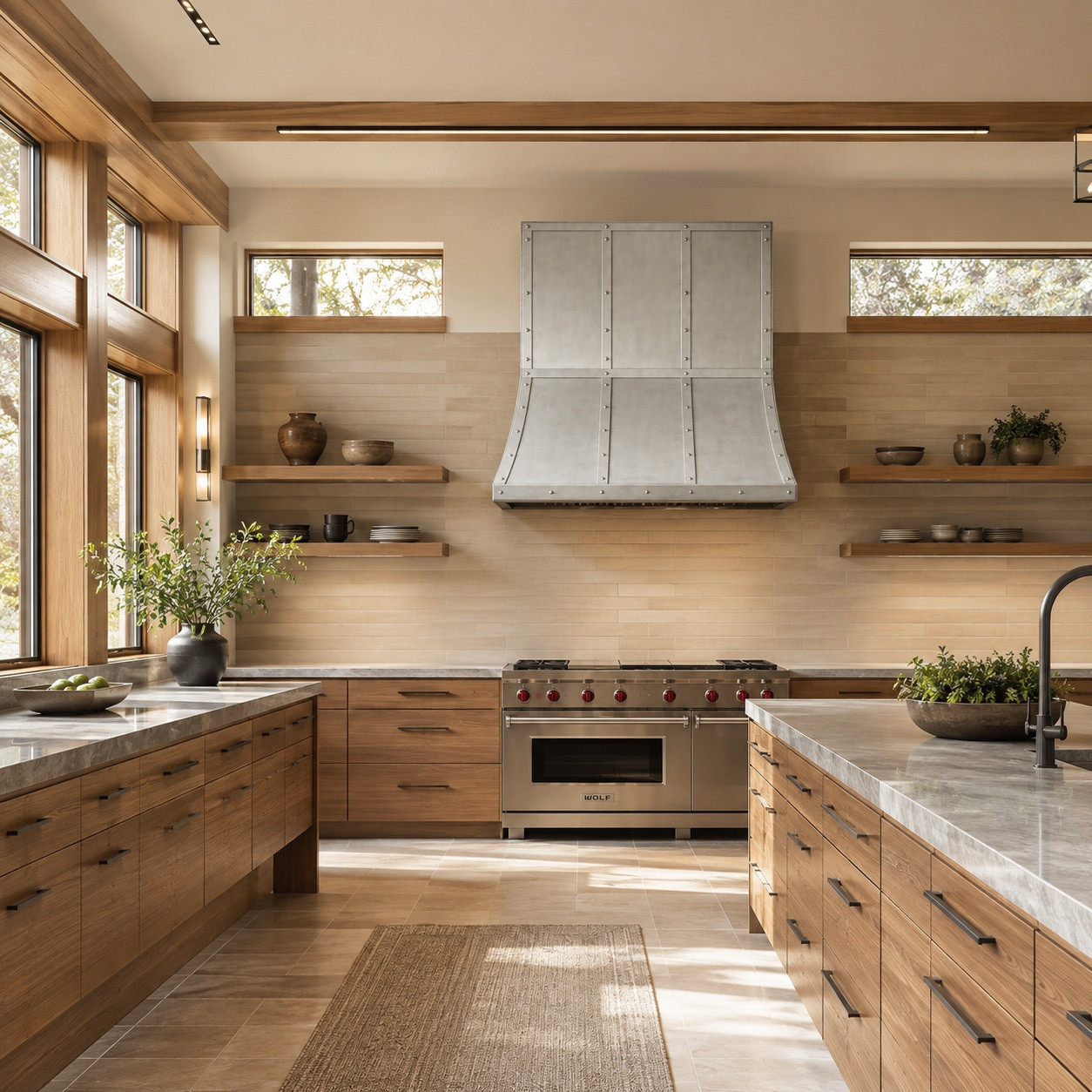
In a modern Prairie kitchen, the hood supports long horizontal lines, natural materials, and controlled architectural rhythm. Prairie-inspired interiors often use extended counters, linear windows, rift-cut oak, stone surfaces, low-profile lighting, earth-toned tile, and broad cabinet planes. The projecting apron works especially well here because it creates a strong horizontal transition across the base of the hood.
The vertical three-bay grid adds controlled contrast to the horizontal composition. It gives the range wall structure without interrupting the broader Prairie emphasis on extended lines. The zinc finish also works well with oak, stone, gray tile, dark bronze hardware, and muted earth tones because it adds a cool metal element without dominating the palette. The result is architectural and calm, with the hood acting as both a focal point and a disciplined part of the wall elevation.
Three-Bay Panel Layout
The three-bay panel layout is the main organizing feature of this hood. The front is divided into three recessed fields, each framed by the same zinc structure. This gives the hood visual order and helps it coordinate with cabinetry, tile grids, wall panels, window divisions, and other rectilinear kitchen elements.
The layout is especially effective because it remains symmetrical and restrained. The bays create depth and shadow, while the rivets reinforce the idea of fabricated metal construction. The hood feels detailed, but not decorative in the traditional sense.
Projecting Beveled Apron
The projecting beveled apron gives the hood a strong lower foundation. Instead of ending in a thin flat strip, the bottom edge projects forward and creates a clear horizontal plinth below the sloped canopy. This detail gives the hood more architectural weight and makes the lower edge feel intentional.
The apron is useful in modern kitchens because it adds depth without ornament. It can relate to counters, cabinet rails, appliance lines, shelf edges, and window bands. In Bauhaus, high-tech, Japanese modern, and modern Prairie kitchens, that horizontal control helps the hood feel integrated into the room.
Monochromatic Zinc Finish
The monochromatic zinc finish keeps the hood cool, refined, and visually cohesive. Because the body, panels, rails, apron, and rivets remain within the zinc family, the design depends on shadow, form, and surface variation rather than color contrast. This makes it a good fit for kitchens that value restraint.
Small differences in zinc tone, brushing, rivet alignment, bay depth, apron shaping, seams, edge detail, and artisan finishing should be expected in handmade metalwork. These variations help each hood feel individual while preserving the precise architectural character of the design.
Style Compatibility
This hood works best in kitchens that value structure over ornament. In Bauhaus interiors, it supports geometric order. In high-tech modern kitchens, it reads as fabricated equipment. In Japanese modern rooms, it brings quiet rhythm and material honesty. In modern Prairie kitchens, it adds a vertical grid and strong horizontal apron to an extended architectural composition.
The surrounding kitchen should allow the panel grid and projecting apron to remain visible. Flat cabinetry, simple stone, restrained backsplashes, linear lighting, and controlled hardware help the hood read as an intentional architectural feature rather than an isolated metal object.
Conclusion
The riveted three-bay zinc range hood with projecting apron brings rectilinear geometry, recessed panel rhythm, riveted zinc construction, a crown-free chimney, angular canopy planes, and a strong beveled apron into the kitchen. These lifestyle images show how the hood adapts to Bauhaus, high-tech modern, Japanese modern, and modern Prairie interiors while keeping its design precise, handcrafted, and architecturally disciplined.