 US Dollar
 Euro
Euro
 Australian Dollar
 Canadian Dollar
 Polish Zloty
 British Pound

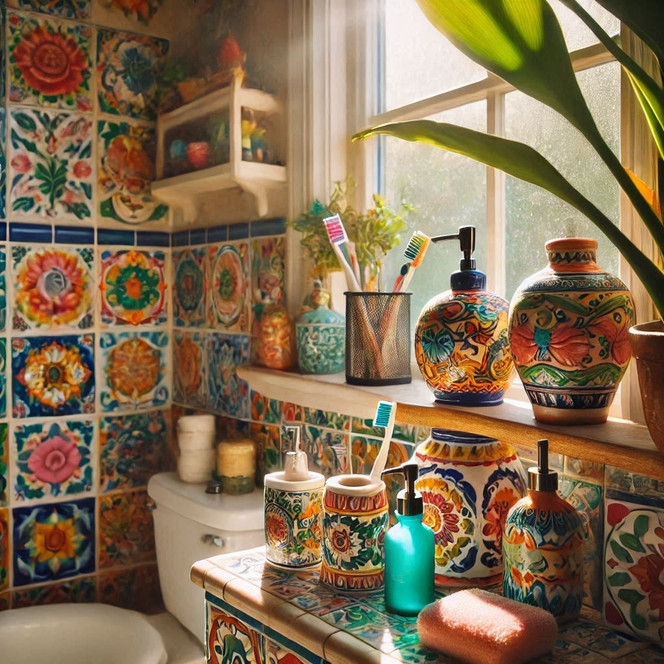
Choosing the right tile is only one part of completing a ceramic installation. The exposed edges, outside corners, countertop transitions, and boundaries between tile and painted walls also need a deliberate finish. Handcrafted Mexican tile trims provide those finishing details while coordinating with colorful Talavera installations. Depending on the project, buyers can use surface bullnose pieces, quarter-round profiles, V-cup corner trims, cornice moldings, or decorative border tiles to frame the main field tile and create smoother visual transitions. These small ceramic components can be especially important around kitchen backsplashes, bathroom walls, counters, niches, and other areas where a standard tile edge would otherwise remain exposed. This guide explains the principal Mexican trim profiles, how they differ, where they can be used, how color affects the finished layout, and what to consider before ordering handmade pieces. Explore the available trim profiles before finalizing your tile layout.
Blog Summary
- Material: Handmade ceramic
- Origin: Crafted in Mexico
- Purpose: Finish exposed tile edges
- Bullnose: Smooth wall transitions
- Quarter round: Narrow edge profile
- V-cup: Wraps outside corners
- Cornice: Decorative raised molding
- Borders: Frame patterned tile fields
Why Tile Trims Matter
A tile installation can use an attractive field pattern and still appear unfinished when exposed edges have not been planned. Trim pieces provide a transition between the tiled surface and adjacent materials while giving the perimeter a more intentional appearance.
They are particularly useful where a backsplash ends against a painted wall, where ceramic covers the front edge of a counter, or where two tiled surfaces meet around an outside corner. Decorative profiles can also be used within the tile field to establish borders, horizontal divisions, or framed sections.
The best trim depends on the location. A flat wall termination requires a different profile from a projecting corner, while a decorative border serves a different purpose from a bullnose edge.
Mexican Tile Trim Types
Mexican ceramic trim is not a single product shape. Different profiles solve different finishing problems, and understanding those profiles before installation makes it easier to calculate quantities and establish a consistent layout.
Handmade production also gives these pieces the slight irregularities associated with traditional ceramic work. Minor differences in dimensions, glaze, edge shape, and color are expected rather than signs that every trim was intended to be mechanically identical.
Surface Bullnose Trims
A surface bullnose has a rounded finished edge that softens the transition from a tiled area to the adjoining surface. It is one of the most versatile options for terminating a backsplash, tiled wall, countertop edge, or similar installation.
The rounded side can prevent the raw ceramic body from becoming the dominant visual edge. It also gives the installation a more complete appearance when the tile ends against plaster, drywall, painted surfaces, or another finish.
Orientation should be determined before ordering because the rounded edge needs to face the exposed side of the installation.
Double Surface Bullnose
Double surface bullnose tiles are useful where two adjacent sides of the same tile remain visible. Instead of rounding only one side, the profile finishes two adjoining edges, making it appropriate for certain outside corners and termination points.
This is particularly useful where a standard single-edge bullnose would leave a second exposed edge unfinished. Corner orientation should be established on the layout before quantities are calculated.
Quarter-Round Trims
Quarter-round ceramic trim creates a narrow rounded profile along the perimeter of a tiled surface. Because it projects differently from a flat bullnose, it can provide a stronger dimensional transition and a more pronounced border.
Quarter rounds work well around backsplashes, wall installations, counters, niches, and other locations where a narrow ceramic molding complements the main field tile. They can also be used decoratively when the installation calls for additional depth around the perimeter.
V-Cup Corner Trims
V-cup trims are designed to wrap around a corner rather than terminate only one flat surface. Their two-sided construction allows ceramic to continue over adjoining faces, creating a more integrated treatment at an outside corner.
They are useful where both sides of the corner need coverage and a conventional flat trim would not provide the required geometry. When planning a V-cup installation, measure the linear corner rather than treating the pieces as ordinary field tiles.
Cornice Moldings
Cornice moldings add greater relief and architectural depth than simple edge trims. They can terminate a tile field, establish a horizontal line, frame a decorative section, or introduce a raised ceramic feature within a backsplash or wall installation.
Because a cornice projects farther from the wall, surrounding cabinetry, outlets, fixtures, shelves, and other nearby elements should be considered before installation. The molding should have enough clearance to display its profile without interfering with adjacent components.
Rope and Linear Moldings
Rope and other linear moldings are primarily decorative. Their raised surfaces introduce shadow and texture while separating areas of field tile or establishing a border around a patterned section.
These profiles can work particularly well with a rustic tile design because the relief adds another handcrafted element to an already varied ceramic surface.
Decorative Border Tiles
Border tiles differ from functional edge profiles because their principal role is visual organization. They can divide two tile patterns, frame a backsplash, create a horizontal accent, or establish a transition between solid-colored and patterned ceramics.
Traditional Talavera borders may use floral, geometric, or repeating motifs, while simpler patterns can work with transitional interiors. The border does not need to reproduce every color in the field tile. Repeating one or two important hues is often enough to connect the two visually.
Buyers using decorative Mexican tiles can use borders to organize a visually active pattern and create a clear boundary around the principal design.
Solid Color Options
Solid-color trim is useful when the field tile already contains a strong pattern. Instead of introducing another motif, the trim can repeat a color from the backsplash and provide a quieter frame.
Rustica House trim collections include traditional Talavera colors such as terra cotta, Mexican white, dark blue, light blue, cobalt, green, yellow, and brown, depending on the specific profile. These colors coordinate with many patterned and solid ceramic installations.
Because the pieces are handcrafted and glazed, tonal variation should be expected. A cobalt trim, for example, should coordinate with cobalt details in the field tile without being expected to reproduce every neighboring tile with machine-made color uniformity.
Matching Talavera Tiles
One practical approach is to select the main field tile first and then identify one of its recurring colors for the trim. A patterned backsplash containing cobalt, yellow, and green might use a cobalt edge to establish contrast or Mexican white for a quieter perimeter.
Another option is to use the trim as a deliberate contrasting line. Terra cotta can introduce an earthy border around lighter ceramics, while darker blue can establish a strong edge around predominantly white tile.
When planning painted Talavera tiles, compare the trim profile as well as its color. The correct hue cannot compensate for a molding shape that does not fit the intended corner or termination.
Kitchen Backsplash Edges
A kitchen backsplash commonly ends before reaching an adjacent wall, cabinet, doorway, or other architectural boundary. That exposed vertical edge is one of the most useful locations for ceramic trim.
Surface bullnose can create a relatively flat termination, while quarter-round trim adds more depth. Decorative moldings can provide a stronger frame when the backsplash itself is intended to function as a prominent design feature.
Determine the termination line before tile installation begins. Adding trim after the field tile has already been laid can change the intended dimensions and leave awkward cuts at the perimeter.
Countertop Applications
Traditional tiled countertops may require trim where the horizontal ceramic surface meets the vertical front edge. A rounded or dimensional molding can soften this transition while maintaining ceramic coverage across the visible perimeter.
The exact trim should be selected according to the countertop construction rather than appearance alone. Substrate thickness, tile thickness, overhang, corner conditions, and the relationship between horizontal and vertical pieces all affect the finished profile.
Bathroom Tile Edges
Bathrooms contain numerous locations where tile may terminate: vanity backsplashes, wainscoting, niches, half walls, and decorative wall panels. Matching ceramic trim can make these transitions feel intentional rather than leaving an exposed field-tile edge.
Water exposure should also be considered. Trim is a decorative finishing component, not a substitute for proper substrate preparation, waterproofing, grout, or sealant where those systems are required.
Outside Corners
Outside corners require particular attention because two visible tiled planes meet at one edge. Depending on the layout, V-cup trim, double bullnose pieces, or another appropriate corner profile may provide the desired finish.
The installer should know the selected trim before setting adjacent field tiles. Its dimensions determine where those tiles terminate and how the corner aligns with surrounding grout joints.
Dry-laying several pieces before permanent installation can reveal dimensional variation and help determine the most balanced sequence.
Decorative Wall Frames
Trim does not need to appear only at the outside perimeter. Moldings and border tiles can frame a decorative panel within a larger field, such as a patterned section centered behind a range.
This approach allows an installation to combine simpler field tile with a more elaborate focal area. The border establishes a clear visual boundary and can repeat colors used elsewhere in the room.
It can also help integrate handmade ceramic wall tiles with cabinetry and surrounding architectural details.
Planning Tile Quantities
Field tile is generally calculated by surface area, while many trims are planned according to linear distance or individual corner requirements. For that reason, trim quantities should be calculated separately from the main tile order.
Measure each exposed edge, outside corner, framed section, and molding run. Then confirm the actual dimensions and selling unit of the selected trim. Some products are sold individually, while others may be offered according to linear coverage.
Allowing for handmade variation, cuts, installation decisions, and potential replacement pieces can also reduce the risk of needing a small follow-up order later.
Buyer Planning Table
| Planning | What to Confirm |
|---|---|
| Location | Wall, counter, niche, or corner |
| Profile | Bullnose, V-cup, round, or molding |
| Orientation | Direction of finished edges |
| Color | Match or contrast with field tile |
| Length | Total linear trim required |
| Corners | Number and type of transitions |
| Thickness | Relationship to adjacent tile |
| Variation | Handmade dimensional differences |
Installation Planning
Tile trim should be included in the layout from the beginning rather than treated as an accessory added after the field tile is installed. Establish finished edges, corners, border positions, grout joints, and transitions before setting the first pieces.
Handmade ceramic can contain small dimensional differences, so installers may need to adjust grout joints slightly to maintain a visually balanced line. Dry fitting is particularly useful around corners and wherever several molding profiles meet.
The substrate, setting material, grout, waterproofing, and installation method should be appropriate for the actual application. Professional tile installation is recommended when the project includes complex corners, wet areas, countertops, or elaborate molding combinations.
Handmade Characteristics
Mexican ceramic trim reflects the handmade character of the tile it accompanies. Small differences in glaze coverage, tone, dimensions, edge shape, surface texture, and other details are expected. Pieces may not align with the mechanical precision associated with mass-produced rectified tile.
These variations become part of the finished installation when the pieces are sorted and laid thoughtfully. Before installation, arranging the trim can help distribute tonal and dimensional differences naturally across the project rather than concentrating similar pieces in one area.
Design Perspective
The most effective tile trim usually supports the field tile rather than competing with it. A highly patterned backsplash may benefit from a solid-color bullnose, while a simple field of Mexican white tile can accommodate a more decorative border or relief molding.
Scale is equally important. Narrow trims can provide a subtle transition, while projecting cornices and dimensional moldings become visible architectural features. Consider the size of the tiled area, cabinetry, fixtures, and surrounding surfaces before selecting a profile.
Color, profile, and placement should therefore be planned together. The result is a tile installation in which the edges and corners look like intentional parts of the composition rather than unfinished boundaries.
FAQ - Mexican Tile Trims
A: Mexican tile trims finish exposed ceramic edges, outside corners, backsplash terminations, countertop transitions, niches, and decorative borders while coordinating with the main tile installation.
A: Surface bullnose has a rounded finished edge designed to create a smoother transition where a tiled surface ends against another wall or finish.
A: Bullnose generally finishes an exposed edge on a flat tiled surface. V-cup trim wraps around two adjoining faces and is designed for appropriate outside-corner applications.
A: Double surface bullnose is useful where two adjacent sides of a tile remain exposed, particularly at certain corner and termination conditions.
A: Yes. Quarter-round trim can create a narrow dimensional border around a backsplash or other tiled surface when its profile suits the installation.
A: Yes. Rope moldings, cornices, patterned borders, and other dimensional profiles can frame tile fields or create decorative divisions within a larger installation.
A: Not necessarily. A trim can repeat an important color from patterned tile, provide a neutral frame, or intentionally contrast with the field depending on the desired design.
A: No. Slight variations in dimensions, glaze, color, edge shape, and surface character are normal features of handcrafted ceramic production.
A: Measure each exposed edge, molding run, framed section, and corner separately, then compare those measurements with the dimensions and selling unit of the selected trim.
A: Yes. Selecting the profile before installation allows the installer to plan field-tile dimensions, corner transitions, grout joints, finished edges, and required quantities correctly.
Complete Your Tile Project
Mexican tile trim turns the perimeter of an installation into part of the overall design. Surface bullnose, double bullnose, quarter rounds, V-cups, cornice moldings, rope profiles, and decorative borders each solve different edge or transition conditions, so the appropriate piece should be selected according to the actual location rather than color alone.
Plan the trim at the same time as the field tile, measure exposed edges and corners carefully, and allow for the dimensional and glaze variations associated with handmade ceramic. Coordinating the profile with the field pattern, grout layout, cabinetry, countertops, and adjacent wall surfaces creates a more deliberate finished installation. Browse Mexican tile trims to compare handcrafted profiles and colors for your backsplash, wall, counter, or corner project.