 US Dollar
 Euro
 Australian Dollar
 Canadian Dollar
 Polish Zloty
 British Pound

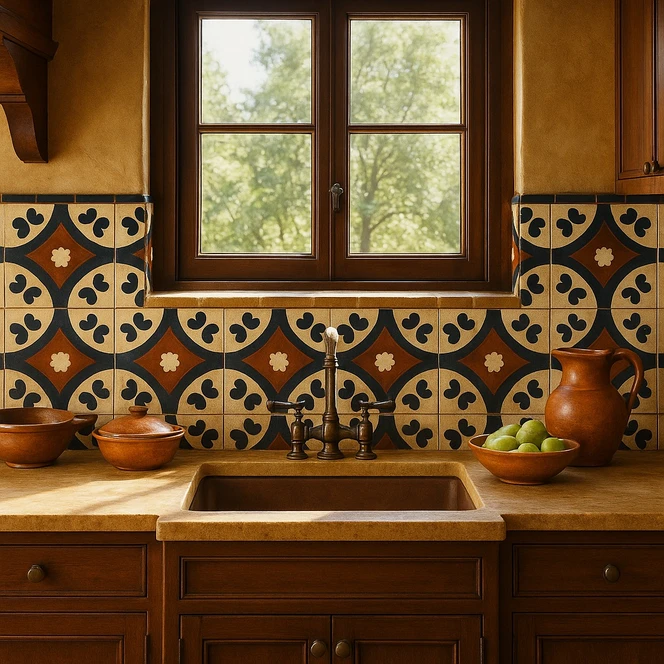
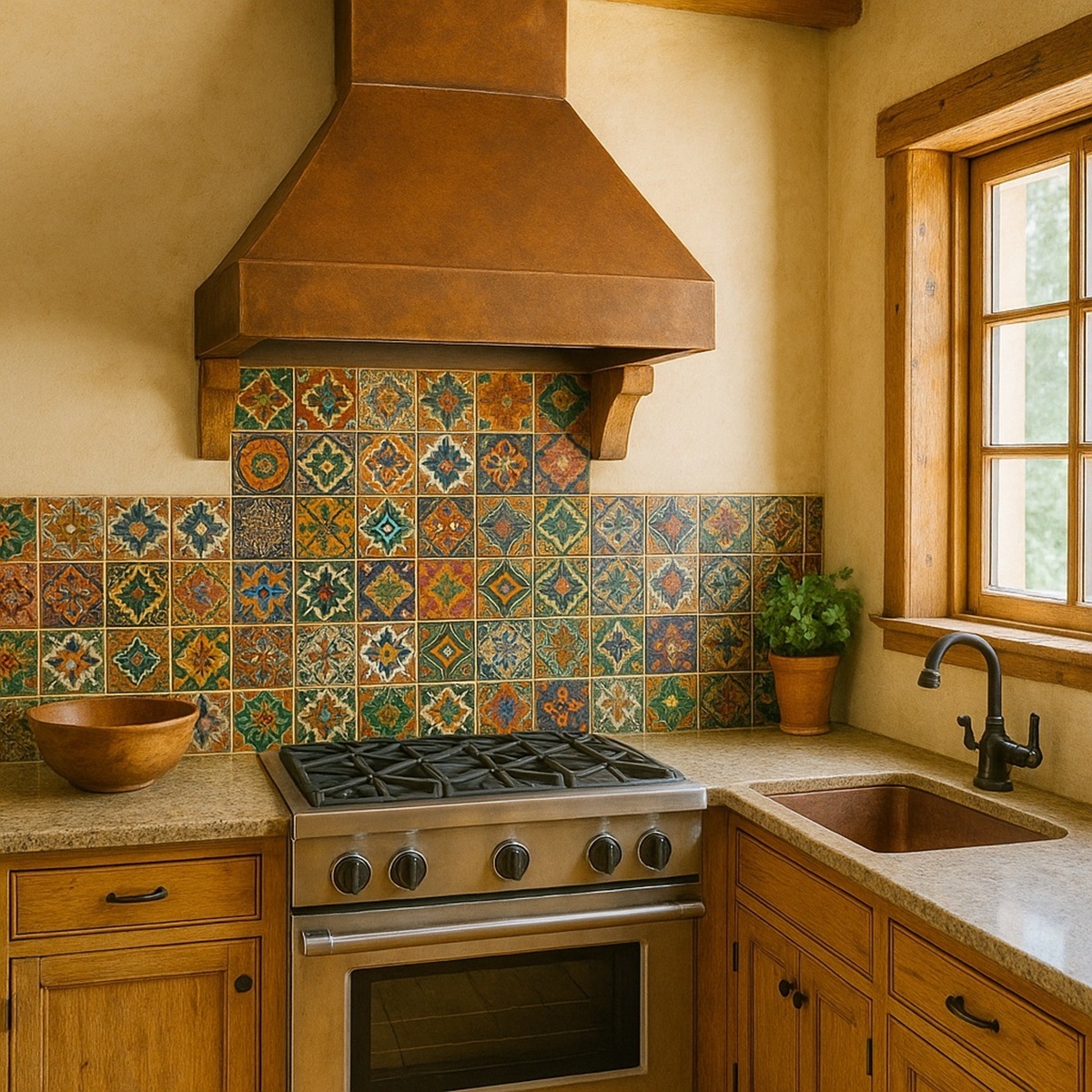
A Mexican tiles for a kitchen backsplash can transform a practical kitchen wall into a colorful architectural feature using hand-painted ceramic patterns, solid colors, decorative borders, and tile murals. Instead of relying on a single repeating design, homeowners can combine patterned Talavera tiles with quieter field colors, use a mural behind the range, or frame a focal section with coordinated ceramic trim. The handcrafted character is especially suitable for kitchens featuring natural wood, plaster, stone, copper, wrought iron, or painted cabinetry. Because backsplash areas include outlets, corners, cabinets, counters, and exposed edges, successful layouts require more than selecting an attractive pattern. Tile dimensions, color balance, focal-point placement, grout joints, trims, and installation boundaries should be considered together. This guide explains how to plan a Mexican backsplash that uses Talavera color and artisan variation without making the kitchen visually overwhelming. Plan the complete backsplash before ordering your tile combination.
Blog Summary
- Material: Hand-painted ceramic
- Style: Mexican and Talavera
- Location: Kitchen backsplash walls
- Patterns: Floral and geometric designs
- Colors: Bold or restrained palettes
- Murals: Decorative focal areas
- Trims: Finish edges and corners
- Variation: Expected in handmade tile
Why Choose Mexican Tile?
White and neutral backsplashes remain practical choices, but they are not the only way to create a kitchen that works with surrounding cabinetry and countertops. Mexican ceramic tile introduces pattern, color, and visible handmade character into an area that might otherwise remain a simple background surface.
A backsplash is particularly suitable for decorative ceramic because it occupies a vertical area that is easily visible without covering the entire kitchen. Patterned tile can therefore become an accent while cabinetry, flooring, and countertops provide quieter visual surfaces.
Hand-painted Mexican ceramic tiles also allow considerable variation in the intensity of the design. A project can use numerous patterns and colors or rely on a limited palette with only occasional decorative accents.
Planning the Backsplash
Before choosing individual patterns, establish the physical boundaries of the backsplash. Measure the wall between the countertop and upper cabinets, the area behind the range, spaces around windows, and any sections extending beyond cabinetry.
Outlets, switches, shelves, range clearances, window trim, and other interruptions should be included in the layout. These details affect where patterns begin and end and can determine whether a decorative motif remains centered after cuts are made.
A measured drawing can help establish where field tile, murals, borders, and trim pieces will appear. This is particularly useful when combining several types of handmade ceramic rather than covering the entire surface with one repeating tile.
Choosing a Focal Point
The area behind the range is often the most visually prominent section of a kitchen backsplash. It provides an opportunity to use a stronger pattern, framed panel, or ceramic mural while allowing surrounding walls to remain simpler.
A focal area does not need to fill the entire cooking wall. A carefully sized composition centered on the range can provide enough color and detail without competing with cabinetry, countertops, lighting, or a decorative range hood.
Where the kitchen already contains several dominant materials, a smaller decorative panel can be more effective than extending complex patterns across every available wall.
Mexican Tile Murals
A ceramic mural creates a picture-like composition rather than a repeating field. Depending on the design, it can become the visual center of the backsplash behind a range, sink, or other selected area.
Murals should be planned according to the available wall proportions. A horizontal composition works differently from a tall vertical design, and the surrounding field tile should leave enough visual space for the central image to remain distinct.
A border can help separate the mural from surrounding tiles and make the composition appear intentionally framed rather than simply inserted into the field.
Patterned Talavera Tiles
Patterned Talavera tiles can be used across the complete backsplash or concentrated within selected sections. Floral, geometric, and other decorative motifs create very different visual rhythms depending on whether the same pattern repeats or several designs are mixed.
Using one repeated pattern creates a more consistent field. Combining multiple patterns produces a livelier patchwork effect that can work particularly well in rustic, Southwestern, Spanish, and eclectic kitchens.
Buyers who prefer a more restrained installation can select hand-painted Talavera tiles with limited color palettes and repeat them consistently throughout the backsplash.
Solid Color Tiles
Solid-colored ceramic can balance highly patterned Talavera designs. Instead of filling the entire wall with decorative motifs, homeowners can use a quieter field color and introduce patterned pieces at intervals or within a defined focal section.
Mexican white is useful when the kitchen needs a light background while still retaining handmade ceramic character. Cobalt, light blue, green, yellow, brown, and terra cotta can create stronger fields or repeat colors already present in patterned tiles.
A solid field also gives decorative borders, murals, and relief tiles more visual importance because those elements do not need to compete with an equally detailed background.
Combining Tile Patterns
A successful mixed-pattern backsplash usually benefits from a shared visual element. Different designs may repeat the same cobalt blue, yellow, green, terra cotta, or another recurring color even when their motifs are unrelated.
Another approach is to repeat the same tile periodically among simpler pieces. This establishes a rhythm without requiring every tile to be decorative.
When several complex patterns are used together, arranging the tiles on a flat surface before installation helps identify unwanted clusters and creates a more balanced distribution of colors and motifs.
Using Limited Colors
A Mexican backsplash does not need a large number of vivid colors. Two-color and limited-palette designs can preserve the handmade character of Talavera while creating a quieter appearance.
Blue and white combinations can work with painted cabinetry and natural wood, while earthy brown and terra-cotta tones can complement stone and warm timber. Green or yellow accents can be introduced selectively rather than repeated across every tile.
The number of colors should respond to the entire room. A kitchen with strongly patterned countertops or flooring may benefit from a more controlled backsplash palette.
Decorative Borders
Border tiles can establish a horizontal line, separate two fields, or frame a decorative backsplash section. They are particularly useful when a mural or patterned panel needs a clear boundary from surrounding solid-colored tile.
The border can repeat a color from the central design without duplicating its exact pattern. This helps connect the components while allowing the focal area to remain visually distinct.
Border placement should be established before installation so that outlets, cabinet bottoms, and other wall elements do not interrupt the intended line unnecessarily.
Tile Trims and Edges
Backsplashes frequently end at cabinet edges, doorways, windows, or open wall areas. Leaving a standard field-tile edge exposed can make an otherwise carefully planned installation appear incomplete.
Bullnose, quarter-round, V-cup, cornice, and other profiles can address different edge and corner conditions. The appropriate trim depends on whether the project needs to finish a flat wall edge, wrap an outside corner, or add a decorative molding.
The Mexican tile trims guide explains how these profiles can be incorporated into backsplash layouts.
Relief Tile Accents
Relief tiles add physical depth as well as color. Raised motifs create highlights and shadows that change with kitchen lighting, making them useful as isolated accents or decorative horizontal lines.
Because relief pieces project farther than flat field tile, their location should be considered carefully around outlets, cabinetry, shelves, and other nearby surfaces. They work best where the dimensional pattern has enough space to remain visible.
Combining relief accents with flatter ceramic can add texture without requiring the entire backsplash to become highly dimensional.
Behind a Copper Hood
Mexican ceramic and copper can work particularly well together because both materials provide warm color and visible surface variation. A decorative tile field can form the background while the metal hood establishes a larger architectural focal point.
Balance is important when both elements are expressive. A highly ornamented copper hood may work better with a controlled tile pattern, while a simpler hood can accommodate a more complex backsplash or framed mural.
Repeating one of the warmer tile colors near the copper tones can help connect the two materials without requiring an exact color match.
Spanish Style Kitchens
Spanish-inspired kitchens can combine patterned ceramic with plaster, dark wood, forged iron, stone, and copper. The backsplash may use repeating Talavera patterns, a framed mural, or a mixture of decorative and solid-color pieces.
Arched architectural details and substantial cabinetry can support stronger patterns, but the backsplash should still be coordinated with the range hood and countertops. Too many unrelated decorative elements can compete for attention.
Southwestern Kitchens
Southwestern interiors provide another natural setting for colorful Mexican ceramic. Terra-cotta flooring, warm plaster, natural wood, and textured metal can complement blues, yellows, greens, and earthy tile colors.
Mixed-pattern backsplashes can work particularly well in this setting because variation reinforces the handcrafted character of the room. A quieter field with a colorful range backsplash is another option when a full patchwork installation would be too visually active.
Rustic Kitchens
Rustic kitchens often rely on visible texture rather than precise uniformity. Handmade tile complements timber, stone, plaster, hammered metal, and other materials that naturally display variation.
A backsplash can use traditional patterns or remain relatively simple with solid-color handmade ceramic. In either case, minor irregularities in tile dimensions and glaze become part of the material character rather than something that needs to be concealed completely.
Transitional Kitchens
Mexican tile can also work in transitional interiors when pattern and color are controlled. A limited palette, repeated geometric design, or framed decorative section can introduce artisan character while maintaining the cleaner organization associated with transitional kitchens.
Neutral cabinetry and countertops can provide enough visual space for the tile to become the principal decorative surface. Using one dominant pattern rather than many unrelated motifs can make the combination easier to integrate.
Handmade Tile Variation
Hand-painted Mexican ceramic should not be expected to reproduce the uniformity of machine-made rectified tile. Slight variations in dimensions, glaze thickness, color intensity, brushwork, edges, and surface character are natural features of handcrafted production.
These differences become especially noticeable when solid-colored pieces are installed side by side. Rather than attempting to group identical tones together, installers can distribute variations across the backsplash for a more balanced appearance.
Dry laying patterned pieces before installation also allows the homeowner or installer to control the distribution of colors and motifs.
Grout and Layout
Grout affects the final appearance of a Mexican tile backsplash because handmade tile edges may not form perfectly uniform joints. Slightly flexible joint spacing can help accommodate dimensional differences while maintaining an orderly overall layout.
Grout color can either emphasize individual tiles or create a quieter field. Strong contrast makes each tile boundary more visible, while a closer color relationship can allow the painted patterns to dominate.
The installer should determine appropriate joint width, setting material, grout, substrate preparation, and sealing requirements according to the tile and installation conditions.
Planning Cuts and Outlets
Electrical outlets and switches can interrupt decorative patterns. Establishing their locations on the layout before installation helps prevent important motifs from being divided by unnecessary cuts.
Where possible, complex focal patterns can be positioned in areas with fewer interruptions, while simpler field tiles surround outlets and other wall penetrations.
Window edges, cabinet terminations, corners, and range openings should receive the same attention. A well-planned layout can reduce narrow tile slivers and awkward transitions.
Calculating Tile Quantity
Measure the backsplash surface carefully and calculate field tile separately from borders, trims, murals, and corner pieces. Decorative components may be sold by piece or according to linear coverage rather than by square footage.
Additional material should be considered for cuts, layout adjustments, handmade variation, and possible future replacement. Ordering all coordinated pieces together can also help simplify installation planning.
For murals, calculate the finished mural dimensions independently and subtract that area from the surrounding field-tile calculation where appropriate.
Buyer Planning Table
| Planning | What to Confirm |
|---|---|
| Area | Total backsplash dimensions |
| Focal point | Range, sink, or central wall |
| Field tile | Patterned or solid ceramic |
| Murals | Finished size and placement |
| Borders | Pattern and linear footage |
| Trims | Edges and corner profiles |
| Obstacles | Outlets, windows, and cabinets |
| Variation | Handmade color and sizing |
Installation Planning
The complete backsplash should be planned before tile setting begins. Establish reference lines, focal-point centers, mural dimensions, border positions, finished edges, and corner treatments so the installer knows how all components relate to one another.
Dry fitting is particularly useful with handmade Mexican tile. It allows dimensional and color variation to be distributed naturally and gives the installer an opportunity to reposition patterns before adhesive is applied.
Substrate preparation, setting materials, grout, waterproofing where applicable, and other installation details should be selected according to project conditions. Professional installation is useful for complex layouts containing murals, multiple borders, relief pieces, numerous outlets, or specialty trim profiles.
Design Perspective
A successful Mexican backsplash does not depend on using the greatest possible number of colors and patterns. The strongest layouts usually establish a hierarchy: one primary focal area, a supporting field, and carefully chosen borders or trims.
When the mural is the focal point, surrounding tiles can remain quieter. When patterned Talavera covers the complete wall, solid-colored trims can provide a calmer perimeter. If the kitchen includes an elaborate range hood, highly figured stone, or ornate cabinetry, reducing the number of competing tile motifs can improve balance.
The goal is to make handcrafted ceramic part of the architecture of the kitchen rather than treating each decorative tile as an isolated accent.
FAQ - Mexican Tile Backsplash
A: Hand-painted patterns, strong color options, handmade variation, decorative borders, relief pieces, murals, and coordinating trims allow the backsplash to become a customized architectural feature.
A: No. Solid-color or limited-palette field tiles can be combined with patterned accents, borders, or a mural to create a more restrained installation.
A: The wall behind the range is a common focal location, but murals can also be used above sinks or within other uninterrupted backsplash areas when the proportions suit the composition.
A: Yes. Mixed patterns work best when they share recurring colors or are arranged deliberately so that similar motifs and strong colors are distributed across the backsplash.
A: Yes. Limited colors, repeated geometric patterns, simple field tiles, and restrained borders can introduce handcrafted character without creating an overly traditional appearance.
A: Appropriate bullnose, quarter-round, V-cup, molding, or other ceramic trim can finish exposed edges and corners depending on the geometry of the installation.
A: No. Differences in dimensions, glaze, color intensity, brushwork, edges, and surface character are expected features of handmade and hand-painted ceramic tile.
A: Yes. Dry laying helps distribute color and dimensional variation, balance mixed patterns, position focal designs, and identify cuts before the tiles are permanently installed.
A: Include outlets and switches in the layout before installation so important motifs can be positioned away from disruptive cuts whenever the wall configuration permits.
A: Planning both together is recommended because trim dimensions, profiles, colors, corners, and linear quantities affect where the field tile terminates and how the finished backsplash is organized.
Create Your Mexican Backsplash
A Mexican tile backsplash can range from a restrained field of handmade ceramic with a few patterned accents to a richly detailed composition incorporating Talavera motifs, decorative borders, relief pieces, trims, and a central mural. The best approach depends on the cabinetry, countertops, range hood, lighting, flooring, and other materials already present in the kitchen.
Plan the entire wall before ordering: establish the focal area, select the field tile, determine the color palette, measure borders and exposed edges, account for outlets and corners, and decide where specialty trim is required. Allow the natural variations of handcrafted ceramic to become part of the finished composition rather than expecting machine-made uniformity. Explore Mexican tile backsplash designs for handcrafted ceramic options that can be combined into a personalized kitchen installation.