 US Dollar
 Euro
Euro
 Australian Dollar
 Canadian Dollar
 Polish Zloty
 British Pound


Mexican Relief Tile Black Orange Star: High-Relief Craftsmanship and Bold Cultural Design
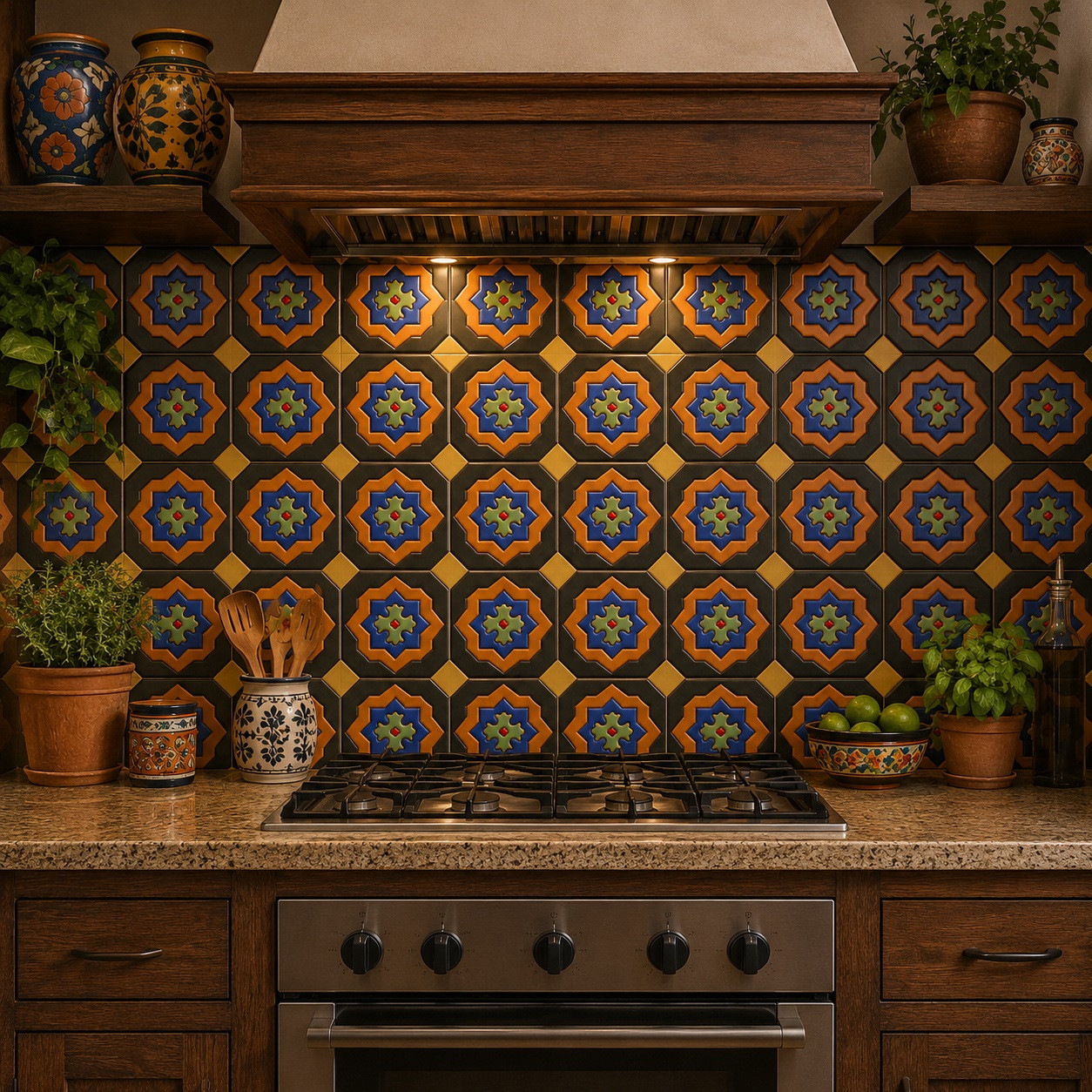
The Mexican Relief Tile Black Orange Star combines dramatic color, radial geometry, and sculptural ceramic depth in a handcrafted design inspired by Mexican, Spanish Colonial, and Moorish decorative traditions. At the center, an olive-green quatrefoil surrounds a vivid red diamond, while eight cobalt-blue points form a strong star against a deep black background. A stepped burnt-orange border adds architectural rhythm and frames the entire composition. Produced by artisans in Dolores Hidalgo, Mexico, the raised outlines and individually applied glazes create shifting shadows that make the pattern appear different throughout the day. Whether installed as a kitchen backsplash, bathroom accent, stair-riser detail, fireplace surround, or covered patio feature, the Mexican Relief Tile Black Orange Star introduces color, texture, and unmistakable artisan character.
Blog Summary
- Pattern: Eight-point geometric star
- Colors: Black, orange, blue, green
- Surface: Sculpted high relief
- Size: Approximately 4 × 4 inches
- Origin: Handmade in Mexico
A High-Impact Geometric Composition
The tile is organized around a centered radial design. Eight cobalt points extend outward from the middle, creating a star that feels energetic, balanced, and immediately recognizable.
Its symmetry allows several tiles to connect into larger uninterrupted fields with a strong architectural rhythm.
Central Quatrefoil and Red Diamond
An olive-green quatrefoil softens the sharp geometry of the star and creates a rounded botanical form at the center. Inside it, a red diamond acts as the visual heart of the pattern.
This layering of curved and angular shapes gives the tile both movement and stability.
Stepped Burnt-Orange Border
The burnt-orange border follows a stepped path around the outer star, reinforcing the geometry and framing the darker background. Its warm terracotta tone connects the tile naturally with clay floors, wood, copper, and stone.
The border also helps neighboring tiles align into a continuous pattern.
Pattern Structure
- Center: Red diamond focal point
- Inner Form: Olive-green quatrefoil
- Star: Eight cobalt-blue points
- Border: Stepped burnt-orange frame
- Background: Deep black contrast
Why the Black Background Matters
The deep black field creates strong negative space around the brighter colors. It sharpens the cobalt, orange, green, and red sections while emphasizing every raised contour.
Black also gives the tile enough visual weight to work in kitchens and bathrooms containing dark hardware, iron fixtures, or contemporary cabinetry.
Warm and Cool Color Balance
Cobalt and olive introduce cooler tones, while burnt orange and red bring warmth. The black ground balances both sides of the palette and prevents the design from appearing overly bright.
This combination allows the tile to coordinate with earthy traditional materials or clean modern finishes.
Color Roles
- Black: Creates depth and contrast
- Orange: Adds warmth and structure
- Blue: Defines the radiating star
- Green: Softens the central geometry
- Red: Establishes the focal center
Mexican, Moorish, and Spanish Colonial Influence
The design reflects a long exchange between geometric traditions. Eight-pointed stars and radial symmetry appear throughout Moorish tilework, while stepped borders and symbolic central forms connect naturally with Mexican decorative language.
Spanish Colonial artisans combined these sources with local clay, pigments, and handcrafting traditions to create distinct regional ceramics.
Moorish Geometric Heritage
Islamic and Andalusian decorative arts frequently use interlocking stars, repeating polygons, and mathematically balanced layouts. These forms entered Spanish architecture and later influenced Colonial tile design in the Americas.
The eight-point star remains especially effective because it repeats cleanly across square tile formats.
Mexican Adaptation
Mexican artisans introduced warmer earth colors, regional symbolism, and stronger hand-painted variation. The Black Orange Star tile reflects this adaptation by combining cobalt geometry with terracotta, olive, red, and deep black.
The result feels historic without reproducing a single European tradition literally.
Cultural Influences
- Moorish: Radial star geometry
- Spanish: Glazed ceramic tradition
- Mexican: Earth colors and symbolism
- Colonial: Cross-cultural ornament
- Artisan: Handmade regional interpretation
Stepped Motifs in Mexican Design
Stepped patterns appear in pre-Hispanic architecture, stone carving, textiles, and later ceramic decoration. Their repeated angular movement can evoke terraces, pyramids, pathways, or layered architectural borders.
In this tile, the burnt-orange step pattern gives the design a strong Mexican visual identity while organizing the outer edge.
Symbolism of the Four-Lobed Center
The central quatrefoil may be interpreted as a balanced four-direction form. Its curved lobes contrast with the pointed star and give the middle of the tile a calmer, more organic appearance.
The red diamond creates an additional axis that strengthens the sense of radial order.
Handcrafted in Dolores Hidalgo
Dolores Hidalgo, in the Mexican state of Guanajuato, is known for colorful ceramic production. Local artisans create tiles, sinks, vessels, plates, and architectural pieces using clay-forming, glazing, painting, and kiln-firing methods.
Each tile passes through several manual stages before the final pattern and relief become visible.
Forming the Ceramic Body
Refined clay is pressed into a mold that establishes the square format and raised pattern. The tile is then dried gradually so moisture can escape before firing.
Because the process is handmade, small differences in thickness, edges, and relief depth may occur.
Creating the Raised Design
The raised lines separate the colored areas and make the geometry physically visible. These contours create small ridges and recessed compartments across the tile surface.
Once glazed, every border catches light differently and strengthens the sculptural effect.
Production Stages
- Clay Preparation: Forms the ceramic body
- Molding: Creates the raised pattern
- Drying: Prepares tile for firing
- Glazing: Adds separate colors
- Firing: Develops final finish
Cuerda Seca–Inspired Color Separation
The pattern uses dark resist-like outlines to prevent neighboring glazes from flowing together. Each compartment receives its own color, allowing the star, border, quatrefoil, and center to remain crisp.
This method creates the clear graphic divisions associated with many traditional relief tiles.
Layered Glaze Application
Artisans place the cobalt, orange, green, red, and black glazes into individual sections. Pigment thickness and kiln conditions may cause subtle tonal differences between pieces.
These small variations help distinguish handmade ceramic from mechanically printed tile.
Kiln-Fired Color
During firing, the glaze develops its final color and glossy surface. Heat also bonds the decorative coating to the clay body.
Because every kiln load behaves slightly differently, exact color repetition cannot be guaranteed.
Glaze Characteristics
- Separation: Distinct colored compartments
- Surface: Glossy ceramic finish
- Variation: Slight tonal differences
- Depth: Glaze fills recessed areas
- Outline: Raised dark borders
How High Relief Changes the Tile
High-relief ceramic does more than add pattern. It changes the way light moves across the surface, creating highlights on raised edges and shadows inside recessed areas.
The design becomes more dimensional than ordinary flat printed or painted tile.
Light and Shadow
Under-cabinet lights, vanity sconces, sunlight, and directional fixtures reveal different aspects of the raised pattern. As the viewing angle changes, some sections appear brighter while others recede.
This interaction gives the wall a changing appearance throughout the day.
Tactile Character
The tile has a visibly sculpted surface that can be appreciated from a distance and up close. The raised lines reinforce the handmade quality and invite closer inspection.
Relief depth should be considered when choosing grout, trim, and adjoining materials.
Relief Benefits
- Dimension: Raised ceramic contours
- Shadow: Strong directional depth
- Texture: Visible artisan surface
- Movement: Changes with lighting
- Impact: Strong architectural presence
Four-Tile Pattern Expansion
When four tiles are joined, the stepped borders and star points interact to create a larger composite motif. The individual squares remain visible, but the repeated geometry produces a broader visual field.
This modularity allows small tiles to create a strong large-scale pattern.
Full-Wall Pattern Fields
Across a larger backsplash or wall, the repeated stars form a rhythmic geometric surface. The black background provides continuity, while the orange, blue, green, and red areas create measured bursts of color.
Careful alignment is important so the stepped borders connect correctly.
Accent Panels
A smaller grouping of four, nine, or sixteen tiles can become a framed focal panel behind a stove, vanity, fireplace, or niche. Solid-color tile or neutral stone can surround the relief design.
This approach delivers strong impact without covering the complete room.
Layout Options
- Single Tile: Small decorative accent
- 2 × 2 Grid: Compact focal panel
- 3 × 3 Grid: Larger star composition
- Full Field: Continuous repeating pattern
- Bordered Panel: Framed architectural feature
Kitchen Backsplash Applications
The Black Orange Star tile can transform a kitchen backsplash into a strong focal surface. Its palette works with wood, white, black, green, terracotta, copper, brass, iron, and neutral stone.
The raised ceramic also provides more texture than a standard flat backsplash.
Behind the Range
A centered tile panel behind the range creates an architectural anchor on the cooking wall. A 2-by-2 or 3-by-3 arrangement can emphasize the star geometry without overwhelming surrounding cabinets.
Frame the panel with solid ceramic, stone, or a simple trim tile for a finished composition.
Behind the Sink
The tile can also be used behind a kitchen sink where its dark background hides minor visual residue more effectively than a very pale pattern. Regular cleaning remains necessary around the faucet and splash zone.
Pair it with a copper, fireclay, stone, or dark metal sink for a coordinated design.
Kitchen Applications
- Range Panel: Main cooking-wall focal point
- Backsplash: Repeating geometric surface
- Sink Wall: Decorative splash protection
- Open Shelving: Textured ceramic backdrop
- Kitchen Bar: Bold vertical accent
Pairing with Wood Cabinets
Oak and walnut connect naturally with the burnt-orange and olive tones. Dark-stained wood reinforces the black background, while lighter timber allows the tile colors to stand out more clearly.
The tile works especially well in rustic, Spanish Revival, Hacienda, and transitional kitchens.
Pairing with White Cabinets
White cabinetry provides strong contrast and keeps the room bright around the darker tile. The backsplash becomes the primary decorative element without making the complete kitchen feel heavy.
Warm white and cream tones coordinate particularly well with burnt orange and red.
Pairing with Black Cabinets
Black cabinetry can merge visually with the tile background, allowing the colored star and border to appear almost suspended across the wall.
Use sufficient natural or artificial light so the overall design does not become too dark.
Cabinet Pairings
- White: Bright graphic contrast
- Oak: Warm natural coordination
- Walnut: Rich Old World depth
- Black: Dramatic unified background
- Green: Connects central quatrefoil
Pairing with Copper Range Hoods
Copper echoes the burnt orange and red sections while adding a reflective metallic surface above the relief tile. Natural, antique, honey, and coffee patinas all coordinate with the warm ceramic palette.
A simple hood shape generally works best when the backsplash pattern is already highly detailed.
Pairing with Iron Details
Black iron straps, hardware, lighting, and mirror frames repeat the tile’s dark outlines and background. This creates a cohesive Spanish Colonial or Hacienda material scheme.
Iron also balances the brighter cobalt and orange sections.
Pairing with Brass
Antique or unlacquered brass introduces a softer golden metal that relates to the warm border without matching it exactly. Brass faucets, cabinet pulls, and lighting can add refinement.
Metal Pairings
- Copper: Repeats warm ceramic tones
- Iron: Echoes black outlines
- Brass: Adds golden warmth
- Bronze: Supports traditional interiors
- Stainless Steel: Creates modern contrast
Bathroom Accent Walls
The tile can create a strong vertical or horizontal accent behind a vanity, around a mirror, or across a selected bathroom wall. Its dramatic palette works especially well against white, cream, or neutral surrounding surfaces.
Wet-area installation requires proper waterproofing beneath the ceramic.
Shower Niches
A shower niche provides a compact location where the relief pattern can be appreciated without covering the full enclosure. The raised contours create depth inside the recessed space.
Regular cleaning is important because soap and minerals may collect around the relief.
Vanity Backsplashes
A short backsplash or full-height vanity wall can frame a copper, Talavera, stone, or white ceramic sink. Black-framed mirrors and simple fixtures help connect the tile to the rest of the room.
Center the pattern carefully behind the sink and faucet.
Bathroom Applications
- Vanity Wall: Bold geometric backdrop
- Shower Niche: Compact relief accent
- Feature Strip: Horizontal decorative band
- Mirror Border: Sculptural ceramic frame
- Powder Room: Strong statement surface
Fireplace Surrounds
The tile can frame a fireplace opening or create a decorative central panel on the fireplace face. Its black background connects easily with dark fireboxes and iron screens.
Burnt orange and red also reinforce the visual warmth associated with fire.
Stair-Riser Applications
Relief tiles may be used on vertical stair risers where they remain protected from direct foot traffic. Repeating the same star creates a consistent rhythm, while mixing related patterns produces a more eclectic staircase.
Measure every riser individually before ordering.
Entryway Accent Panels
A framed wall panel near an entry can introduce Mexican or Spanish Colonial character immediately. The tile works well beside carved wood doors, iron lighting, plaster, and stone flooring.
Relief wall applications are generally more practical than using this dimensional tile directly underfoot.
Architectural Applications
- Fireplace: Decorative heat-area surround
- Stair Risers: Vertical pattern sequence
- Entry Wall: Strong arrival focal point
- Niche: Framed sculptural accent
- Column Detail: Limited ceramic ornament
Covered Patio Applications
In covered outdoor areas, the tile can decorate outdoor kitchens, wall panels, bar backs, planter surrounds, and protected stair risers. Natural light intensifies the cobalt, orange, green, and red glazes.
Exterior use depends on climate, moisture exposure, freeze-thaw conditions, substrate preparation, and installation materials.
Outdoor Kitchens
A backsplash behind a sheltered grill or sink can bring indoor craftsmanship into an outdoor entertaining area. Stone counters, stucco walls, wrought iron, and wood furnishings coordinate naturally with the tile.
The tile should remain protected from severe weather and direct impact.
Patio Bars
A bar front or backsplash panel can create a memorable feature in a covered patio. The geometric pattern works especially well beside black iron stools and terracotta planters.
Use lighting that grazes the tile surface to emphasize the relief after sunset.
Outdoor Pairings
- Stucco: Soft neutral frame
- Stone: Natural architectural base
- Iron Furniture: Repeats black detail
- Terracotta: Echoes burnt orange
- Greenery: Connects olive accents
Spanish Revival Interiors
The star geometry, dark outlines, warm border, and sculpted surface fit naturally within Spanish Revival kitchens, bathrooms, fireplaces, and entries. Plaster walls, wood beams, copper, iron, and terracotta complete the material palette.
The tile can serve as either a focal point or a repeated architectural field.
Mexican Hacienda Interiors
Hacienda design embraces strong color, handmade surfaces, carved wood, metalwork, and ceramic ornament. The Black Orange Star tile reinforces this layered regional character without relying on floral imagery.
Its geometry creates a more architectural alternative to traditional painted Talavera patterns.
Mediterranean Interiors
Cobalt, burnt orange, olive green, black, and red also suit Mediterranean rooms containing limestone, warm plaster, wood beams, and aged brass.
Use the tile in one controlled area to keep the room balanced.
Traditional Style Pairings
- Spanish Revival: Geometric architectural detail
- Hacienda: Bold Mexican craftsmanship
- Mediterranean: Warm Old World palette
- Southwestern: Earth tones and geometry
- Rustic: Handmade textured surfaces
Transitional Interior Design
In transitional spaces, the tile can introduce color and heritage beside simple cabinetry, quartz, marble, and restrained fixtures. Limiting it to a backsplash panel or niche prevents the design from feeling overly traditional.
Black hardware and neutral surrounding tile create a clean connection.
Contemporary Applications
The tile’s bold geometry can work in modern kitchens and bathrooms when paired with flat cabinetry, concrete, glass, steel, and simple walls. The black background supports contemporary color schemes especially well.
A small panel becomes a sculptural artwork rather than a complete theme.
Industrial Interiors
Brick, concrete, black steel, copper, and open shelving can all support the tile’s strong colors and raised surface. The geometric star softens the harder industrial materials without reducing their visual strength.
Modern Design Strategies
- Limit Coverage: Use one focal zone
- Repeat Black: Coordinate hardware
- Keep Counters Simple: Avoid pattern conflict
- Add Directional Light: Reveal relief
- Use Neutral Walls: Preserve balance
Commercial and Hospitality Interiors
Restaurants, hotels, bars, cafés, and boutique properties can use the tile to create memorable walls, backsplashes, restroom accents, fireplace surrounds, and patio features.
The strong geometry provides a recognizable visual identity that photographs well and supports Mexican, Mediterranean, or artisan branding.
Restaurant Applications
A backsplash behind a bar or service area can become a visible decorative feature while protecting the wall. The black background coordinates easily with commercial metal fixtures and dark millwork.
Regular cleaning remains important in food-service spaces.
Boutique Hotel Design
Hotels may use the tile inside guest bathrooms, lobby niches, courtyard bars, or fireplace surrounds. Repeating the same design in selected locations creates continuity across the property.
Commercial Applications
- Restaurants: Distinctive backsplash feature
- Hotels: Artisan guest interiors
- Bars: Bold service-area backdrop
- Cafés: Colorful wall accents
- Retail: Memorable branded surfaces
Wall Use Is the Safest Application
High-relief tile is generally best used on vertical surfaces where raised ornament remains visible and protected. Backsplashes, walls, niches, stair risers, and fireplace faces are appropriate applications.
Do not assume the tile is suitable for flooring unless the specific product is rated for foot traffic.
Why Relief Tile Is Less Practical Underfoot
The raised surface may be uncomfortable to walk on, difficult to level, and more vulnerable to impact. It may also create cleaning and slip concerns depending on the location.
Vertical installation allows the design to retain its full sculptural character.
Understanding Handmade Variation
Handcrafted relief tiles may vary slightly in dimensions, glaze color, relief depth, edge shape, and pattern alignment. These differences are expected from individual production.
Mix tiles from several boxes before installation to distribute variation across the wall.
Expected Variations
- Color: Slight tonal differences
- Edges: Handmade irregularity
- Relief: Minor depth variation
- Dimensions: Small size differences
- Glaze: Natural surface movement
Choosing the Grout Joint
Handmade tile usually requires a more visible grout joint than rectified porcelain. The spacing gives the installer room to balance dimensional variation and align the larger pattern.
The exact width should be selected with a tile professional familiar with relief ceramic.
Choosing Grout Color
Dark grout can blend with the black background and create a continuous field. Light gray, cream, or warm neutral grout outlines each tile and emphasizes the handmade grid.
Test several colors before completing the installation.
Cleaning Grout from Relief
Grout must be removed carefully from recessed compartments and raised borders before it hardens. Relief surfaces require more detailed cleanup than flat tile.
An experienced installer should work in manageable sections.
Grout Considerations
- Dark Grout: Blends with background
- Light Grout: Emphasizes tile grid
- Wider Joints: Accommodate variation
- Cleanup: Protect recessed areas
- Testing: Confirm color in advance
Preparing the Installation Surface
The substrate must be clean, stable, level, and suitable for ceramic tile. Uneven walls may make relief patterns difficult to align.
Wet areas require a complete waterproofing system beneath the tile and grout.
Dry-Laying the Pattern
Arrange the tiles before installation to review star alignment, color distribution, grout spacing, edge cuts, and border placement. This is especially important when several tiles combine into a larger motif.
Center the most important pattern behind ranges, sinks, vanities, and architectural openings.
Cutting Relief Tile
Cutting should be minimized because partial stars and stepped borders may interrupt the design. When cuts are necessary, position them near corners, cabinets, trim, or adjoining surfaces.
Use appropriate ceramic tools and protect raised details from impact.
Installation Checklist
- Substrate: Stable and level
- Waterproofing: Required in wet areas
- Dry Layout: Confirm pattern alignment
- Spacing: Allow handmade variation
- Installer: Experienced with relief tile
Ordering the Correct Quantity
Measure the full installation area and include additional tile for cuts, breakage, pattern alignment, handmade variation, and future repairs.
Complex centered panels and bordered designs may require a larger allowance than simple full-field installations.
Keeping Replacement Tiles
Store several unused pieces after installation in case plumbing, electrical, or remodeling work later affects the wall. Future production may not match the original batch exactly.
Label the remaining tiles and protect them from impact.
Cleaning the Glazed Surface
Use mild soap, warm water, and a soft cloth or sponge for routine cleaning. A soft brush may help remove residue from recessed areas.
Avoid abrasive pads, strong acids, bleach, and aggressive cleaners that may dull the glaze or damage grout.
Cleaning Kitchen Grease
Remove grease regularly before it accumulates around raised borders. Gentle frequent cleaning is easier than removing heavy buildup from a sculpted surface.
Rinse the tile after cleaning and dry it with a soft cloth.
Cleaning Bathroom Mineral Deposits
Hard water may leave pale residue inside recessed areas. Wiping the surface after use can reduce buildup.
Do not use strong descaling acids unless they are confirmed safe for glazed ceramic.
Care Tips
- Clean: Mild soap and water
- Use: Soft cloth or brush
- Rinse: Remove cleaning residue
- Avoid: Abrasive acidic products
- Inspect: Maintain grout joints
Why This Tile Stands Apart
The Black Orange Star design combines a limited but dramatic palette, pronounced geometric order, and sculptural relief within a compact ceramic format. It creates greater architectural impact than a flat printed pattern.
Its cross-cultural visual language allows it to work in both historically inspired and contemporary interiors.
Supporting Mexican Artisan Workshops
Choosing handmade relief tile supports artisans who continue practicing clay preparation, molding, glaze application, pattern work, and kiln firing. Each piece reflects several stages of direct manual involvement.
The finished installation becomes both a practical surface and an expression of living Mexican craft tradition.
Ordering and Product Information
Before ordering, confirm the installation area, tile quantity, pattern layout, grout width, grout color, border treatment, trim, substrate, waterproofing, climate exposure, cleaning requirements, and installer experience.
Visit the Mexican Relief Tile Black Orange Star product page for ordering information, or contact Rustica House for help with quantity, layout, and project planning.
Conclusion
The Mexican Relief Tile Black Orange Star combines a deep black background, stepped burnt-orange frame, cobalt eight-point star, olive-green quatrefoil, red center, and pronounced high-relief contours in a handcrafted ceramic design rooted in Mexican, Spanish Colonial, and Moorish decorative traditions. Its modular pattern can form compact focal panels or broad repeating fields across kitchen backsplashes, bathroom walls, shower niches, stair risers, fireplaces, covered patios, restaurants, and hospitality interiors. With thoughtful layout planning, proper substrate preparation, suitable grout spacing, experienced installation, and gentle cleaning, this relief tile creates a lasting architectural surface filled with color, shadow, geometry, and Mexican artisan character.