 US Dollar
 Euro
Euro
 Australian Dollar
 Canadian Dollar
 Polish Zloty
 British Pound

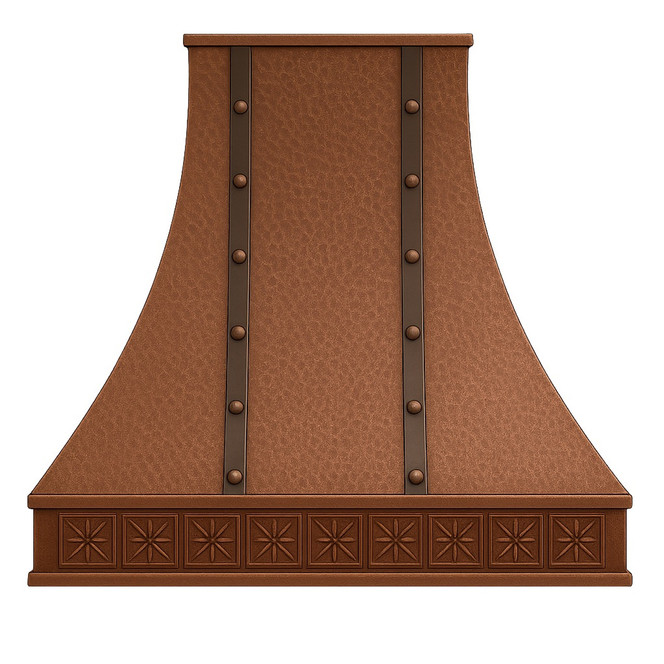
Hand-Hammered Copper Range Hood: Rustic Spanish Revival Craftsmanship
A hand-hammered copper range hood brings together functional kitchen ventilation, sculptural architecture, and the warmth of traditional Mexican metalwork. This made-to-order design draws strongly from Rustic Spanish Revival and Spanish Colonial interiors through its flared silhouette, dark iron straps, riveted detailing, embossed starflower apron, and rich fire-aged copper patina. Its tapered body widens gracefully toward the base, creating a strong focal point above the range without losing visual balance. Whether installed in a Hacienda kitchen, Mediterranean residence, rustic farmhouse, or transitional interior, this artisan copper hood introduces texture, Old World character, and custom craftsmanship while remaining compatible with a professionally selected ventilation insert.
Blog Summary
- Product: Hand-hammered copper hood
- Style: Rustic Spanish Revival
- Finish: Fire-aged copper patina
- Details: Iron straps and starflowers
- Craft: Made to order in Mexico

Rustic Spanish Revival Design
This copper hood is best categorized as Rustic Spanish Revival, a style known for combining substantial architectural forms with natural materials, handcrafted finishes, and details inspired by Spanish Colonial buildings.
The dark iron straps, rivets, warm copper, and embossed apron create a sense of age and permanence, while the controlled geometry keeps the hood suitable for contemporary renovations.
Spanish Colonial Influence
Spanish Colonial kitchens often use plaster walls, carved wood cabinetry, hand-painted tile, wrought iron lighting, terracotta flooring, and aged metalwork. This hood reflects that material language through copper and iron rather than relying on applied decoration alone.
Its silhouette recalls the broad, architectural cooking enclosures found in traditional Hacienda interiors while adapting the form for modern ventilation equipment.
Mediterranean Character
The curved sides and warm reddish-brown patina also connect the hood to Mediterranean and Tuscan interiors. Copper pairs naturally with stone, cream cabinetry, warm plaster, limestone, and wood beams.
The result is a design that feels historic and expressive without belonging exclusively to one regional decorating style.
Compatible Design Influences
- Spanish Revival: Architectural metal detail
- Spanish Colonial: Old World craftsmanship
- Hacienda: Warm Mexican character
- Mediterranean: Curved traditional form
- Industrial: Riveted iron accents
Flared and Tapered Silhouette
The hood narrows toward the crown and expands gradually toward the lower apron. This flared form creates visual movement while giving the base enough width to feel proportionate above the cooking area.
The silhouette is commanding without appearing excessively heavy because the curves soften the transition from the narrow upper section to the broad lower band.
Why the Flared Profile Works
A flared hood places greater visual weight near the range, where capture and ventilation are needed, while reducing bulk near the ceiling. This creates a natural architectural hierarchy from the crown down to the decorative apron.
The form also gives the hammered copper more surface area to display tonal variation and reflected light.
Balanced Curves
The side curves remain controlled rather than dramatically bell-shaped. This balance allows the hood to work in both heavily rustic rooms and cleaner transitional kitchens.
The profile looks especially effective when centered between upper cabinets or installed against a broad plaster or tile backsplash.
Silhouette Characteristics
- Upper Section: Narrow and tailored
- Body: Smooth tapered curve
- Lower Section: Broad architectural base
- Proportion: Balanced vertical movement
- Effect: Strong but refined presence
Random Hand-Hammered Texture
The copper surface is hammered manually rather than stamped with a repeating factory pattern. This produces irregular impressions that vary naturally in size, depth, and spacing.
The texture catches light differently across the curved body, making the hood appear warmer, darker, or more reflective depending on the room and time of day.
Why Hammering Adds Character
Hammering records the physical process used to shape and strengthen the copper. Each visible mark reflects the artisan’s hand and prevents the enclosure from appearing flat or mechanically produced.
The irregular texture also helps integrate small scratches and natural patina changes into the overall appearance.
Visual Movement Across the Surface
Natural daylight reveals reddish highlights and soft bronze tones, while evening lighting creates deeper shadows inside the hammer marks. The metal therefore changes visually without altering the architectural design.
This movement is one of the primary reasons hammered copper works so well as a kitchen focal point.
Hammered Surface Benefits
- Texture: Visible artisan character
- Reflection: Changing light and shadow
- Variation: Unique on every hood
- Depth: Richer than flat metal
- Aging: Integrates natural surface change
Warm Fire-Aged Copper Patina
The hood features a warm reddish-brown finish associated with fire-aged copper. This patina allows lighter copper tones to remain visible beneath deeper brown areas, particularly around hammer marks, edges, and joined sections.
The finish creates the appearance of aged architectural metal without covering the natural character of the copper.
Understanding Fire-Aged Copper
A fire-aged finish is developed by exposing and treating the copper surface rather than applying an opaque painted coating. The resulting color follows the natural movement of the metal.
Because the process is performed by hand, the final tone will vary from photographs, samples, and previously produced pieces.
Living Patina
Copper reacts naturally to air, moisture, heat, fingerprints, oils, cooking residue, and cleaning products. Its color may deepen, lighten, or develop additional variation over time.
This evolving appearance is part of the material’s character and should not be interpreted as failure of the finish.
Patina Characteristics
- Base Color: Reddish-brown copper
- Highlights: Warm natural undertones
- Variation: Hand-applied tonal movement
- Aging: Continues gradually
- Texture: Hammer marks remain visible
Dark Iron Straps
Vertical iron straps divide the copper body into structured sections and emphasize the height of the hood. Their dark finish creates a strong contrast against the warmer metal.
The straps also introduce the visual weight associated with forged gates, railings, doors, and architectural hardware found in Spanish Colonial buildings.
Symmetrical Strap Placement
The straps are positioned symmetrically so the hood maintains a balanced appearance. Their alignment guides the eye from the crown toward the decorated apron.
This vertical rhythm helps the broad hood feel taller and more refined.
Copper and Iron Contrast
Copper provides warmth and visual movement, while iron adds structure and definition. The combination creates a richer composition than using a single metal throughout the enclosure.
Black or dark iron straps can also connect the hood with nearby lighting, cabinet hardware, doors, stools, or window frames.
Strap Design Benefits
- Contrast: Dark iron over warm copper
- Height: Emphasizes vertical form
- Structure: Divides the broad surface
- Symmetry: Creates balanced rhythm
- Style: Reinforces Spanish Revival
Round Iron Rivets
Round rivets are placed along the vertical straps to reinforce the hand-forged appearance. Their repeated spacing adds texture and small areas of shadow without overwhelming the copper body.
The rivets visually connect the straps with the darker lower apron details.
Artisan-Industrial Undertones
Although the design is rooted in Spanish Revival architecture, the exposed rivets introduce a subtle industrial quality. They suggest traditional fabrication methods and visible construction rather than hidden mechanical assembly.
This detail allows the hood to work in rustic-industrial and transitional kitchens as well as historic interiors.
Rivet Scale and Proportion
The rivets should remain proportional to the width and height of the hood. Oversized hardware can make the enclosure feel heavy, while small rivets may disappear against the broad copper surface.
The existing design uses repeated round accents to create visual continuity without competing with the starflower apron.
Rivet Characteristics
- Shape: Round metal heads
- Placement: Along vertical straps
- Finish: Dark iron contrast
- Style: Forged and industrial
- Effect: Repeated handcrafted detail
Embossed Starflower Apron
The lower apron is decorated with a repeated starflower motif inspired by Southwestern, Mexican, and Spanish Colonial ornament. The pattern adds a recognizable decorative identity to the broadest part of the hood.
Because the apron sits closer to eye level, the embossed detail remains visible even when the hood is installed high above the range.
Meaning of the Starflower Pattern
Star and floral forms appear frequently in Mexican metalwork, tile, carved stone, textiles, and architectural decoration. Their radial geometry creates a balanced motif that feels both ornamental and structured.
The repeated design reinforces regional character without requiring a figurative scene or highly complex engraving.
Embossed Copper Detail
The pattern is formed into the apron rather than printed onto the surface. Raised and recessed areas create shadows that make the ornament visible from different viewing angles.
The fire-aged patina settles differently across the embossed design, creating lighter highlights and darker recesses.
Apron Features
- Motif: Repeated starflower pattern
- Method: Embossed copper detail
- Location: Broad lower band
- Influence: Mexican and Southwestern
- Effect: Strong decorative identity
Straight-Edged Crown
The upper crown uses clean, straight edges rather than ornate scrolling or layered molding. This tailored finish balances the decorative lower apron and keeps the silhouette visually controlled.
The crown provides a clear termination at the ceiling or upper chimney while reinforcing the vertical lines created by the iron straps.
Balancing Ornament and Geometry
The lower portion of the hood carries the strongest ornament through the starflower apron and riveted straps. The simple crown prevents the design from becoming overly elaborate from top to bottom.
This contrast allows the hood to work in transitional spaces where some traditional detail is desired without excessive decoration.
Crown Integration
The crown should coordinate with nearby cabinet molding, ceiling beams, and architectural trim. Its straight profile works well beside simple shaker cabinetry as well as heavier carved wood.
Custom height can be used to ensure the crown meets the ceiling or stops below it in the correct proportion.
Crown Characteristics
- Shape: Straight-edged profile
- Style: Clean architectural finish
- Balance: Offsets decorative apron
- Alignment: Supports vertical straps
- Use: Traditional or transitional rooms
Made-to-Order Construction
The hood is produced individually according to the selected dimensions, mounting style, finish, and ventilation requirements. Made-to-order fabrication allows the enclosure to respond to the actual kitchen rather than a fixed factory format.
Width, height, depth, insert preparation, strap placement, and other details should be confirmed before production begins.
Custom Width
The hood width should be planned in relation to the cooking appliance, burner arrangement, surrounding cabinets, insert, and desired visual scale. Some projects use a hood wider than the range to improve side coverage and architectural proportion.
A contractor or ventilation specialist should confirm the appropriate dimensions before ordering.
Custom Height
Ceiling height, mounting clearance, ductwork, cabinet arrangement, and the selected silhouette all influence the final hood height. A tall room may support an extended chimney, while lower ceilings require more compact proportions.
The iron straps and copper curves can be adjusted so the design remains balanced at the selected height.
Custom Depth
A depth of approximately 24 inches works for many residential installations, although deeper ranges and inserts may require 26 to 30 inches.
The enclosure should be sufficiently deep to contain the ventilation insert and provide appropriate capture over the cooking surface.
Customizable Dimensions
- Width: Based on cooking area
- Height: Coordinated with ceiling
- Depth: Adapted to range and insert
- Chimney: Sized for duct route
- Mounting: Wall or island construction
Wall-Mounted Configuration
A wall-mounted hood is finished across the front and sides, with the rear positioned against the wall. This configuration works naturally between cabinets or as a freestanding focal point on a plaster, stone, or tiled cooking wall.
The back remains open to accommodate mounting, ductwork, electrical service, and the selected insert.
Island Configuration
An island version is finished on all four sides because it remains visible from the kitchen, dining room, and surrounding circulation areas. The iron straps and apron pattern must continue in a balanced manner around the enclosure.
Island hoods also require structural ceiling support and carefully planned duct routing.
Choosing the Correct Mounting Style
The mounting type should be finalized before production because wall and island hoods differ in construction, support, and visible surfaces. A wall model cannot simply be converted into an island hood after fabrication.
The installer should confirm the structural and ventilation requirements for the selected configuration.
Mounting Options
- Wall Mount: Front and sides finished
- Island Mount: Four sides finished
- Ceiling Support: Required for island use
- Wall Support: Required for wall models
- Custom Layout: Planned before fabrication
Ventilation Insert Preparation
The copper enclosure serves as the decorative shell around a separate ventilation system. The insert contains the blower, filters, lights, and controls that determine actual performance.
The exact insert should be selected and documented before the hood is fabricated.
Buyer-Supplied Inserts
The hood can be made ready for a compatible buyer-supplied insert. Provide the manufacturer, model number, complete dimensions, duct location, liner requirements, and installation documentation.
Internal systems rated up to approximately 1,200 CFM may be accommodated when their dimensions are compatible with the hood.
External Blower Systems
An external blower places the motor on the roof or exterior wall rather than inside the kitchen enclosure. This may reduce some motor noise near the cooking area.
The hood may be prepared for an external blower rated up to approximately 1,500 CFM when full specifications are supplied before production.
Insert Information Needed
- Brand: Ventilation manufacturer
- Model: Exact product number
- Dimensions: Width, depth, and height
- Duct: Opening size and location
- Manual: Technical installation sheet
Ducted Ventilation
A ducted system captures cooking smoke, grease, steam, and odors and moves them outside through metal ductwork. This is generally the preferred configuration when a practical exterior route exists.
Duct diameter, elbows, total run, roof or wall termination, and local ventilation requirements should be reviewed by a professional.
Recirculating Ventilation
A recirculating insert filters the cooking air before returning it to the room. This option may be used where exterior ducting is unavailable.
The selected insert must support recirculation, and the copper enclosure may require side openings for filtered air discharge.
Performance Depends on the Insert
The copper hood itself does not determine airflow, noise, lighting, filter type, speed settings, or controls. These functions depend on the ventilation insert installed inside it.
The mechanical system should therefore be selected according to cooking habits, burner output, room volume, ductwork, and local requirements.
Ventilation Factors
- Blower: Determines airflow
- Filters: Capture grease
- Ductwork: Affects resistance
- Mounting Height: Influences capture
- Cooking Style: Determines demand
Farmhouse Kitchen Applications
In a farmhouse kitchen, the copper hood adds warmth above shaker cabinets, an apron-front sink, reclaimed beams, wood floors, and handmade tile. The iron straps provide enough contrast to connect with dark hardware and lighting.
The starflower apron introduces ornament without making the design overly formal.
Spanish Revival Kitchens
Spanish Revival kitchens provide the most natural setting for this design. Plaster walls, arched openings, Talavera tile, terracotta floors, carved wood, and iron lighting reinforce the hood’s historic character.
The flared silhouette works especially well beneath tall ceilings or broad cooking alcoves.
Hacienda-Style Kitchens
Hacienda interiors emphasize substantial forms, warm materials, artisan surfaces, and regional craftsmanship. A fire-aged copper hood with iron straps naturally becomes the centerpiece above the range.
Pair it with dark wood, stone, plaster, and colorful ceramic accents for a cohesive composition.
Traditional Pairings
- Talavera Tile: Colorful Mexican backdrop
- Dark Wood: Warm cabinetry
- Terracotta: Earthy flooring
- Iron Lighting: Repeats strap finish
- Plaster: Soft architectural walls
Mediterranean Kitchens
The flared profile and warm patina coordinate with limestone, cream cabinetry, arched niches, wood beams, and warm plaster. The starflower apron adds regional ornament without relying on overly elaborate scrollwork.
Natural stone counters and bronze fixtures can deepen the material palette.
Rustic-Industrial Kitchens
The exposed iron straps and rivets give the hood enough industrial character to work with brick, concrete, steel appliances, open shelving, and black-framed windows.
The copper prevents the room from feeling cold by adding warm color and hand-worked texture.
Transitional Kitchens
In a transitional setting, the hood can bridge clean cabinetry with traditional materials. White or gray shaker cabinets, simple stone, and restrained lighting allow the starflower apron and iron straps to provide controlled decoration.
The straight-edged crown keeps the design compatible with cleaner architectural lines.
Compatible Kitchen Styles
- Spanish Revival: Primary design influence
- Hacienda: Mexican artisan warmth
- Mediterranean: Curved traditional profile
- Farmhouse: Handcrafted material character
- Transitional: Balanced historic detail
Pairing with White Cabinets
White cabinetry creates strong contrast against the reddish-brown copper and dark iron. The hood becomes the dominant visual feature while the surrounding cabinets keep the room bright.
Warm white or cream tones generally coordinate more naturally than cool blue-white paint.
Pairing with Wood Cabinets
Walnut, cherry, oak, and darker stains reinforce the warmth of the copper. The hood should remain different enough in tone to avoid disappearing into the cabinetry.
Iron hardware can repeat the dark straps and create continuity across the room.
Pairing with Gray Cabinets
Gray cabinetry creates a more transitional relationship with the hood. Medium and charcoal grays emphasize the copper warmth, while light gray produces a softer contrast.
Stone or plaster backsplashes can help connect the materials without adding excessive pattern.
Cabinet Pairings
- White: Strong visual contrast
- Cream: Soft traditional warmth
- Walnut: Rich Old World character
- Oak: Relaxed natural balance
- Gray: Transitional coordination
Pairing with Talavera Tile
Talavera tile adds cobalt, yellow, terracotta, green, and white behind the hood. The colorful ceramic reinforces Mexican and Spanish Colonial character.
Because the apron already contains a repeated starflower motif, a simpler tile field may create better balance than an extremely complex backsplash.
Pairing with Stone
Limestone, travertine, fieldstone, and textured neutral stone provide an architectural background that supports the fire-aged patina. The stone should remain practical for cleaning in the cooking area.
Darker stone creates a dramatic traditional effect, while lighter stone allows the copper to stand out.
Pairing with Plaster
Plaster creates one of the quietest and most historically appropriate backgrounds for a Spanish Revival hood. Its soft variation complements the copper without competing with the embossed apron.
Warm white, cream, sand, and pale earth tones work especially well.
Backsplash Pairings
- Talavera: Colorful regional character
- Limestone: Soft natural texture
- Travertine: Warm architectural stone
- Plaster: Quiet traditional backdrop
- Brick: Rustic material depth
Mixed-Metal Kitchen Design
The hood already combines copper and dark iron, making it a natural foundation for mixed-metal interiors. Brass, bronze, stainless steel, and nickel may be added through faucets, appliances, lighting, and hardware.
Repeating each finish in more than one location helps the combination feel intentional.
Copper and Stainless Steel
A stainless-steel range can sit beneath the copper hood without appearing mismatched. The dark iron straps help bridge the warm hood and cooler appliance.
Stainless details may be repeated through sinks, small appliances, or cabinet hardware.
Brass and Copper
Brass introduces a brighter golden tone that complements the reddish copper. It works well for faucets, lighting, and cabinet pulls in traditional or transitional kitchens.
The metals should appear related rather than perfectly matched.
Professional Installation
A custom copper hood can be substantial in size and weight. The wall or ceiling must provide adequate structural support, and the installation team should coordinate the insert, ductwork, electrical service, mounting height, and appliance clearances.
Professional installation is strongly recommended.
Installation Checklist
- Support: Prepare wall or ceiling
- Insert: Confirm exact model
- Duct: Verify route and diameter
- Electrical: Plan power location
- Clearance: Follow appliance guidance
Protecting the Hood During Installation
The copper should remain covered during surrounding construction to protect it from dents, scratches, plaster, grout, adhesive, paint, and dust.
Installers should use clean gloves and padded handling surfaces.
Cleaning the Copper Surface
Use mild soap, warm water, and a soft cloth to remove dust and cooking residue. Wipe gently and dry the surface after cleaning.
Avoid abrasive pads, bleach, ammonia, acids, and aggressive copper cleaners that may damage or remove the fire-aged patina.
Polishing the Hood
Polishing is not recommended for preserving a dark fire-aged finish because it may remove the applied patina and reveal brighter copper beneath.
Gentle cleaning is generally preferable for maintaining the intended appearance.
Copper Care Tips
- Clean: Mild soap and water
- Use: Soft cloth
- Dry: Remove moisture gently
- Avoid: Harsh chemical cleaners
- Patina: Allow natural aging
Maintaining the Iron Details
The dark iron straps and rivets should be cleaned with a soft dry or lightly dampened cloth. Avoid leaving standing moisture around the rivets or where the iron meets the copper.
Do not use abrasive metal polish unless it is specifically approved for the selected iron finish.
Filter Maintenance
Grease filters should be cleaned or replaced according to the ventilation insert manufacturer’s instructions. Regular maintenance helps preserve airflow and reduces grease accumulation inside the enclosure.
The copper shell and mechanical insert may require different cleaning procedures.
Durability and Long-Term Character
Copper does not rust like untreated iron, although it naturally changes color. Fine scratches, darkening, and additional patina variation may develop through normal use.
With proper installation and gentle maintenance, the hood can remain a long-term architectural feature.
Free Shipping
Free shipping helps reduce the transportation cost associated with a large made-to-order metal hood. The exact destination, freight service, and delivery conditions should be reviewed before placing the order.
Delivery may be curbside, and the buyer may need to arrange suitable help or equipment for receiving the crate.
Crated Freight Delivery
The hood is packed in a protective crate to reduce the risk of damage during export and domestic freight transport. The crate may be considerably larger than the hood because of the protective materials.
Confirm truck access, gate width, driveway conditions, unloading requirements, and storage space in advance.
Inspecting the Shipment
Inspect the crate before signing the freight receipt. Any visible damage should be noted on the carrier paperwork and photographed immediately.
Retain all packaging until the hood has been unpacked and reviewed fully.
Delivery Checklist
- Access: Confirm freight truck route
- Unloading: Arrange appropriate help
- Crate: Inspect before signing
- Photos: Document visible damage
- Storage: Protect before installation
Understanding Handmade Expectations
Minor dimensional variation, irregular hammer marks, tonal differences, small forming marks, and subtle asymmetry are normal in handmade copper work. They are part of the artisan character of the hood.
These details should be distinguished from severe dents, punctures, structural deformation, or freight damage.
Why This Hood Stands Apart
Factory-made hoods rely on fixed dimensions, standardized finishes, and repetitive surfaces. This hand-hammered design combines custom fabrication, living copper, forged iron accents, and embossed decoration within one architectural enclosure.
Its Spanish Revival character makes it especially valuable for homeowners seeking a kitchen centerpiece with a clear sense of heritage and craftsmanship.
Ordering and Project Planning
Before ordering, confirm the hood width, height, depth, mounting style, patina, strap finish, apron design, ceiling height, range dimensions, duct route, electrical service, and exact ventilation insert.
Review all measurements and technical information with the contractor before production begins so the hood, cabinetry, ductwork, and mechanical insert work together correctly.
Conclusion
A hand-hammered copper range hood with a Rustic Spanish Revival design combines flared architectural form, random artisan hammering, dark iron straps, round rivets, an embossed starflower apron, and a warm fire-aged patina. Its straight-edged crown balances the decorative lower band, allowing the design to suit Spanish Colonial, Hacienda, Mediterranean, farmhouse, rustic-industrial, and transitional kitchens. With accurate custom dimensions, complete ventilation specifications, professional installation, careful freight inspection, and gentle maintenance, this made-to-order copper hood becomes a functional centerpiece that expresses heritage, craftsmanship, and lasting architectural character.