 US Dollar
 Euro
Euro
 Australian Dollar
 Canadian Dollar
 Polish Zloty
 British Pound

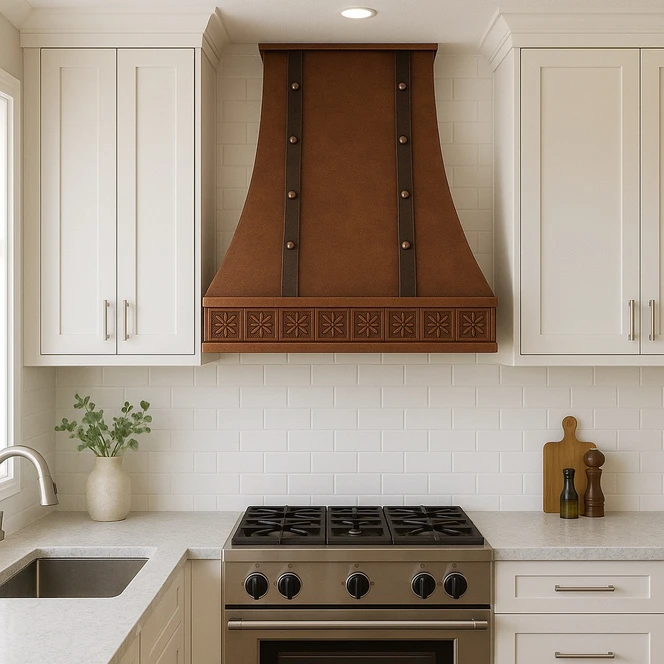
Hand-Hammered Copper Range Hoods: Artisan Craftsmanship and Custom Kitchen Ventilation
Hand-hammered copper range hoods combine functional kitchen ventilation with the warmth, texture, and architectural presence of traditional metalwork. Individually formed by skilled artisans, each hood displays subtle hammer marks and tonal variations that make it distinct from mass-produced appliances. The copper enclosure can be customized in width, height, depth, mounting style, patina, decorative details, and internal preparation for a compatible ventilation insert. Whether installed in a farmhouse, Spanish Colonial, Hacienda, transitional, industrial, or contemporary kitchen, a handmade copper hood becomes a lasting focal point while helping manage cooking smoke, steam, grease, heat, and odors.
Blog Summary
- Product: Hand-hammered copper hood
- Purpose: Decorative kitchen ventilation
- Mounting: Wall, island, or cabinet
- Options: Custom size and patina
- Craft: Handmade by artisans

More Than a Kitchen Appliance
A range hood performs the essential task of capturing airborne contaminants generated during cooking. The internal insert contains the blower, filters, lighting, and controls, while the copper shell provides the visible architectural form.
When the enclosure is handmade, the hood becomes more than mechanical equipment. It contributes material warmth, visual balance, and decorative identity to the cooking wall.
The Historical Appeal of Hammered Copper
Copper has been shaped into cookware, vessels, tools, architectural details, and decorative objects for centuries. Its malleability allowed artisans to form useful objects with hand tools long before modern manufacturing equipment existed.
Hammered copper preserves that relationship between material and maker. Every impression records part of the forming process while creating a surface that reflects light in varied directions.
Traditional Metalworking in Modern Kitchens
Contemporary kitchens often combine factory-made cabinetry and appliances with one handcrafted focal point. A copper hood introduces visible human craftsmanship without sacrificing modern ventilation planning.
The contrast between traditional hammering and contemporary architecture allows copper to work in interiors that range from historically inspired to highly minimalist.
Historic Material Qualities
- Malleable: Suitable for hand forming
- Durable: Long-lasting architectural metal
- Textured: Reflects artisan hammering
- Warm: Rich reddish-brown color
- Adaptable: Traditional or modern use
How Hammered Copper Is Created
The artisan begins with flat copper sheets measured according to the approved hood dimensions. Each section is cut, shaped, and joined to create the body, apron, chimney, crown, and any decorative elements.
Hammering is performed manually across the metal surface. The depth, spacing, and rhythm of the impressions vary naturally according to the artisan and selected texture.
Why Every Hood Looks Different
No two handmade copper hoods are identical. Surface tone, hammer marks, seams, rivets, and patina respond differently during fabrication and finishing.
These variations should be expected and are part of the visual character of genuine handmade metalwork rather than signs of defective production.
Handmade Characteristics
- Hammer Marks: Individual artisan pattern
- Patina Variation: Natural tonal differences
- Forming Marks: Evidence of handwork
- Seams: Individually joined sections
- Dimensions: Minor handmade variation
Visual Depth and Reflected Light
The hammered texture creates highlights and shadows that shift as daylight and artificial light move across the kitchen. This gives copper more visual depth than a flat painted or printed surface.
Warm lighting strengthens reddish and brown tones, while cooler daylight can reveal deeper gray, bronze, and occasional green undertones.
Hammered Versus Smooth Copper
A hammered surface emphasizes artisan character and tends to integrate scratches and natural patina variation more easily. It is especially suitable for rustic, Hacienda, Spanish Colonial, farmhouse, and Mediterranean kitchens.
Smooth copper creates a cleaner appearance that places greater emphasis on the hood silhouette, finish, straps, and surrounding cabinetry.
Surface Options
- Hammered: Traditional artisan texture
- Smooth: Refined architectural surface
- Light Hammering: Subtle visual movement
- Deep Hammering: Strong rustic character
- Custom Texture: Project-specific finish
Custom Hood Shapes
Handmade copper hoods can be produced in several silhouettes, including bell-shaped, trapezoidal, box-style, curved, tapered, flared, and under-cabinet forms. The selected profile should respond to the ceiling height, cabinet arrangement, range size, and overall architectural style.
A curved bell shape feels more traditional, while a straight-sided form supports transitional and contemporary interiors.
Bell-Shaped Copper Hoods
A bell-shaped hood expands outward toward the lower apron, creating a softer and more sculptural profile. The curve gives the metal space to display its hammered texture and changing patina.
This silhouette works especially well in Spanish Colonial, Tuscan, Mediterranean, and traditional kitchens.
Trapezoidal Copper Hoods
A trapezoidal hood uses straight sloping sides and a more disciplined architectural profile. It preserves the warmth of copper while reducing decorative complexity.
This shape is appropriate for farmhouse, transitional, Mission, rustic-modern, and contemporary kitchens.
Popular Silhouettes
- Bell: Curved traditional profile
- Trapezoid: Straight sloping sides
- Box: Clean geometric enclosure
- Flared: Wider lower capture area
- Under Cabinet: Compact installation
Wall-Mounted Copper Hoods
A wall-mounted hood is installed above a range positioned against a wall. The front and sides are fully finished, while the back remains open against the mounting surface.
This configuration works naturally between cabinets, beneath a ceiling, or as a standalone architectural feature on a plaster or tiled wall.
Island Copper Hoods
An island hood hangs above a cooktop positioned away from the wall. Because it remains visible from every direction, all four sides must be fabricated and finished attractively.
Island models also require adequate ceiling support, carefully routed ductwork, and proportions that remain balanced from adjoining dining and living areas.
Under-Cabinet Copper Hoods
An under-cabinet hood fits beneath an upper cabinet or built-in enclosure. It is useful when the kitchen has limited vertical space or when the homeowner wants to preserve cabinetry above the cooking area.
The internal opening must still provide sufficient room for the selected insert and required service access.
Mounting Options
- Wall Mount: Installed against wall
- Island Mount: Finished on four sides
- Under Cabinet: Compact integration
- Ceiling Mount: Suspended configuration
- Custom: Project-specific installation
Custom Width, Height, and Depth
Custom dimensions allow the hood to fit the cooking appliance, ventilation insert, cabinetry, and ceiling rather than relying on a limited factory size. Width, height, and depth should be planned together.
The finished proportions should provide sufficient capture while remaining visually balanced within the kitchen.
Choosing the Correct Hood Width
The hood should provide appropriate coverage for the cooking surface. Many projects use a hood wider than the range so smoke and grease rising near the outer burners can enter the capture area more effectively.
A common planning approach is to select a hood approximately six inches wider than the insert, subject to the appliance and ventilation requirements.
Choosing the Correct Depth
A standard depth of approximately 24 inches works for many residential installations. Deeper ranges or inserts may require a hood depth of 26 to 30 inches.
The hood should generally be deeper than the insert so the ventilation equipment can be contained comfortably inside the decorative shell.
Sizing Considerations
- Width: Cover cooking surface
- Height: Coordinate with ceiling
- Depth: Commonly 24 inches
- Insert: Allow surrounding clearance
- Mounting: Follow appliance guidance
Planning Around the Ventilation Insert
The copper hood and ventilation system must be designed as one coordinated assembly. Before production, the buyer should provide the exact insert brand, model, width, depth, height, duct location, and installation manual.
Incomplete or estimated dimensions can result in internal conflicts that are difficult to correct after the copper enclosure is finished.
Economy Ventilation Insert
An economy 200 CFM insert may be suitable for lighter residential cooking where limited extraction is required. It provides basic fan operation, filtration, and lighting within the decorative copper shell.
More demanding cooking applications generally require a stronger buyer-supplied ventilation system.
Buyer-Supplied Internal Inserts
The hood can be prepared for a compatible internal insert supplied separately by the buyer. Internal ventilation systems rated up to approximately 1,200 CFM may be accommodated when complete technical specifications are provided before production.
The copper interior can be customized around the insert dimensions without additional interior modification charges when the information is submitted on time.
External Blower Systems
An external blower places the motor away from the decorative hood, often on the roof or exterior wall. This can reduce some motor noise near the cooking area, although airflow noise may still remain.
The enclosure may be prepared for an external system rated up to approximately 1,500 CFM when the full equipment specifications are supplied before fabrication.
Ventilation Options
- Economy Insert: Basic 200 CFM system
- Internal Insert: Up to 1,200 CFM
- External Blower: Up to 1,500 CFM
- Buyer Supplied: Selected separately
- Custom Interior: Built to specifications
Ducted Range Hoods
A ducted system moves cooking air outside through metal ductwork. This configuration is generally preferred where an appropriate exterior route is available.
The duct diameter, length, elbows, termination, and local code requirements should be reviewed by a qualified installer.
Recirculating Copper Hoods
A recirculating system filters the air and returns it to the kitchen. This option may be useful in apartments, condominiums, interior kitchens, or structures where exterior ducting is not practical.
Side openings can be added to the copper enclosure so filtered air can return to the room. The selected insert must be designed for recirculating operation.
Ducting Configurations
- Ducted: Exhausts cooking air outdoors
- Recirculating: Returns filtered air
- Top Vent: Duct through ceiling
- Rear Vent: Project-dependent routing
- Side Openings: Recirculation discharge
Ventilation Performance Depends on the Insert
The copper enclosure does not create airflow by itself. Ventilation capacity, noise, controls, filters, lighting, and energy use depend primarily on the insert or blower system installed inside it.
Claims about quiet operation, touchscreen controls, timers, and energy efficiency should therefore be evaluated according to the selected ventilation manufacturer rather than the copper shell.
Cooking Style and Airflow Requirements
Ventilation needs vary according to burner output, cooking frequency, fuel type, hood width, mounting height, ductwork, and local requirements. Frequent frying, grilling, or high-heat cooking may require greater capture and airflow.
A ventilation professional should evaluate the project before the insert is purchased.
Noise Management
Noise depends on blower design, airflow speed, duct size, duct restrictions, installation quality, and the distance between the motor and cooking area. A larger duct with fewer bends may reduce unnecessary airflow resistance.
Remote blowers can move motor noise farther away, but they do not eliminate all sound from moving air.
Performance Factors
- Blower: Determines airflow capacity
- Ductwork: Affects resistance and sound
- Filters: Require regular maintenance
- Mounting Height: Influences capture
- Cooking Load: Determines ventilation need
Decorative Copper Straps
Straps can divide the hood surface into vertical or horizontal sections while emphasizing its height and shape. They may match the copper body or use a contrasting material such as brass, zinc, or iron.
Vertical straps make the hood appear taller, while horizontal bands create a broader architectural composition.
Decorative Rivets
Rivets may be installed along straps, aprons, crowns, seams, or lower edges. They reinforce the visual language of handcrafted metal fabrication even when their role is primarily decorative.
The rivet size and spacing should remain proportionate to the hood dimensions.
Embossed Aprons and Motifs
The lower apron can include embossed grapes, flowers, scrolls, stars, geometric borders, or other custom-inspired motifs. Decoration is generally most visible along this lower area because it remains near eye level.
A detailed apron can strengthen traditional character, while a plain lower band supports cleaner transitional design.
Decorative Features
- Straps: Vertical or horizontal
- Rivets: Repeated metal accents
- Apron: Decorative lower band
- Crown: Finished upper molding
- Embossing: Hand-worked ornament
Natural Copper Patina
Natural copper displays reddish, golden, and warm brown tones. It works well in farmhouse, transitional, contemporary, and rustic kitchens where the metal should remain visually lively.
The surface will gradually change as it reacts to the surrounding environment.
Coffee Copper Patina
Coffee patina creates a deeper brown appearance with subtle warm undertones. It is one of the most versatile options for Spanish Colonial, Hacienda, rustic, and traditional kitchens.
The darker color also contrasts effectively with white, cream, and light-gray cabinetry.
Antique Copper Finish
An antique finish creates an aged appearance inspired by historic architectural metalwork. Tonal variation around seams, edges, and hammered areas reinforces the impression of time and handcraft.
Because the patina is applied manually, exact color matching with photographs or separate products cannot be guaranteed.
Oxidized Green Copper
Oxidized copper introduces green, turquoise, and blue tones associated with naturally weathered metal. The effect may cover the full hood or appear selectively around edges and decorative details.
This finish becomes a strong color statement in kitchens with neutral cabinetry and understated backsplashes.
Patina Options
- Natural: Warm reddish copper
- Coffee: Rich brown finish
- Antique: Aged tonal character
- Dark Coffee: Deeper dramatic color
- Oxidized: Green-blue variation
Understanding the Living Finish
Copper reacts naturally to air, moisture, oils, heat, fingerprints, cleaning products, and cooking residue. The finish may darken, lighten, or develop additional variation over time.
This evolving patina is part of the material’s appeal and should not be treated like a permanently uniform painted coating.
Farmhouse Kitchens
A hammered copper hood adds warmth above a farmhouse range and pairs naturally with shaker cabinets, apron-front sinks, reclaimed wood, stone counters, and handmade tile.
A simple hood profile with natural or coffee patina keeps the room inviting without making it excessively ornate.
Spanish Colonial Kitchens
Spanish Colonial interiors commonly combine copper, Talavera tile, carved wood, wrought iron, terracotta, plaster, and stone. A hammered hood reinforces this material vocabulary while creating a dominant feature above the range.
Decorative straps, rivets, and antique finishes strengthen the historic character.
Hacienda-Style Kitchens
Hacienda kitchens celebrate substantial forms, handcrafted surfaces, and warm regional materials. A curved or flared copper hood fits naturally within this tradition.
Pair it with dark wood, iron lighting, colorful tile, and textured plaster for a cohesive composition.
Traditional Pairings
- Talavera Tile: Colorful artisan backdrop
- Carved Wood: Warm cabinetry
- Iron Lighting: Strong metal contrast
- Terracotta: Earthy flooring
- Plaster: Soft architectural walls
Mediterranean and Tuscan Kitchens
Copper works naturally with stone, cream cabinetry, terracotta, wood beams, and warm plaster. Curved silhouettes and decorative aprons reinforce Mediterranean and Tuscan character.
Grape or vine ornament can add a traditional vineyard-inspired detail without changing the hood’s functional role.
Transitional Kitchens
Transitional interiors combine traditional materials with cleaner forms. A straight-sided or lightly curved copper hood can introduce warmth while preserving visual restraint.
Smooth or lightly hammered copper pairs well with shaker cabinetry, quartz, marble, and understated lighting.
Contemporary Kitchens
A hand-hammered copper hood can provide strong contrast in a contemporary kitchen. Flat-panel cabinetry, simple stone, and neutral walls allow the warm textured metal to become the primary focal point.
Minimal straps and a clean silhouette help the hood integrate with modern architecture.
Compatible Styles
- Farmhouse: Warm artisan character
- Spanish Colonial: Historic metalwork
- Hacienda: Mexican handcrafted design
- Transitional: Balanced traditional-modern form
- Contemporary: Sculptural focal point
Industrial Kitchens
Copper softens industrial interiors containing concrete, exposed brick, stainless steel, black iron, and open shelving. Visible seams and rivets can reinforce the fabricated character of the room.
Natural copper offers warmer contrast, while dark coffee creates a more subdued industrial effect.
Pairing Copper with White Cabinets
White cabinetry provides one of the strongest backgrounds for a copper hood. Natural copper appears brighter and more reflective, while dark coffee and antique finishes create deeper visual contrast.
Warm lighting and repeated metal accents help connect the hood with the rest of the room.
Pairing Copper with Wood Cabinets
Copper and wood share warm undertones. Walnut and dark-stained wood create a rich Old World composition, while oak and lighter finishes support farmhouse and transitional design.
The copper should remain distinct enough from the cabinetry to preserve the hood’s role as a focal point.
Cabinet Pairings
- White: Strong copper contrast
- Cream: Soft traditional warmth
- Walnut: Rich material depth
- Oak: Relaxed natural balance
- Gray: Transitional coordination
Backsplash Materials
Talavera tile adds colorful Mexican character behind the hood, while stone, plaster, brick, and neutral ceramic create quieter architectural backgrounds.
A highly decorative hood usually benefits from a simpler backsplash so the two surfaces do not compete for attention.
Backsplash Pairings
- Talavera: Colorful artisan pattern
- Stone: Natural architectural texture
- Plaster: Soft neutral backdrop
- Brick: Rustic material depth
- Neutral Tile: Restrained support
Mixed-Metal Kitchens
Copper can be combined with stainless steel, brass, zinc, bronze, and black iron. A stainless range below a copper hood works successfully when both finishes are repeated elsewhere in the room.
Black iron lighting or cabinet hardware can create a visual bridge between warm copper and cooler appliances.
Coordinating Copper Fixtures
A copper hood may be paired with a copper sink, faucet details, cookware, cabinet hardware, lighting, or decorative accessories. The finishes do not need to match perfectly.
Hand-applied patinas naturally vary, so a visually compatible family of tones is more realistic than an exact match.
Professional Installation
A custom copper hood can be substantial in size and weight. The wall or ceiling must provide adequate support, and the installation team should coordinate the insert, ductwork, electrical supply, clearances, and service access.
Professional installation is strongly recommended for wall-mounted, under-cabinet, and island configurations.
Installation Checklist
- Support: Prepare wall or ceiling
- Insert: Confirm exact model
- Duct: Verify route and diameter
- Electrical: Plan power location
- Clearance: Follow appliance guidance
Handling the Copper During Installation
The finished hood should be protected from dents, scratches, adhesives, plaster, grout, and construction dust. Clean gloves and padded handling surfaces help preserve the patina.
The protective wrapping should remain in place until the installation area is ready.
Cleaning the Copper Surface
Use mild soap, warm water, and a soft cloth to remove dust and grease. Wipe gently in sections and dry the surface after cleaning.
Avoid abrasive pads, bleach, ammonia, strong acids, and aggressive metal cleaners that could alter or remove the patina.
Should a Copper Hood Be Polished?
Polishing may remove an antique, coffee, or oxidized finish. It should only be used when the hood was intentionally ordered with a bright polished appearance and the care instructions support that treatment.
For most artisan patinas, gentle cleaning is preferable to repeated polishing.
Copper Care Tips
- Clean: Mild soap and water
- Use: Soft non-abrasive cloth
- Dry: Remove moisture gently
- Avoid: Harsh chemical cleaners
- Patina: Allow natural aging
Filter Maintenance
Grease filters should be cleaned or replaced according to the insert manufacturer’s instructions. Neglected filters can reduce airflow and allow grease to accumulate inside the ventilation system.
The decorative copper enclosure and mechanical insert may require different cleaning products and maintenance schedules.
Blower and Duct Maintenance
The blower, controls, lighting, and ductwork should be inspected according to the ventilation manufacturer’s guidance. Unusual noise, reduced airflow, or persistent odors may indicate that filters, ducts, or mechanical components require service.
Professional servicing may be appropriate when internal parts are difficult to access.
Durability of Copper
Copper does not rust like untreated iron, although it naturally changes color. Fine scratches, darkening, and patina development do not mean the metal is deteriorating.
With proper installation and reasonable care, a handmade copper hood can remain an architectural kitchen feature for many years.
Production and Delivery
A custom copper hood is made according to the approved size, configuration, texture, patina, and insert information. After fabrication, it is inspected, packed, transported for export, cleared through customs, and transferred to a domestic carrier.
Production and delivery timing depends on customization, insert preparation, packing requirements, customs processing, and destination.
Delivery Stages
- Production: Handmade metal fabrication
- Inspection: Reviewed before packing
- Crating: Protected for freight
- Customs: Processed for import
- Delivery: Final carrier transport
Receiving a Custom Hood
The receiving team should inspect the crate before signing the freight documentation. Visible damage should be noted on the delivery receipt and photographed immediately.
The hood should remain protected until the contractor is prepared to install it.
Why Custom Craftsmanship Matters
Factory hoods are built around standard sizes and limited finishes. A handmade copper hood can respond to the actual range, cabinetry, ceiling, duct route, ventilation insert, and decorative goals of the project.
The result feels integrated with the kitchen architecture rather than added as an ordinary appliance.
Ordering and Project Planning
Before ordering, confirm the hood width, height, depth, mounting style, copper texture, patina, straps, rivets, apron design, ceiling height, range dimensions, duct route, and exact ventilation insert.
Submit the insert documentation before production and review all final measurements with the contractor responsible for installation.
Conclusion
Hand-hammered copper range hoods bring together traditional metalworking, custom architectural design, and modern kitchen ventilation. Their textured surfaces, living patinas, made-to-order dimensions, decorative details, and flexible mounting configurations allow them to suit farmhouse, Spanish Colonial, Hacienda, Mediterranean, transitional, industrial, and contemporary kitchens. With accurate insert planning, professional installation, regular filter maintenance, and gentle copper care, a handcrafted range hood becomes both a functional ventilation enclosure and a lasting expression of artisan craftsmanship.