 US Dollar
 Euro
Euro
 Australian Dollar
 Canadian Dollar
 Polish Zloty
 British Pound

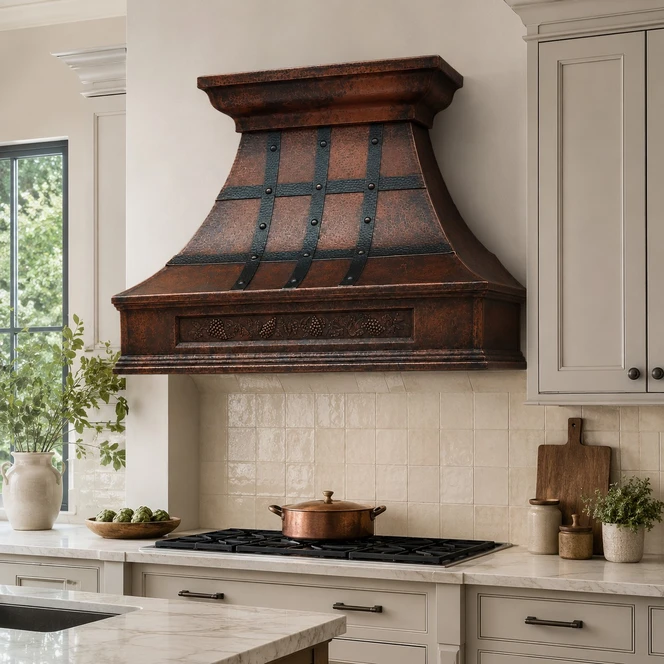
The Hammered Copper Range Hood with Darkened Copper Straps combines a broad bell-shaped body with hand-hammered copper, contrasting darkened copper bands, and a decorative grapevine apron. Unlike designs that rely on a single copper tone, this hood uses darker straps to outline the silhouette and divide the front into structured sections. The projecting crown adds architectural weight at the top, while the shaped apron establishes a decorative lower edge above the cooking area. Made to order in multiple widths and heights, the hood can be configured for wall-mount or kitchen-island installation rather than being tied to one fixed set of dimensions. Buyers can also coordinate the shell with different copper patinas and ventilation equipment. View the Hammered Copper Range Hood with Darkened Copper Straps to compare its construction and available options. Order this handcrafted copper hood for a kitchen requiring substantial architectural presence.
Blog Summary
- Material: Handcrafted copper
- Texture: Hand-hammered copper
- Shape: Broad bell silhouette
- Straps: Darkened copper bands
- Apron: Decorative grapevine detail
- Crown: Projecting upper molding
- Mounting: Wall or island
- Width: Multiple custom options
- Height: Multiple custom options
- Depth: Standard 24 inches
Range Hood Design
This copper range hood uses a bell profile that widens gradually toward the cooking surface. The silhouette gives the upper chimney a relatively narrow appearance while creating greater visual mass across the lower body. Instead of leaving the hammered copper shell uninterrupted, darkened copper straps divide and outline the hood, emphasizing its construction and proportions. Explore completed interiors showcasing the hammered surface and darker copper detailing in our darkened strap hammered copper range hood kitchen images.
The design becomes progressively more detailed toward the lower section. The upper crown defines the ceiling-side termination, the vertical and angled straps organize the body, and the decorative apron establishes a substantial base. Together, these elements create a hood suited to kitchens where the ventilation surround is intended to function as a principal architectural feature.

Bell-Shaped Architecture
The bell shape is defined by sides that expand outward as they approach the apron. This creates a softer silhouette than a straight rectangular chimney while retaining enough structure to work with substantial cabinetry, stone, plaster, wood beams, and other architectural kitchen materials.
Because the hood is available in multiple widths and heights, the bell profile is not limited to one fixed proportion. Its dimensions can be selected according to the cooking appliance, cabinetry, ceiling conditions, installation type, and ventilation requirements.
This flexibility is particularly important in custom kitchens. A hood installed between cabinets may require a different width-to-height relationship from an island hood viewed from several sides.
Hand-Hammered Copper Surface
Hammering gives the copper body a visibly worked surface rather than the uniform appearance of smooth sheet metal. Small depressions across the shell catch light differently as viewing angles and kitchen lighting change, making the surface appear more dimensional.
The texture also reinforces the handmade character of the hood. Individual hammer marks do not need to be mechanically identical. Subtle differences across the metal are part of the artisan fabrication rather than an attempt to reproduce a factory-stamped pattern.
Hammered copper works particularly well on this design because the large bell body provides enough uninterrupted surface for the texture to remain visible between the decorative straps.
Darkened Copper Straps
The darkened straps are made from copper and provide visual contrast against the main hood body. Their darker appearance makes the structural lines easier to see and gives the front elevation a more organized composition.
The straps run vertically and follow the changing geometry of the bell body. Rather than functioning as unrelated decoration, they emphasize the transition from the narrower chimney to the broader lower section.
This contrast is one of the defining features of the design. It allows the hood to combine a warm copper field with darker architectural lines without introducing a different primary metal.
Decorative Grapevine Apron
The apron introduces the hood's most ornamental detail. Its grapevine-inspired decoration creates a distinct visual band along the lower section and separates the cooking area from the simpler hammered body above.
Because the apron is already decorative, the remainder of the shell does not require extensive ornamentation. The hammered surface and darkened straps provide texture and structure, allowing the lower detail to become a focal feature.
This combination makes the hood particularly appropriate for interiors that use carved wood, artisan tile, stone, plaster, or other materials with visible craftsmanship.
Projecting Copper Crown
The crown gives the upper section a finished architectural termination. Its projecting profile creates a clear boundary between the vertical chimney and the surrounding wall or ceiling area while balancing the substantial apron below.
Visually, the crown also prevents the top of the hood from appearing too narrow relative to the expanding bell body. The resulting composition has three recognizable zones: crown, tapered body, and decorative apron.
Front Composition
Viewed from the front, the hood is strongly symmetrical. The bell silhouette expands evenly to both sides, while the darkened straps divide the hammered copper surface into balanced fields. The apron then forms a continuous horizontal base.
Symmetry makes the design suitable for installations centered over a range or cooktop. Cabinetry, backsplash patterns, lighting, and other surrounding features can be aligned with the hood's centerline to reinforce the composition.
Side Profile
The side view reveals how the hood projects outward from the upper chimney toward the cooking surface. This depth is an important part of the bell silhouette and should be considered when planning surrounding cabinets, windows, shelves, lighting, and circulation.
For wall installations, the profile also helps determine how the hood relates to the backsplash and adjacent cabinetry. Island versions need additional consideration because the shell remains visible from multiple directions.
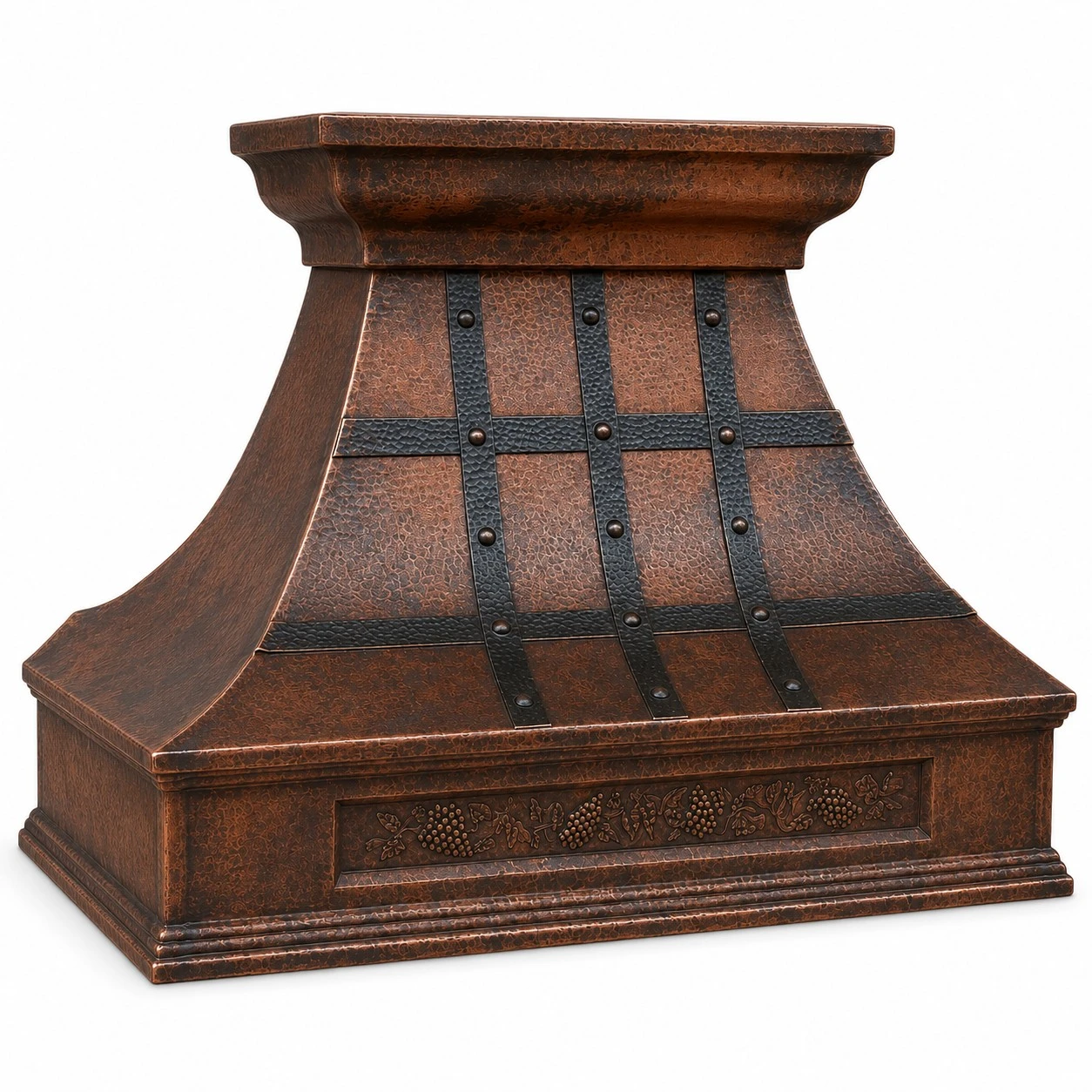
Additional Profile View
The additional side view provides another reference for the transition between the upper chimney, expanding body, projecting crown, and lower apron. These relationships matter when the hood is installed near cabinetry or other architectural elements.
Because final dimensions can vary with the selected configuration, project drawings and approved specifications should control fabrication and installation rather than measurements inferred from product photography.

Available Dimensions
This range hood is made to order rather than being restricted to the proportions shown in one product photograph. Available width and height options allow the shell to be adapted to different cooking appliances, cabinet layouts, ceiling conditions, and kitchen designs.
- Widths: 28" to 78"
- Heights: 24" to 72"
- Depth: Standard 24"
- Mounting: Wall or island
- Construction: Made to order
Width should not be selected from appearance alone. Cooking-appliance specifications, required coverage, nearby cabinetry, installation conditions, and ventilation planning should all be considered before the final dimensions are approved.
Technical Drawing
A technical drawing is useful for understanding the hood's general architecture and dimensional relationships. It can help communicate the bell profile, crown, apron, depth, and installation concept during project planning.
For a made-to-order hood, however, the drawing should not be interpreted as establishing one universal set of dimensions for every order. Final fabrication should follow the specifications approved for the individual project.

Wall-Mount Installation
A wall-mounted configuration places the hood against the kitchen wall above the range or cooktop. This arrangement allows the bell silhouette to become a central feature of the backsplash wall and makes it easier to coordinate the hood with surrounding upper cabinets.
Wall installations should account for the appliance location, hood width, mounting height, wall structure, backsplash, cabinet clearances, duct routing, and ventilation equipment before fabrication.
Depending on the approved insert and project layout, duct routing may be vertical or may require another approved configuration. The ventilation equipment and installation requirements should be established before the shell is produced.
Kitchen Island Installation
The same basic design can be configured for a kitchen island. An island hood is visible from multiple sides, making exterior finishing and overall proportions particularly important.
Island installations generally require vertical duct planning through the ceiling structure. Ceiling framing, electrical service, ventilation equipment, mounting support, and finished hood height should therefore be coordinated early in the project.
The hood should also be evaluated from the surrounding room rather than only from the cooktop. Its width, height, crown, and bell profile become part of the broader kitchen architecture.
Underside and Insert Opening
The underside is where the decorative copper shell interfaces with the functional ventilation equipment. The opening must be planned around the selected insert rather than assuming every ventilation unit uses the same housing or cutout.
Access to filters, lights, controls, and serviceable components should remain practical after installation. The insert manufacturer requirements and approved fabrication information should govern the internal configuration.

Ventilation Insert Planning
The copper hood is the decorative exterior shell. The ventilation insert is the functional equipment responsible for airflow, filtration, lighting, and controls. Treating these as separate components is important when planning a custom metal hood.
Rustica House offers an optional 200 CFM insert with a two-speed fan, lights, and filters. Projects requiring greater ventilation capacity can be fabricated around compatible buyer-supplied equipment when complete specifications are provided and approved before production.
Internal inserts up to 1,260 CFM can be considered with complete technical information. External blower systems up to 1,500 CFM can also be accommodated when the required specifications are supplied before fabrication.
Information Needed for Custom Inserts
- Manufacturer: Insert brand
- Model: Exact equipment number
- Housing: Overall dimensions
- Cutout: Required opening size
- Flange: Mounting dimensions
- Duct: Outlet size and position
- Controls: Access requirements
- Lighting: Fixture configuration
- Filters: Removal clearance
Buyer-supplied ventilation equipment should be approved before hood production begins. Providing the model only after fabrication can create conflicts between the insert housing and the completed copper shell.
Choosing Ventilation Capacity
Ventilation capacity should not be selected solely according to hood width. The cooking appliance, fuel type, burner output, manufacturer requirements, mounting height, duct length, duct configuration, makeup-air requirements, and applicable building codes can all affect the final system.
A qualified ventilation professional should determine the appropriate equipment for the project. The hood shell can then be fabricated around the approved insert dimensions and installation requirements.
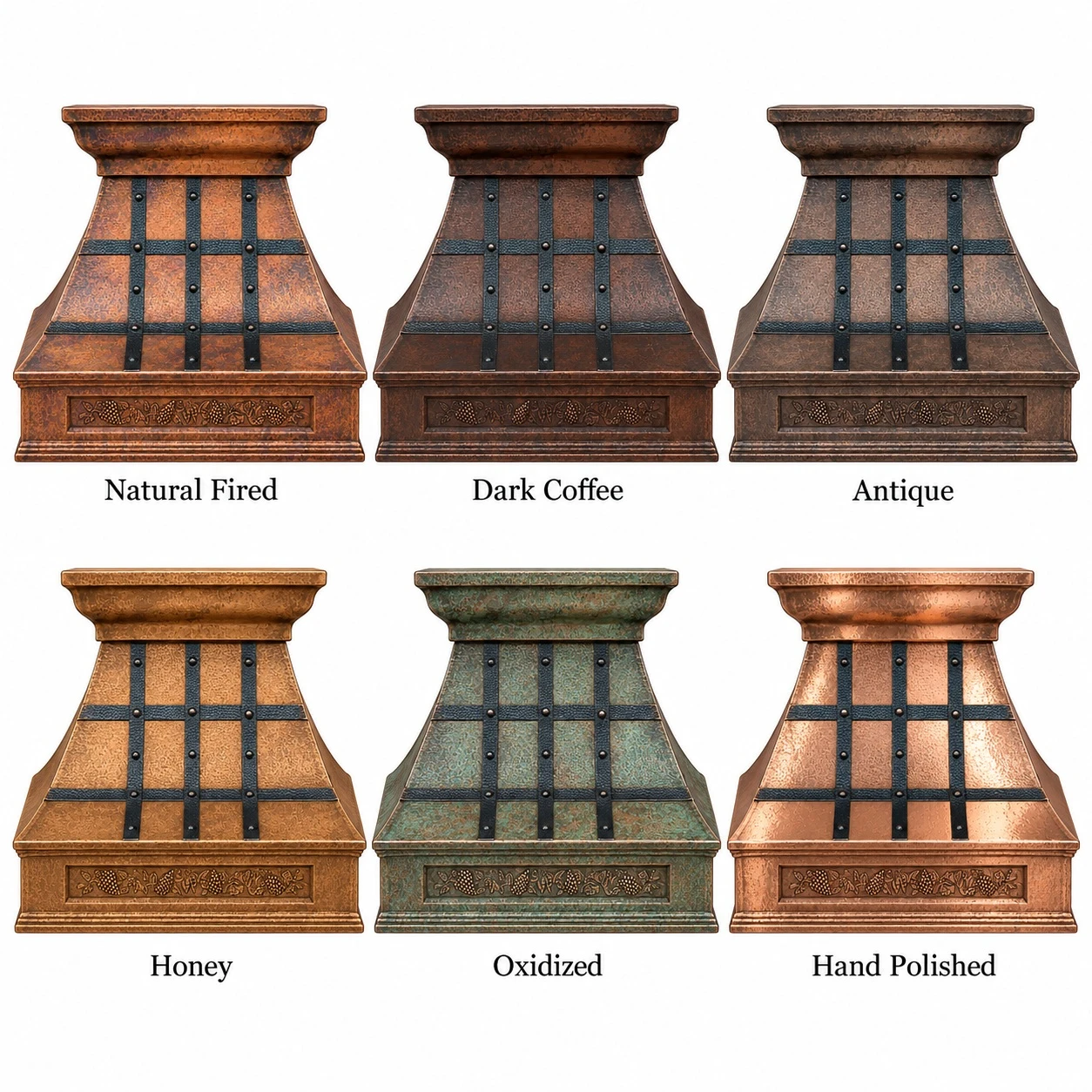
Copper Finish Options
Copper finish changes the overall character of the hood while preserving its bell shape, hammered texture, darkened straps, crown, and apron. The finish should be selected in relation to cabinetry, backsplash tile, countertops, flooring, lighting, and other metal elements in the kitchen.
- Natural Fired: Warm varied copper
- Dark Coffee: Deep brown copper
- Antique: Aged traditional tone
- Honey: Warm golden copper
- Oxidized: Weathered color variation
- Hand Polished: Brighter copper surface
Living Copper Patina
Copper is a living metal, so its appearance can continue to evolve after installation. Exposure to air, moisture, handling, cooking conditions, and cleaning can gradually alter the surface tone. This natural development is part of the character of copper rather than evidence that the original finish must remain visually unchanged forever.
The darkened straps may also develop with time, although their deliberately deeper tone continues to provide contrast with the surrounding copper body.
Best Kitchen Styles
Mediterranean Estate
Natural stone, warm plaster, dark wood cabinetry, and artisan tile complement the hammered copper surface and substantial crown molding. The darkened straps introduce definition against the warmer copper body, while the grapevine apron adds decorative detail appropriate for a kitchen built around layered natural materials.
Spanish Revival
Exposed beams, arched openings, handmade tile, plaster walls, and dark wood coordinate naturally with the riveted straps, bell profile, and aged copper character. The broad lower body gives the hood enough architectural presence to hold its own against substantial cabinetry and traditional Spanish-inspired details.
Mexican Hacienda
Rustic beams, textured plaster, colorful Talavera tile, masonry, and handcrafted wood reinforce the artisan character of the hammered copper. The grapevine apron and contrasting copper bands add ornament without concealing the hand-worked metal surface that defines the main body.
New Traditional
Inset cabinetry, stone countertops, detailed millwork, and symmetrical layouts can accommodate the projecting crown and structured front composition. Selecting a controlled copper patina allows the handmade hood to introduce material warmth while maintaining the organized architecture associated with a traditional kitchen.
Transitional
Warm-white cabinetry, natural oak, quartzite, and restrained hardware can balance the handcrafted copper with the organized strap layout. In a transitional kitchen, the hood becomes the principal artisan feature while surrounding surfaces remain comparatively quiet and visually structured.
Coordinating the Backsplash
The backsplash sits directly behind the hood and can either reinforce or compete with its decorative features. Because this design already includes hammered texture, dark straps, a projecting crown, and a grapevine apron, highly elaborate tile is not always necessary.
Natural stone, handmade ceramic, plaster, simple field tile, and controlled Talavera patterns can all work depending on the broader kitchen style. If a decorative tile panel is used behind the range, its width and centerline should be coordinated with the hood before installation.
Coordinating Cabinetry
Dark wood emphasizes the Old World qualities of the copper, while warm white or cream cabinetry creates greater contrast. Natural oak can provide a lighter transition between the metal and surrounding kitchen finishes.
Cabinet dimensions should also be coordinated with the selected hood width. The hood should not be treated as an isolated object because its bell silhouette and projecting crown affect the visual relationship with adjacent cabinetry.
Buyer Planning Table
| Planning | What to Confirm |
|---|---|
| Width | Range and cabinet layout |
| Height | Ceiling and mounting conditions |
| Depth | Standard 24-inch projection |
| Mounting | Wall or kitchen island |
| Finish | Coordinate surrounding materials |
| Insert | Approve equipment before production |
| Ducting | Outlet size and routing |
| Support | Verify mounting structure |
Installation Planning
Installation planning should begin before the copper shell enters production. Confirm the cooking appliance, finished hood dimensions, mounting height, wall or island configuration, ventilation equipment, duct routing, electrical requirements, structural support, and nearby cabinetry.
Custom fabrication makes advance coordination particularly important. Changing the insert or installation configuration after the shell has been built may require modifications that could have been avoided by supplying complete specifications at the beginning.
Professional installation is recommended. The installer should follow the cooking-appliance and ventilation-equipment manufacturer requirements as well as applicable project and building requirements.
Copper Care
Routine cleaning should remain gentle. Use mild soap, warm water, and a soft cloth, then dry the copper after cleaning. Abrasive pads, steel wool, bleach, ammonia, acidic cleaners, and aggressive degreasers can alter or damage the finish.
Polishing is optional rather than a routine requirement. Because polishing can remove or change developed patina, it should only be used when a brighter copper appearance is intentionally desired.
Protective wax may be used where appropriate, but it is not required for every owner or every finish. Many buyers prefer to allow the copper to evolve naturally.
Handcrafted Variation
Each hood is individually fabricated, so minor differences in hammer marks, patina distribution, strap appearance, seams, tool marks, and other handcrafted details are expected. These characteristics distinguish artisan metalwork from mechanically identical factory production.
Finish samples and product photographs should therefore be treated as visual references rather than guarantees that every square inch of a new hood will reproduce another piece exactly.
Coppersmith Perspective
The strongest feature of this design is the way the darker copper bands organize the broad hammered shell. The straps visually trace the bell shape instead of covering it, while the projecting crown and grapevine apron establish clear upper and lower boundaries.
From a fabrication perspective, those details need to remain proportionate as the width and height change. A custom hood should preserve the intended relationship among the crown, body, straps, and apron rather than simply enlarging one dimension without considering the complete silhouette.
FAQ - Hammered Copper Range Hood with Darkened Straps
A: Its defining combination includes a bell-shaped hammered copper body, contrasting darkened copper straps, a projecting crown, and a decorative grapevine apron.
A: No. The contrasting bands are darkened copper straps, allowing the design to create visual contrast while retaining copper as the principal decorative metal.
A: Yes. It is made to order in multiple widths and heights rather than being restricted to the dimensions represented by a single product photograph.
A: Available width options extend from 28 inches through 78 inches, allowing the hood to be coordinated with different cooking appliances and kitchen layouts.
A: Height options extend from 24 inches through 72 inches, providing flexibility for different ceiling conditions, mounting requirements, and kitchen proportions.
A: Yes. The hood can be configured for either wall-mount or kitchen-island installation, with the final construction planned for the selected mounting type.
A: Rustica House offers an optional 200 CFM insert, while compatible buyer-supplied internal inserts up to 1,260 CFM can be accommodated with complete pre-approved specifications.
A: External blower systems up to 1,500 CFM can be considered when complete equipment and installation specifications are supplied and approved before fabrication.
A: Yes. Copper develops naturally with exposure, handling, moisture, cooking conditions, and cleaning, so gradual patina changes should be expected.
A: Use mild soap, warm water, and a soft cloth, dry the surface afterward, and avoid abrasives, bleach, ammonia, acids, and harsh degreasers.
Planning This Custom Copper Hood
The Hammered Copper Range Hood with Darkened Copper Straps is designed for kitchens where the hood should contribute substantial architectural character rather than function only as a ventilation enclosure. Its expanding bell silhouette, hammered copper field, darker copper bands, projecting crown, and grapevine apron create a layered composition that can coordinate with plaster, natural stone, handmade tile, substantial wood cabinetry, and both traditional and transitional interiors.
Before ordering, confirm the cooking appliance, required hood width and height, wall or island mounting, copper finish, ventilation equipment, duct routing, structural support, and surrounding cabinetry. Buyer-supplied inserts should be approved before production so the shell can be fabricated around the actual equipment. View the Hammered Copper Range Hood with Darkened Copper Straps to select the configuration for your kitchen project.