 US Dollar
 Euro
Euro
 Australian Dollar
 Canadian Dollar
 Polish Zloty
 British Pound

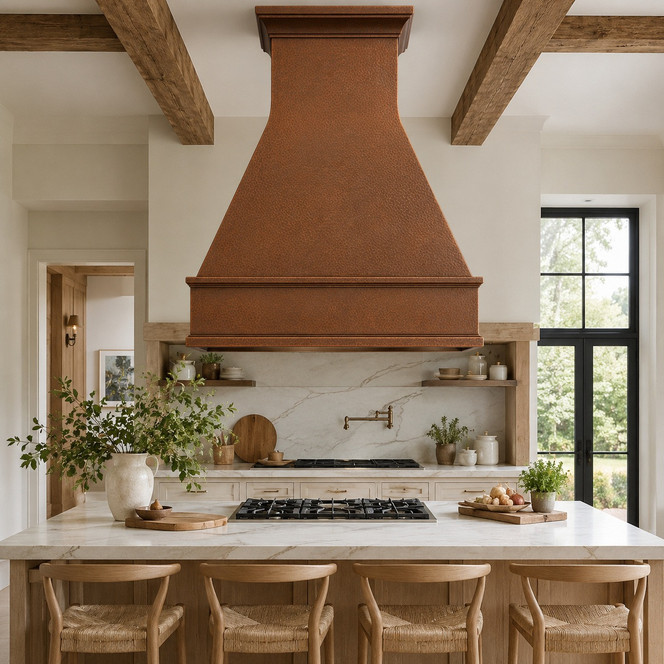
48-Inch Copper Range Hood: Artisan Scale and Hand-Hammered Kitchen Character
A 48-inch copper range hood combines generous cooking-area coverage with the warmth, texture, and architectural presence of handcrafted metalwork. Its substantial width makes it especially suitable for larger ranges, professional-style cooktops, spacious kitchen walls, and statement island installations. Hand-hammered copper catches light across the surface, while natural, antique, coffee, polished, or aged patinas allow the hood to complement farmhouse, rustic, traditional, transitional, Spanish Colonial, and modern kitchens. Whether designed as a restrained architectural form or embellished with straps, rivets, molding, and decorative aprons, a 48-inch copper range hood becomes both a functional ventilation enclosure and a lasting artisan focal point.
Blog Summary
- Product: 48-inch copper range hood
- Surface: Hand-hammered copper
- Mounting: Wall or island
- Ventilation: Insert-ready construction
- Style: Farmhouse to modern
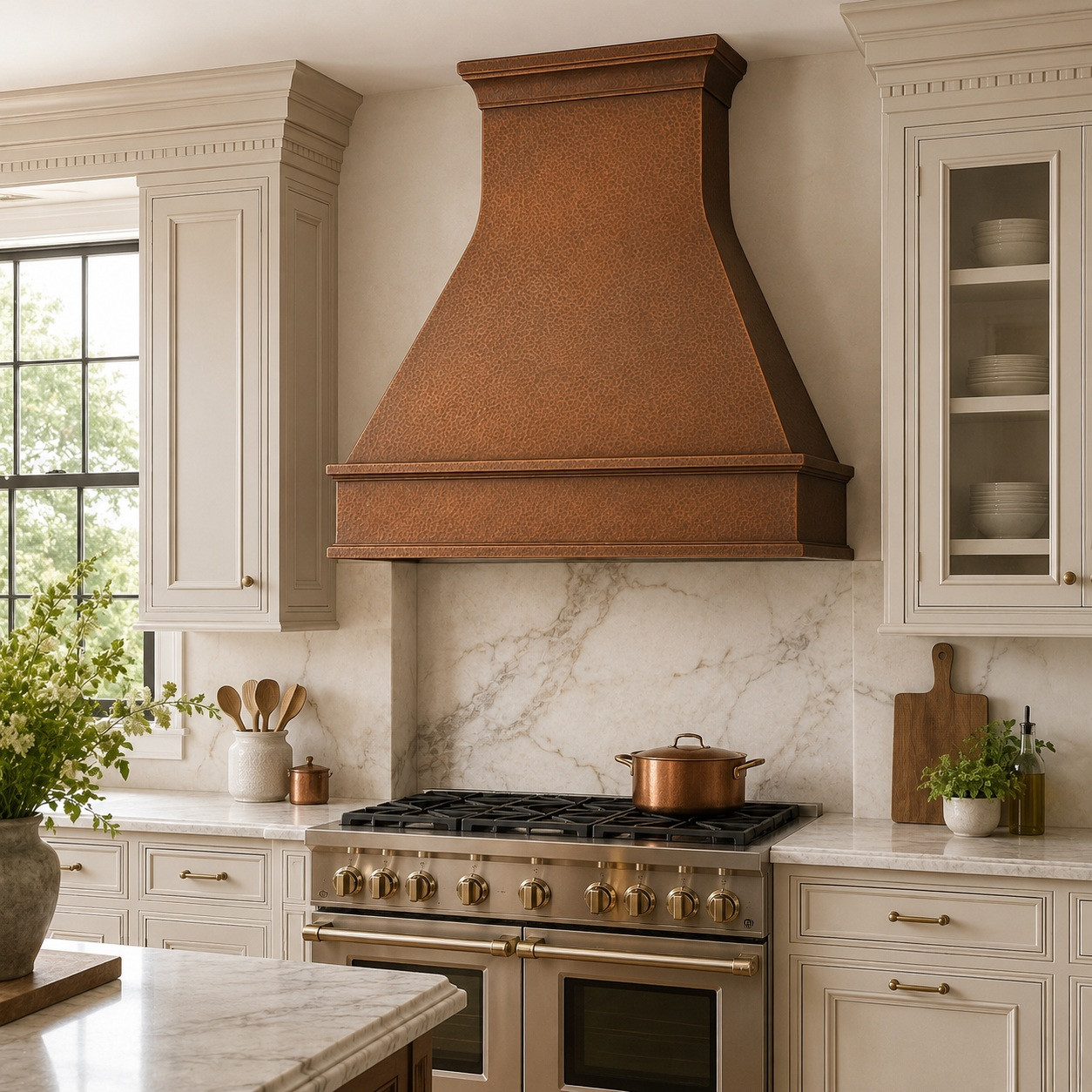
Why Choose a 48-Inch Copper Range Hood?
A 48-inch hood provides a visually substantial enclosure that can balance larger cooking appliances and generous kitchen architecture. It is often selected for professional-style ranges, oversized cooktops, broad cabinet openings, and kitchens where the hood is intended to become the central design feature.
The wider surface also provides more room for visible hammering, patina variation, decorative straps, rivets, molding, and custom apron details.
Generous Scale for Larger Kitchens
A smaller hood can appear undersized above a large range or within a tall kitchen wall. The 48-inch width gives the appliance enough presence to feel proportional beside substantial cabinetry, stone backsplashes, ceiling beams, and large islands.
Its dimensions can also help visually anchor open-concept kitchens where the cooking area is visible from adjoining dining and living rooms.
48-Inch Hood Benefits
- Coverage: Suited to wider cooking areas
- Scale: Balances larger kitchens
- Presence: Creates a strong focal point
- Customization: Supports decorative detail
- Versatility: Wall or island construction
Hand-Hammered Copper Surface
The copper body is formed and textured by hand, leaving individual hammer impressions across the front, sides, apron, chimney, and decorative elements. These small indentations catch light and produce depth that cannot be achieved with a flat printed or painted finish.
The hammering also helps the hood feel connected to traditional Mexican metalworking rather than mass-produced kitchen equipment.
How Hammering Changes the Appearance
Light moves differently across a hammered surface throughout the day. Natural daylight may reveal reddish and golden highlights, while warmer evening lighting can deepen brown, bronze, and coffee tones.
Because the impressions are created manually, the pattern remains naturally irregular and unique to the finished hood.
Smooth Copper Alternatives
Although hand-hammered copper is one of the most recognizable options, the hood may also be produced with a smoother surface. Smooth copper creates a more restrained architectural appearance and places greater emphasis on the silhouette, patina, straps, and surrounding cabinetry.
Subtle forming marks may still remain visible because the enclosure is handmade.
Surface Options
- Hammered: Traditional artisan texture
- Smooth: Refined architectural surface
- Light Hammering: Subtle visual movement
- Deep Hammering: Strong rustic texture
- Custom Texture: Project-specific appearance
Handmade Copper Craftsmanship
A custom copper hood begins as flat metal sheets measured according to the approved dimensions. The copper is cut, formed, joined, hammered, and finished by experienced artisans.
The process allows the enclosure to be designed around the actual kitchen, rather than forcing the cabinetry, ceiling, or ventilation system to fit a fixed factory shell.
Why Every Hood Is Unique
Small differences in hammering, seams, patina, dimensions, rivets, edge shape, and color are natural results of manual fabrication. No two handmade copper hoods will be perfectly identical.
These variations should be understood as evidence of artisan production rather than defects.
Expected Handmade Variation
- Hammering: Individual surface pattern
- Patina: Natural tonal differences
- Seams: Hand-finished construction
- Edges: Subtle forming variation
- Color: Unique on every hood
Choosing the Correct Range Width
A 48-inch hood is often associated with a 48-inch cooking appliance, but the final relationship should be reviewed carefully. Some kitchens benefit from a hood wider than the range to improve side coverage and create stronger architectural proportions.
The range width, burner layout, fuel type, cooking habits, hood depth, mounting height, and ventilation requirements should all be considered before production.
Using a 48-Inch Hood Above a Smaller Range
A 48-inch copper hood may also be installed above a 36- or 42-inch range when additional side coverage and stronger visual scale are desired. This arrangement can be especially effective for high-output cooking or kitchens with generous cabinet openings.
The final width should remain balanced with the surrounding architecture and the insert dimensions.
Using a 48-Inch Hood Above a 48-Inch Range
When the hood matches the range width, accurate alignment becomes especially important. The appliance, hood, cabinets, and backsplash should be centered carefully so the cooking wall feels intentional.
A ventilation specialist should confirm whether matching widths provide sufficient capture for the intended cooking conditions.
Sizing Considerations
- Range Width: Confirm cooking surface
- Burners: Review outer heat sources
- Mounting Height: Follow appliance guidance
- Depth: Cover the front cooking area
- Insert: Allow interior clearance
Standard Hood Depth
A depth of approximately 24 inches works for many residential installations. This dimension provides space for the insert and helps the hood extend over the front portion of the cooking surface.
Professional-style ranges and deeper inserts may require a custom hood depth of 26, 28, or 30 inches.
Custom Hood Height
The hood height depends on ceiling height, cabinetry, mounting clearance, ductwork, and the desired silhouette. A tall chimney can create drama in a high-ceiling kitchen, while a shorter hood may fit beneath soffits, beams, or architectural molding.
Custom height helps the hood feel integrated with the room rather than appearing stretched or compressed.
Key Dimensions
- Width: Standard 48 inches
- Depth: Commonly about 24 inches
- Height: Customized to project
- Chimney: Coordinated with ductwork
- Insert Opening: Built to specifications
Wall-Mounted 48-Inch Copper Hoods
A wall-mounted model is installed above a range positioned against a wall. The front and two sides are fully finished, while the back remains open against the mounting surface.
This configuration integrates naturally with cabinetry, tile backsplashes, plaster walls, shelves, and architectural cooking alcoves.
Island 48-Inch Copper Hoods
An island hood is suspended above a cooktop positioned away from the wall. Because it remains visible from every direction, all four sides must be finished attractively.
The island version also requires adequate ceiling support, carefully planned ductwork, and dimensions that remain balanced from adjoining living and dining spaces.
Under-Cabinet Possibilities
Some 48-inch copper hood designs can be adapted for under-cabinet or built-in installations. This configuration may preserve upper storage while still adding copper across the visible lower enclosure.
The selected insert and cabinet structure must provide sufficient interior space and service access.
Mounting Options
- Wall Mount: Installed against wall
- Island Mount: Finished on four sides
- Under Cabinet: Compact integration
- Ceiling Mount: Suspended installation
- Custom: Project-specific configuration
Ventilation Insert Compatibility
The copper enclosure does not create airflow on its own. The insert installed inside the hood contains the blower, filters, lighting, controls, and mechanical ventilation components.
The hood should be designed around the exact insert rather than an estimated brand or general width.
Providing Insert Specifications
Before production, provide the insert manufacturer, model number, complete dimensions, duct location, liner requirements, and technical installation sheet. This information allows the interior copper construction to be prepared correctly.
Submitting incomplete dimensions may create conflicts that cannot be corrected easily after the hood is finished.
Buyer-Supplied Internal Inserts
The 48-inch hood can be prepared for a compatible buyer-supplied insert when the complete specifications are submitted before production. Internal systems rated up to approximately 1,200 CFM may be accommodated depending on the insert dimensions and hood design.
The buyer purchases the mechanical ventilation equipment separately.
External Blower Systems
An external blower places the motor away from the kitchen, often on the roof or exterior wall. This arrangement may reduce some motor noise near the range, although airflow through the ductwork will still create sound.
The hood may be prepared for an external system rated up to approximately 1,500 CFM when the technical documentation is provided before fabrication.
Ventilation Options
- Internal Insert: Mechanical unit inside hood
- External Blower: Remote motor system
- Buyer Supplied: Selected separately
- Ducted: Exhausts air outside
- Recirculating: Returns filtered air
Ducted Ventilation
A ducted system moves cooking smoke, steam, grease, and odors outdoors through approved metal ductwork. This configuration is generally preferred when the kitchen allows a practical exterior route.
Duct diameter, total length, elbows, termination, makeup air, and local building requirements should be evaluated by the installer.
Recirculating Ventilation
A recirculating insert filters the cooking air before returning it to the kitchen. This option may be useful in apartments, condominiums, and interior kitchens where exterior ducting is unavailable.
The insert must be specifically designed for recirculation, and the copper enclosure may require side openings for filtered air discharge.
Performance Depends on the Mechanical System
Airflow, lighting, noise, controls, filters, timers, and energy use depend on the selected insert rather than the decorative copper shell. Claims about quiet operation or advanced controls should therefore be verified with the ventilation manufacturer.
A properly designed enclosure supports the insert, but the insert determines the actual ventilation performance.
Performance Factors
- Blower: Determines airflow capacity
- Duct Size: Affects resistance
- Elbows: Influence efficiency
- Filters: Require regular cleaning
- Mounting Height: Affects capture
Copper Patina Options
The finish determines whether the hood appears bright, warm, aged, rustic, refined, or dramatic. Patina should be selected together with cabinets, countertops, flooring, backsplash tile, appliances, lighting, and hardware.
Because the finish is applied by hand, photographs and samples represent a general color direction rather than an exact final match.
Natural Copper Finish
Natural copper displays reddish, golden, and light brown tones. It works well in farmhouse, transitional, contemporary, and rustic kitchens where the metal should remain visually bright.
The surface may continue darkening or developing additional color variation with time.
Antique Copper Patina
An antique finish introduces deeper browns and aged tonal variation across the hammer marks, seams, edges, and decorative elements. It is well suited to Spanish Colonial, traditional, Tuscan, and Old World kitchens.
The darker finish provides strong contrast against white, cream, and light-gray cabinets.
Coffee and Dark Coffee Patinas
Coffee patina creates a rich brown appearance with warm copper undertones. Dark coffee produces an even deeper and more dramatic surface.
These finishes pair naturally with carved wood, stone, iron lighting, plaster walls, and earthy tile.
Polished Copper
Polished copper creates a brighter and more reflective appearance. It emphasizes light and can feel more formal or contemporary than dark aged finishes.
A polished surface generally requires more attention if the homeowner wants to preserve a consistent shine.
Oxidized Green Copper
Green and turquoise oxidation creates the appearance of weathered copper. It may cover the full hood or appear selectively around edges, seams, rivets, and straps.
This finish works especially well in neutral kitchens where the hood is intended to become the main color feature.
Finish Options
- Natural: Warm reddish copper
- Antique: Traditional aged tone
- Coffee: Rich brown finish
- Polished: Bright reflective surface
- Oxidized: Green-blue variation
Copper as a Living Finish
Copper responds naturally to air, moisture, heat, fingerprints, oils, cleaning products, and cooking residue. Its color may deepen, lighten, or develop additional variation over time.
This evolving patina is part of genuine copper’s character and should not be treated as a permanently uniform painted coating.
Decorative Straps
Straps can be installed vertically or horizontally across the hood. Vertical straps emphasize height, while horizontal bands create a broader architectural effect.
The straps may match the copper body or use contrasting iron, brass, zinc, or another metal.
Rivets and Nails
Decorative rivets may follow the straps, apron, crown, seams, or lower edge. Their repeated spacing reinforces the handcrafted appearance and adds subtle shadow across the metal.
The rivet size should remain proportional to the hood dimensions.
Decorative Aprons
The lower apron provides one of the most visible locations for ornament. It may remain simple or include embossed grapes, flowers, scrolls, stars, geometric borders, or other custom-inspired motifs.
A detailed apron works well in traditional settings, while a plain band supports cleaner transitional and modern design.
Crown Molding
A crown or upper molding creates a finished transition between the hood and ceiling or chimney. It can remain narrow and simple or become more substantial in a formal traditional kitchen.
The molding dimensions should coordinate with surrounding cabinetry and architectural trim.
Decorative Details
- Straps: Vertical or horizontal bands
- Rivets: Repeated metal accents
- Apron: Decorative lower section
- Crown: Finished upper molding
- Embossing: Hand-worked ornament
48-Inch Hood in a Farmhouse Kitchen
A farmhouse kitchen benefits from the warmth and visible texture of hammered copper. The hood pairs naturally with shaker cabinets, apron-front sinks, reclaimed beams, open shelving, wood floors, and handmade tile.
A natural or coffee patina can reinforce the comfortable, lived-in character of the room without making the appliance appear overly formal.
Pairing with an Apron-Front Sink
An apron-front sink creates another strong farmhouse reference below the copper hood. The two features do not need to match in material, but they should feel balanced within the kitchen.
A copper sink can establish stronger continuity, while white fireclay creates brighter contrast.
Farmhouse Materials
Wood beams, plaster, stone, woven textures, and simple painted cabinetry create an effective background for the 48-inch hood. The metal provides enough visual richness that the remaining surfaces can stay relatively restrained.
Farmhouse Pairings
- Shaker Cabinets: Clean traditional structure
- Apron Sink: Classic farmhouse feature
- Wood Beams: Rustic architectural warmth
- Stone Counters: Natural foundation
- Open Shelves: Relaxed kitchen styling
48-Inch Hood in a Rustic Kitchen
In a rustic kitchen, the hammered copper surface complements reclaimed wood, natural stone, rough plaster, terracotta, leather, and black iron. The patina reinforces the impression of age and handcraft.
A wider hood also holds its own visually beside substantial beams, heavy cabinetry, and large cooking appliances.
Pairing with Natural Stone
Stone backsplashes and walls provide a strong architectural base behind the copper. Limestone, fieldstone, slate, and textured neutral stone work especially well with antique and coffee patinas.
The backsplash surface should remain practical for cleaning near the cooking area.
Pairing with Reclaimed Wood
Reclaimed wood introduces variation in grain, knots, age, and color that complements the irregularity of hand-hammered copper. It may be used for cabinetry, ceiling beams, open shelving, or flooring.
The warm materials create a cohesive rustic composition without requiring elaborate decoration.
Rustic Pairings
- Reclaimed Wood: Natural aged texture
- Stone: Strong architectural backdrop
- Terracotta: Earthy flooring color
- Iron Lighting: Dark metal contrast
- Plaster: Soft handmade wall finish
48-Inch Hood in a Traditional Kitchen
A traditional kitchen can support a more ornate copper hood with layered molding, decorative straps, rivets, and embossed apron details. The substantial width balances carved cabinetry, furniture-style islands, paneled appliances, and detailed millwork.
Antique and coffee patinas provide a warm counterpoint to polished stone, painted cabinets, and formal architectural trim.
Pairing with Rich Wood Cabinetry
Walnut, cherry, mahogany, and dark-stained wood create a rich visual environment around copper. The hood should remain sufficiently different in tone so its silhouette does not disappear into the cabinetry.
Warm lighting can help reveal the hammered texture and metal variation.
Traditional Molding and Copper
Decorative crown molding around the kitchen can be echoed through the upper hood profile. Similar scale and proportion help the custom copper enclosure feel integrated with the cabinetry.
The hood should complement the millwork rather than compete with every decorative element in the room.
Traditional Pairings
- Carved Cabinetry: Formal architectural detail
- Marble: Refined stone contrast
- Paneling: Furniture-style kitchen design
- Brass Hardware: Warm mixed-metal detail
- Chandeliers: Traditional illumination
48-Inch Hood in a Transitional Kitchen
Transitional kitchens combine traditional materials with cleaner forms. A straight-sided or gently curved copper hood can add warmth without making the room feel excessively ornate.
Balanced proportions, restrained straps, and a neutral patina help the hood bridge shaker cabinetry, modern appliances, quartz, marble, and understated lighting.
Pairing with White or Gray Cabinets
White cabinetry creates strong contrast with copper, while gray cabinets produce a softer and more contemporary relationship. Natural copper appears brighter, and coffee patinas create deeper traditional contrast.
Repeating the copper tone through small hardware or lighting details can help connect the hood to the rest of the kitchen.
Clean Architectural Lines
A transitional copper hood should allow the material itself to provide most of the visual interest. Simple straps, a modest apron, and a narrow crown often create enough detail.
The surrounding backsplash can remain calm through marble, neutral tile, or plaster.
Transitional Pairings
- Shaker Cabinets: Balanced traditional form
- Quartz: Clean practical surface
- Marble: Refined natural contrast
- Gray Cabinetry: Soft modern balance
- Simple Hardware: Controlled decoration
48-Inch Hood in a Modern Kitchen
In a modern kitchen, a 48-inch copper hood can become the principal sculptural element. Flat-panel cabinets, large stone surfaces, simple walls, and restrained lighting allow the textured metal to dominate.
A geometric silhouette, minimal straps, and smooth or lightly hammered copper generally work best in contemporary architecture.
Copper and Stainless Steel
A stainless-steel range can sit beneath a copper hood without appearing mismatched. The contrast feels intentional when both metals are repeated through fixtures, lighting, hardware, or accessories.
Black detailing can create a visual bridge between the warm copper and cooler stainless surfaces.
Minimalist Surroundings
Because the hood already provides texture and color, the surrounding kitchen can remain simple. Neutral cabinets, slab stone, concealed storage, and clean lines help the copper feel deliberate rather than decorative excess.
Modern Pairings
- Flat Cabinets: Clean architectural background
- Stainless Steel: Cool metal contrast
- Concrete: Industrial neutral texture
- Large Stone: Minimal visual seams
- Black Accents: Strong graphic definition
Spanish Colonial and Hacienda Kitchens
A hammered copper hood fits naturally within Spanish Colonial and Hacienda interiors. Copper, Talavera tile, plaster, carved wood, wrought iron, terracotta, and stone create a deeply layered material palette.
Curved silhouettes, antique patinas, rivets, and embossed aprons can strengthen the traditional regional character.
Pairing with Talavera Tile
Talavera tile introduces cobalt, green, yellow, terracotta, and white behind the warm copper. A patterned backsplash can reinforce Mexican character, while solid-color tile creates a quieter background.
A highly decorated hood usually benefits from a simpler tile arrangement.
Mixed-Metal Kitchen Design
Copper can be combined with brass, bronze, zinc, black iron, chrome, nickel, and stainless steel. The key is to repeat each metal intentionally rather than introducing several isolated finishes.
Black iron straps or lighting can provide a strong contrast and connect the hood with other architectural details.
Compatible Styles
- Farmhouse: Warm handcrafted focal point
- Rustic: Natural textured materials
- Traditional: Decorative architectural detail
- Transitional: Old and new balance
- Modern: Sculptural material contrast
Professional Installation
A 48-inch copper hood can be substantial in size and weight. The supporting wall or ceiling must be prepared correctly, and the installer should coordinate the insert, ductwork, electrical connections, clearances, and service access.
Professional installation is strongly recommended for both wall-mounted and island configurations.
Structural Support
The hood should be attached to framing or another structural support system rather than relying only on finished drywall or decorative panels. Island hoods require especially careful ceiling reinforcement.
The contractor should review the finished hood weight before installation.
Protecting the Finish During Installation
The copper should remain covered during surrounding construction to prevent dents, scratches, grout, adhesive, plaster, paint, and dust from damaging the patina.
Clean gloves and padded handling surfaces help preserve the finish.
Installation Checklist
- Support: Prepare wall or ceiling
- Insert: Confirm exact model
- Duct: Verify diameter and route
- Electrical: Plan power supply
- Clearance: Follow equipment guidance
Cleaning the Copper Surface
Use mild soap, warm water, and a soft cloth to remove dust, fingerprints, and cooking residue. Wipe gently and dry the surface after cleaning.
Avoid abrasive pads, bleach, ammonia, strong acids, and aggressive copper cleaners that may alter or remove the patina.
Should Copper Wax Be Applied?
A compatible wax may be used periodically when recommended for the selected finish. It can provide additional protection and help preserve sheen.
Waxing should not be treated as a universal requirement for every copper hood. The proper schedule depends on the patina, protective coating, kitchen conditions, and product care instructions.
Polishing the Hood
Polishing can remove or change an antique, coffee, or oxidized patina. It should only be used when the hood was intentionally ordered with a bright polished finish and the care instructions approve that treatment.
For most aged finishes, gentle cleaning is preferable to repeated polishing.
Copper Care Tips
- Clean: Mild soap and water
- Use: Soft cloth
- Dry: Remove moisture gently
- Avoid: Harsh chemicals
- Patina: Expect natural aging
Maintaining the Ventilation Insert
The insert filters should be cleaned or replaced according to the ventilation manufacturer’s instructions. Grease accumulation can reduce airflow and increase residue inside the hood.
The copper shell and mechanical insert may require different cleaning products and schedules.
Blower and Duct Maintenance
Reduced airflow, persistent odors, or unusual noise may indicate that the filters, blower, or ductwork require service. Mechanical components should be inspected according to the insert manufacturer’s guidance.
Professional servicing may be necessary when internal parts are difficult to access.
Durability of Copper
Copper does not rust like untreated iron, although it naturally changes color and develops patina. Fine scratches, darkening, and tonal variation do not mean the material is failing.
With proper installation and reasonable care, a copper hood can remain a long-term architectural kitchen feature.
Crating and Freight Delivery
The 48-inch hood is packed in a protective crate to reduce the risk of damage during export and freight transport. Its size generally requires coordinated delivery rather than ordinary parcel shipping.
The buyer should confirm truck access, unloading requirements, storage space, and the route from the delivery point to the kitchen.
Insured Shipment
Insured freight provides a process for addressing documented transportation damage. The receiving party must still inspect the crate carefully and follow the applicable claim instructions.
Insurance does not replace the need for proper inspection and delivery documentation.
Inspecting the Hood on Arrival
Review the crate before signing the freight receipt. Visible damage should be noted on the carrier paperwork and photographed immediately.
Retain the packaging until the hood has been unpacked and inspected fully.
Delivery Checklist
- Access: Confirm freight route
- Unloading: Arrange appropriate help
- Crate: Inspect before signing
- Photos: Document visible damage
- Storage: Protect until installation
Production and Customization
The hood can be customized in width, height, depth, mounting style, surface texture, patina, straps, rivets, crown, apron, and insert preparation. All details should be confirmed before fabrication begins.
Changes requested after production starts may affect cost, compatibility, appearance, or delivery timing.
Choosing Finish Samples
Finish samples can help compare natural, antique, coffee, dark, polished, and oxidized copper. Samples indicate the general finish direction but cannot guarantee an exact match to the completed hood.
Hammering, lighting, sheet variation, and hand-applied patina all influence the final result.
Planning with the Contractor
The homeowner, cabinetmaker, ventilation supplier, electrician, and installer should review the same final dimensions and insert specifications before production. Coordinated planning reduces conflicts between the copper shell and surrounding construction.
Do not finalize cabinets, duct openings, or electrical locations using estimated hood information.
Why a Custom 48-Inch Hood Stands Apart
Factory-made range hoods offer fixed dimensions, limited finishes, and standardized forms. A handmade copper hood can respond to the actual range, ceiling, cabinetry, duct route, insert, and architectural style.
The finished piece feels integrated into the kitchen rather than added as an ordinary appliance.
FAQs About 48-Inch Copper Range Hoods
Is the hood available in sizes other than 48 inches?
Yes. Copper range hoods can be produced in additional standard and custom widths depending on the kitchen, range, insert, mounting style, and design requirements.
Which patina finishes are available?
Common finish directions include natural copper, antique, coffee, dark coffee, polished copper, and oxidized green. Because each patina is applied by hand, exact color matching cannot be guaranteed.
Can the hood be made for a wall or kitchen island?
Yes. Wall-mounted hoods are finished on the front and sides, while island hoods are finished on all four sides and require appropriate ceiling support.
Does the copper hood include the ventilation insert?
The hood can be prepared for a compatible buyer-supplied insert. The exact brand, model, dimensions, and technical specifications should be provided before production.
How should the copper finish be cleaned?
Use mild soap, warm water, and a soft cloth. Avoid abrasive pads and harsh chemicals that may damage or remove the patina.
Will the copper finish change over time?
Yes. Copper is a living finish that may darken, lighten, or develop additional tonal variation through exposure to air, moisture, heat, oils, and cleaning products.
Can decorative straps and rivets be added?
Yes. The hood can be customized with vertical or horizontal straps, rivets, decorative aprons, crown molding, and selected embossed details.
Is professional installation recommended?
Yes. A qualified contractor should coordinate structural support, ventilation, ductwork, electrical service, appliance clearances, and safe handling of the copper enclosure.
Ordering and Product Information
Before ordering, confirm the hood width, height, depth, mounting style, copper texture, patina, decorative details, range dimensions, ceiling height, duct route, and exact ventilation insert.
Visit the 48-Inch Copper Range Hood product page for specifications and customization options, or explore the complete copper range hood collection to compare additional silhouettes and sizes.
Conclusion
A 48-inch copper range hood offers generous scale, custom ventilation preparation, hand-hammered texture, living patina, and architectural presence for kitchens designed around substantial cooking appliances. Available in wall-mounted, island, and custom configurations, the hood can be tailored with natural, antique, coffee, polished, dark, or oxidized finishes as well as straps, rivets, molding, and decorative aprons. With accurate measurements, complete insert specifications, coordinated construction, professional installation, careful freight inspection, and gentle maintenance, a handmade 48-inch copper hood becomes a lasting focal point where functional ventilation and artisan craftsmanship meet.