 US Dollar
 Euro
Euro
 Australian Dollar
 Canadian Dollar
 Polish Zloty
 British Pound

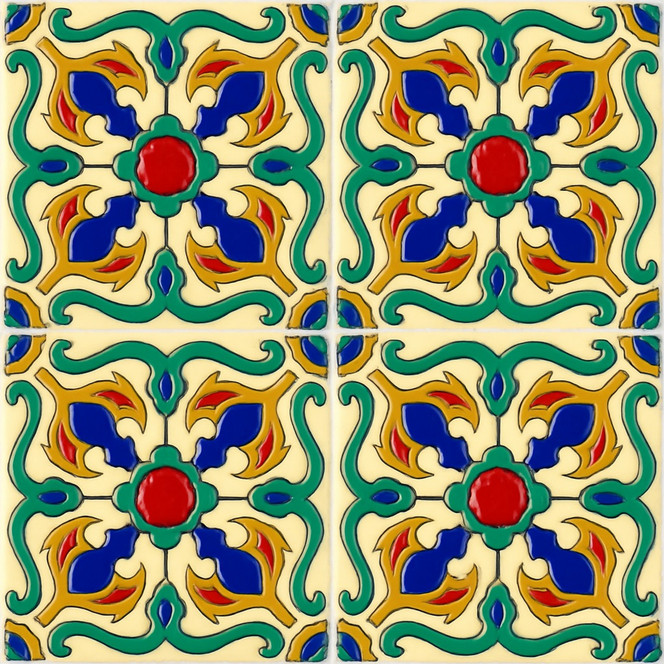
Tlalpan Floral Scroll Relief Tile
The Tlalpan Floral Scroll Relief Tile blends curvilinear scrollwork with radial floral symmetry rooted in Mexican ceramic tradition. A vivid red rosette anchors the center, flanked by cobalt blue and ochre flame-like leaves that radiate outward. Soft green scrolls stretch into each corner, creating diagonal balance, while ivory and tan fill the background. Glossy raised outlines, achieved with the cuerda seca technique, bring depth and clarity to the design. Made in Dolores Hidalgo, this tile is ideal for Spanish Revival kitchens, Mediterranean patios, and rustic interiors seeking vibrant artistry.
Tile Pattern Details
Pattern Colors
- Ivory and warm tan background tones
- Central red floral rosette
- Deep cobalt blue leaf-flame elements
- Ochre and red accent flourishes
- Soft green scrolling arms in corners
- Black raised outlines for sharp definition
Design & Decorative Elements
- Radial floral-medallion composition
- Central red rosette with layered detailing
- Scrolls form curved arms along diagonal axes
- Repeating motifs create visual rhythm
Stylistic & Regional Influence
- Colonial Spanish and Moorish tile heritage
- Produced in central Mexico’s Dolores Hidalgo
- Ideal for traditional and eclectic interiors
- Vibrant colors in classic Talavera proportions
Best Installation Settings & Styles
- Spanish Revival kitchen backsplashes
- Eclectic bathroom feature walls or mirror frames
- Mission-style entryways or stair risers
- Mediterranean-style patio accents
Tile Specifications
- Size: 4x4 inch square
- Thickness: Approx. 1/4 inch
- Material: High-fired glazed ceramic
- Technique: Cuerda seca relief tile
- Finish: Glossy enamel with raised outlines
- Pattern: Floral scroll with radial geometry
- Origin: Handcrafted in Dolores Hidalgo, Mexico
- Delivery: Ships in approximately 6 weeks
Shipping & Returns
Each Tlalpan floral scroll relief tile is handcrafted to order and typically ships within 4 to 6 weeks. We offer international shipping upon request and provide secure packaging to ensure your tiles arrive safely. If for any reason you're not satisfied, returns are accepted within 60 days of delivery on unused items. Please note that buyers are responsible for return shipping costs.
Production & Craftsmanship
This tile is handmade using the traditional cuerda seca method, a technique that employs high-relief black outlines to achieve crisp separation between colors. Each section of the pattern is filled by hand with richly pigmented glazes, ensuring vibrant contrast and artisanal precision. After glazing, the tile is fired at high temperatures to produce a glossy, durable finish that enhances both its visual depth and surface strength.
Artisan Testimony
"Creating the Tlalpan tile is like building a garden in color and form—every line I trace is a tribute to the memory of old traditions." – Daniela H., relief tile artisan in Dolores Hidalgo
The History of Dolores Hidalgo
Symbolism and Cultural Meaning in Mexican Tile Art
Mexican tile design is more than just ornamental—it is symbolic, rooted in centuries of history, faith, and identity. Every shape, color, and pattern carries cultural resonance, drawing from pre-Hispanic cosmology, Spanish religious iconography, and a deep relationship with nature. The floral scroll motif found in the Tlalpan tile is a prime example of how visual language tells stories in ceramic form.
In pre-Columbian times, radial floral symbols represented the sun, life cycles, and divine presence. The rosette at the center of the Tlalpan tile echoes this tradition, acting as a visual sun from which symmetrical designs radiate. This radial balance was symbolic of harmony in the universe—north, south, east, and west unified by a spiritual center. These cosmic principles were often expressed in Indigenous textiles, codices, and architectural decoration.
With the arrival of Spanish colonization in the 16th century, Moorish tile aesthetics from Andalusia were introduced to the New World. The scrolls, symmetry, and cuerda seca technique in the Tlalpan tile reflect this Islamic-Spanish heritage. But in Mexico, these elements were quickly adapted by local artisans who blended European geometry with Indigenous botanical symbolism, creating what is now known as the Talavera tradition.
Colors in Mexican tiles are equally meaningful. Cobalt blue—prominent in this tile—was historically reserved for sacred and royal applications, both in Spanish majolica and Aztec ritual items. Red is associated with fertility, passion, and blood; ochre with the earth and ancestral roots; green with life and vegetation. Together, they communicate an earthy vibrancy that reflects both physical and spiritual vitality.
When someone installs a tile like the Tlalpan design, they’re not just decorating—they’re tapping into a living history of sacred geometry, symbolic color, and cultural storytelling that spans both continents and centuries.
From Colonial Influence to Contemporary Craft
The decorative tile tradition in Mexico has evolved through waves of cultural exchange, innovation, and resilience. The Tlalpan Floral Scroll Relief Tile illustrates how colonial influences, specifically Spanish and Moorish, were localized into something distinctively Mexican—and how those traditions have survived and flourished in the hands of modern artisans.
When Spain colonized Mexico in the early 1500s, they brought with them their architectural and decorative customs, including glazed ceramics. Many of these styles were inherited from Islamic artisans in southern Spain, particularly the cuerda seca method used for defining patterns with wax-resist black lines. These techniques were taught in monasteries and municipal tile workshops throughout New Spain, especially in Puebla and later in Guanajuato and Dolores Hidalgo.
Local potters, many of them Indigenous, quickly adopted these methods and began modifying the iconography. Instead of Christian symbols or Moorish patterns alone, Mexican artisans added native flowers, animals, and glyph-like scrolls to the tiles. These new hybrid patterns often retained the radial symmetry and color blocking of their European origins but incorporated local identity, regional colors, and folk interpretations.
Fast forward to the 20th and 21st centuries, and these same traditions have been reasserted as a form of cultural pride and economic livelihood. In Dolores Hidalgo, generations of artisans have worked in family-run talleres (workshops) to handcraft tiles like the Tlalpan design. While globalization has introduced machine-made alternatives, the cuerda seca technique has survived due to its richness in detail and its cultural authenticity.
Today, these tiles are not only used in traditional homes and haciendas but also embraced in modern and eclectic design worldwide. They represent a bridge between old and new—between colonial legacy and Indigenous continuity—crafted by hand, fired by tradition, and kept alive by passion.
Relief Tile as Architectural Storytelling
In Mexican architecture, tiles are not just surface decoration—they are part of the narrative structure of a home or building. The use of relief tile, particularly in stair risers, fountains, alcoves, and kitchen backsplashes, reflects a tradition of integrating art and architecture to express culture, identity, and place.
Relief tiles such as the Tlalpan Floral Scroll design carry dimension and tactile detail that distinguish them from flat printed ceramics. The cuerda seca method, with its raised black outlines and carefully glazed segments, creates both visual depth and surface texture. This technique allows motifs like scrolls and flowers to appear sculpted rather than merely painted, inviting interaction from the eye and the hand.
In colonial-era buildings, tiles were often used to signal thresholds and transitions—between public and private space, sacred and secular, indoor and outdoor. Stair risers decorated with tiles signified a rise in importance; fountain walls tiled with floral medallions suggested abundance and life. Kitchens, long considered the heart of Mexican homes, were clad in relief tiles as symbols of warmth, protection, and cultural wealth.
This tradition continues today, especially in designs that value human touch and historical continuity. Relief tiles tell stories of craft, region, and ritual. Each pattern becomes a chapter in a spatial narrative, honoring the people who made them and the traditions they carry. Whether used in a courtyard or interior wall, the Tlalpan tile doesn’t just add beauty—it adds meaning to a space.
Conclusion
The Tlalpan Floral Scroll Relief Tile is a vibrant expression of heritage, geometry, and color. Whether featured in a Mediterranean courtyard or as a backsplash in a rustic kitchen, it brings handmade depth to architectural surfaces. To learn more or place an order, visit our product page here. For custom orders or assistance, please contact our team—we’re here to help bring authentic Mexican tile into your home.