 US Dollar
 Euro
Euro
 Australian Dollar
 Canadian Dollar
 Polish Zloty
 British Pound

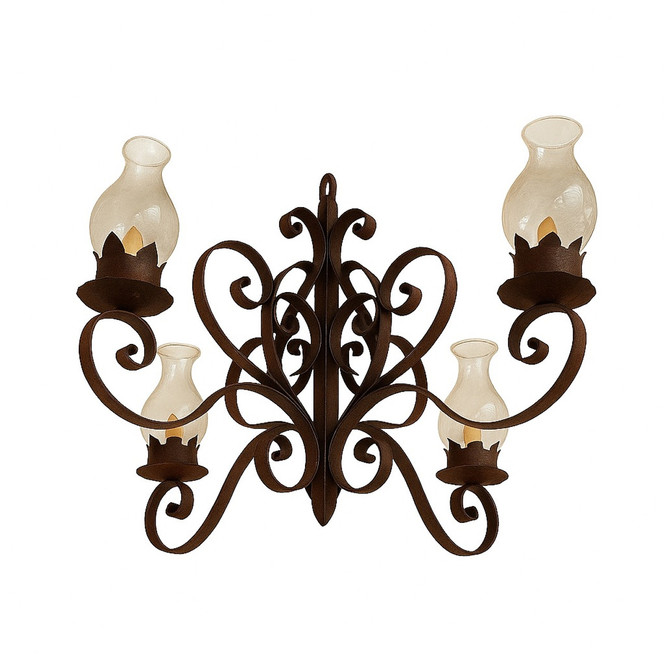
Spanish Colonial Wrought Iron Chandelier
Bring the heritage and elegance of old-world craftsmanship into your home with our Spanish Colonial wrought iron chandelier. Entirely hand-forged in Patzcuaro, Mexico, this lighting fixture marries strength with artisanal detail. The chandelier features four gracefully arched scroll arms, each supporting a tulip-style hurricane glass shade. Its matte rust-brown or classic black finish is applied by hand, enhancing its weathered, timeless character.
Perfect for interiors inspired by hacienda, Tuscan, or Mediterranean aesthetics, this chandelier adds depth and charm whether suspended over a dining table, in a warm rustic kitchen, or lighting an arched entryway. The fusion of bold ironwork and delicate glass elements makes this piece both a practical light source and a striking design feature.
Hand-Forged Beauty with Lasting Appeal
Each chandelier is crafted using traditional blacksmithing techniques, emphasizing attention to detail and quality. The circular base and upward sweeping arms give the fixture a balanced, elegant silhouette, while the tulip domes diffuse light in a soft, inviting glow. The chandelier is available in various diameters, ranging from 36 to 60 inches, and can be customized to meet specific design needs.
Interior Applications
- Enhances Spanish Colonial entryways with dramatic ironwork
- Complements Tuscan-style dining rooms with warmth and presence
- Adds rustic charm to kitchens with stone and wood finishes
- Brings character to living rooms with beams and warm accents
Details that Matter
The chandelier ships carefully crated and fully insured within eight weeks. While bulbs and chains are not included, a drop of up to 7 feet can be added optionally. Returns are accepted within 60 days when the product remains in its original packaging and condition.
The History of Chandeliers
The word “chandelier” originates from the French term chandelle, meaning “candle holder.” Chandeliers began as practical, utilitarian wooden crosses with spikes to hold candles in medieval churches and castles during the 10th century. Suspended from ceilings, these early lighting structures illuminated vast halls and sacred spaces, offering both function and grandeur. By the 15th century, chandeliers had become symbols of status and wealth, particularly in the homes of nobility and the clergy.
As metalworking advanced, chandeliers evolved from wooden frames to intricate forged and cast metal forms. During the Renaissance, Italian and Flemish artisans created elaborately carved chandeliers of bronze and wrought iron, often featuring motifs such as acanthus leaves, angels, and heraldic emblems. These decorative pieces were not only sources of light but artistic expressions aligned with the grandeur of Renaissance architecture and interior design.
The Baroque period in the 17th century introduced even more elaborate chandeliers, with gilded surfaces, complex scrollwork, and eventually, the use of cut glass crystals. France, under the rule of Louis XIV, saw the chandelier transformed into a centerpiece of opulence in the Hall of Mirrors at Versailles. These developments quickly influenced the aristocratic homes of England and Spain, where chandeliers reflected both national pride and the wealth of empires.
By the 18th century, the development of lead crystal in England revolutionized chandelier design. Glassmakers like Bohemia’s artisans crafted chandeliers that refracted candlelight into brilliant displays of color and light. During this period, chandeliers became more accessible to the upper-middle class and began appearing in public buildings like theaters, ballrooms, and town halls.
The 19th century ushered in new materials and technologies. Gas lighting was introduced, prompting a new wave of “gasoliers,” and later, electric chandeliers began appearing after Edison’s invention of the lightbulb. This innovation removed the limitations imposed by flame and allowed for safer, more intricate designs.
Today, chandeliers are no longer confined to grand halls or stately homes. From minimalist modern pendants to rustic Spanish Colonial ironwork, they remain timeless focal points in interior design. They serve not only as light fixtures but as cultural artifacts—each one reflecting a blend of history, craftsmanship, and aesthetic values passed down through the centuries.
The Legacy of Forged Iron
Forged iron—also known as wrought iron—is among the oldest and most resilient materials in human history. The earliest uses of iron date back to around 1200 BCE, during the Iron Age, when civilizations like the Hittites and Assyrians began smelting iron ore into usable tools and weapons. However, it wasn’t until the medieval period that iron forging became a widespread craft, shaping everything from agricultural tools to weapons, gates, and household items.
The process of forging iron involves heating the metal until malleable and then hammering, bending, and shaping it into a desired form. This technique gave rise to blacksmithing, an essential craft across Europe, Asia, and Africa. Iron's durability and availability made it a foundational material in both functional and decorative design, often chosen for its ability to withstand time and the elements.
During the Middle Ages, wrought iron was essential for castle gates, horseshoes, nails, and architectural reinforcements. Blacksmiths also began crafting decorative pieces—door knockers, lanterns, and railings—introducing artistry to function. The forged spiral, scroll, and leaf motifs seen in today’s chandeliers trace their lineage to this period, where decorative ironwork flourished alongside Gothic architecture.
In the Renaissance and Baroque periods, ironwork expanded from utilitarian roles to luxury decor. Spanish, Italian, and French artisans pushed the limits of iron shaping, creating iron balconies, window grilles, and ornate lighting fixtures. In Spain, iron became an iconic material in Colonial-style architecture, celebrated for its rustic elegance and endurance in harsh climates.
The Industrial Revolution in the 18th and 19th centuries shifted ironwork from artisanal to industrial production. Cast iron became widespread due to mass manufacturing, and many decorative elements lost their handmade charm. However, hand-forged iron remained prized for its authenticity and craftsmanship—qualities that could not be replicated by machines.
Today, forged iron is enjoying a renaissance, especially in architectural and interior design. Craftsmen and designers value it for its organic beauty, its connection to historical traditions, and its ability to blend seamlessly with wood, stone, and glass. Whether in a Spanish Colonial chandelier or a Tuscan stair railing, forged iron represents a timeless fusion of strength and artistry.
Forged Iron in Decorative Arts
The evolution of forged iron from a purely functional material into an art form is one of the most fascinating chapters in design history. Originally used to make weapons and tools, forged iron eventually found a place in architectural embellishment, home decor, and lighting fixtures. Its aesthetic potential emerged fully in the hands of artisans who saw iron not only as a durable metal but as a sculptural medium capable of fluidity and grace.
Iron’s earliest decorative use can be traced to ancient gates and hinges where function met form. These utilitarian pieces began to bear etched or hammered patterns, a precursor to the ornamental flourishes that define modern ironwork. In medieval Europe, blacksmiths began incorporating scrolls, curls, and naturalistic shapes into their work, embellishing castles and cathedrals with iron gates, lanterns, and decorative fencing.
During the Spanish Colonial expansion of the 16th to 18th centuries, forged iron became a hallmark of domestic and religious architecture in the Americas. Artisans combined European craftsmanship with indigenous motifs, creating a hybrid decorative style that persists to this day. Chandeliers, window grills, and door hardware were all hand-forged with floral, animal, or geometric patterns meant to reflect harmony and protection.
The rise of iron as a decorative element accelerated with the Rococo and Art Nouveau movements, where artisans manipulated iron into fluid, almost botanical shapes. Wrought iron gates, benches, and balcony railings became focal points of garden and facade design, particularly in cities like Paris, Barcelona, and New Orleans. These pieces blended art and engineering, serving both aesthetic and architectural purposes.
In the 20th century, modernist designers reimagined iron in minimalist and industrial forms. Forged iron chandeliers became more streamlined, shedding excess ornamentation but maintaining the material’s tactile appeal. The rusted patinas and matte finishes used today in rustic and Spanish Colonial chandeliers continue this evolution—merging heritage with contemporary simplicity.
Forged iron remains popular in decorative arts because of its authenticity and symbolic richness. It evokes a sense of permanence, of handcrafted quality in a mass-produced world. Whether shaped into a scroll arm of a chandelier or the delicate detail of a garden gate, forged iron connects us to centuries of craftsmanship and cultural heritage.
Learn More or Customize
Discover more about this handcrafted chandelier or begin a custom order by visiting our Spanish Colonial wrought iron chandelier product page. For personalized assistance or design consultations, feel free to request a custom chandelier consultation.