 US Dollar
 Euro
Euro
 Australian Dollar
 Canadian Dollar
 Polish Zloty
 British Pound

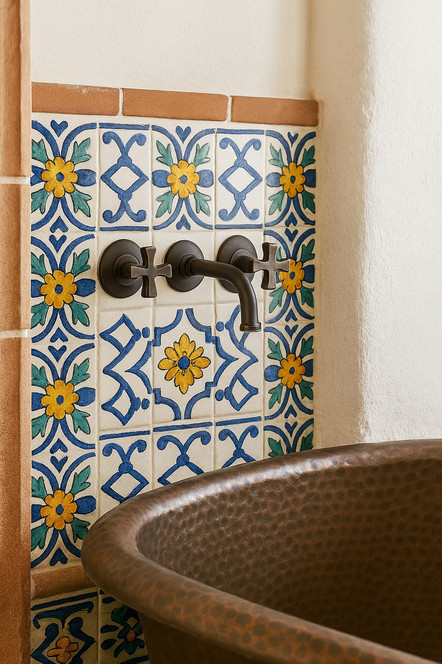
Rustic Wall-Mount Bronze Faucet: Materials, Craft, and Real-World Applications
The Rustic Wall-Mount Bronze Faucet is a handcrafted fixture for spaces that value tactile materials and enduring mechanics. Forged using an old-world sand-casting technique in Guanajuato, Mexico, it features a long 10-inch spout and dual cross handles for intuitive, glove-friendly control. Two patina options—warm golden bronze and dark aged bronze—let the faucet read either as a luminous accent or a quietly timeworn element. Whether you’re finishing a farmhouse vanity, a Spanish Colonial kitchen, or a Tuscan-inspired powder room, this wall-mounted set pairs naturally with copper sinks, stone walls, and Talavera backsplashes while delivering dependable, ceramic-valve performance.
Key Features and Materials
- Construction: Solid bronze body produced via traditional sand casting; each piece is hand-finished.
- Operation: Dual cross handles with smooth ceramic valves for precise flow control.
- Spout: Approximately 10 inches of reach for comfortable clearance over vessel and drop-in sinks.
- Mounting: Wall-mount configuration keeps counters open and simplifies cleaning around the basin.
- Finishes: Choice of warm golden bronze or dark aged bronze patina.
- Origin: Crafted by metalworkers in the state of Guanajuato, Mexico.
Specifications
- Style: Wall-mounted bronze faucet set (spout + two cross handles).
- Finish Options: Dark aged bronze; warm golden bronze.
- Spout Length: ~10 inches (nominal).
- Includes: Spout, two cross handles, ceramic valves.
- Use: Kitchen and bathroom walls; guest baths and powder rooms.
- Technique: Sand-cast bronze, hand-polished and patinated.
Finish Behavior & Patina Care
Bronze is a living metal. The warm golden tone can deepen toward honey and chestnut with handling, while the dark aged finish can gain subtle highlights at edges and touch points. This evolving patina is part of the aesthetic. Clean with a soft cloth and mild, pH-neutral soap; avoid bleach, ammonia, and abrasive pads. If you prefer to slow patina development, a microcrystalline wax applied sparingly to dry metal adds a breathable barrier—reapply as needed based on use.
Applications and Design Pairings
- Spanish Colonial kitchens & baths: Pair with plaster walls, Talavera tile, and hand-hewn wood for a grounded, architectural feel.
- Farmhouse spaces: A natural match to copper or fire-clay sinks; the wall mount keeps counters airy and easy to wipe.
- Tuscan interiors: Works with limestone, tumbled travertine, and iron hardware; choose dark aged bronze for a quieter profile.
- Southwestern style: Complements adobe tones, saltillo floors, and turquoise accents; golden bronze lifts warm palettes.
- Rustic vanities: Use over reclaimed wood or stone tops; center the 10-inch spout so water falls comfortably within the basin.
Sand Casting: From Mold to Patina
- Pattern & mold: Artisans press a master pattern into packed sand to form a cavity that captures fine detail.
- Pour: Molten bronze flows into the sand mold, filling the negative space of the faucet body and handles.
- Shake-out: Once cooled, the sand is broken away to reveal raw castings with a granular texture and sprue marks.
- Finishing: Each casting is trimmed, filed, and hand-polished; distinctive tool marks speak to the maker’s hand.
- Patination: Chemical and heat treatments develop either a warm golden tone or a deep aged finish; pieces are lightly sealed.
Planning the Installation
- Rough-in height: Aim the spout outlet ~3–5 inches above the rim of the sink (or as your basin depth requires) for splash control.
- Reach: With a ~10 inch spout, position the outlet so the water stream lands comfortably inside the bowl’s center third.
- Handle spacing: Set handles at an ergonomic distance from the spout and from each other for clear wrist clearance.
- Substrate: Mount to a solid backing (stud/blocking) and confirm valve support before closing walls.
- Compatibility: Verify local plumbing codes, connection types, and adapter needs with a licensed plumber prior to rough-in.
Care, Cleaning, and Longevity
- Wipe water spots regularly to keep patina even; hard water may require gentler, more frequent care.
- Avoid acidic cleaners on nearby stone and tile that may drip onto bronze surfaces.
- Operate cross handles gently; ceramic valves are designed for smooth, low-torque rotation.
- If limescale accumulates on the aerator or spout tip, soak a cloth in warm, mild soapy water and wrap briefly, then rinse and dry.
Design Heritage & Cultural Context
Guanajuato’s metalwork sits at the crossroads of centuries of craft knowledge. The region’s mining history fostered a deep familiarity with metals and alloys, while Spanish Colonial hardware—hinges, pulls, spigots, and church bells—popularized sand casting as a practical, repeatable method for architectural fittings. In that tradition, this faucet embraces bronze for its weight, longevity, and expressive surface. Unlike chrome-plated fixtures that chase a perfect mirror, sand-cast bronze invites touch and time; edges polish with use, planes retain a quiet matte, and the whole piece settles into its surroundings like a well-handled tool. The cross handles, readable at a glance and easy to grasp, echo historical patterns that favored ergonomics before the word existed. Installed over stone, copper, or tile, the faucet contributes not only water service but a small piece of living metalwork—an object that records use in its finish and grows more characterful year after year.
Why This Faucet Works
Functionally, a wall mount frees counter space and simplifies cleanup; the 10-inch spout reach covers vessel and drop-in basins; ceramic valves ensure precise control. Aesthetically, bronze acts as a bridge between materials—warm against plaster and wood, authoritative against tile and stone. The patina evolves, but the engineering stays constant, making the faucet a durable, adaptable choice for kitchens and baths that privilege craft and calm over trends.
Ordering, Samples, and Project Support
For dimensions, finish photos, and lead times, please view product details. If you’d like help confirming rough-in clearances, basin compatibility, or finish selection, you can contact our team. Share drawings or site photos, and we’ll suggest heights, spacings, and wall conditions that suit your sink and daily use.