 US Dollar
 Euro
Euro
 Australian Dollar
 Canadian Dollar
 Polish Zloty
 British Pound

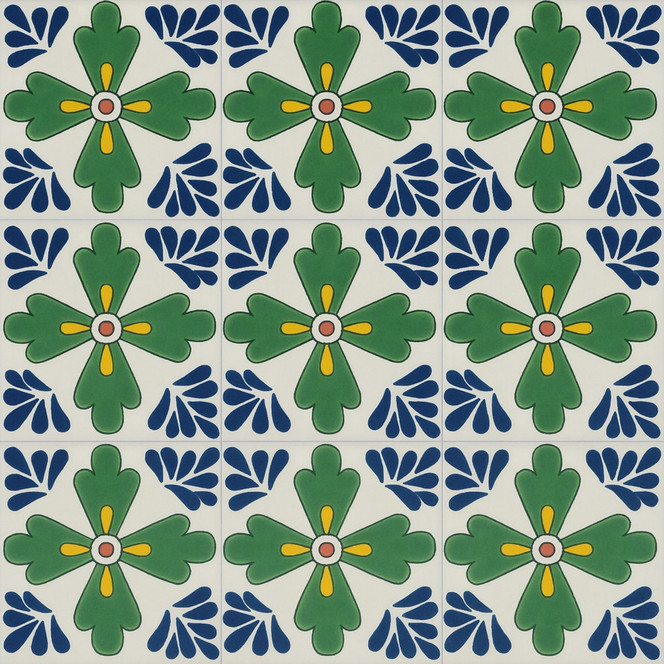
Green Clover Mexican Tile Design: Materials, Heritage, and Real-World Applications
The Green Clover Mexican Tile Design brings rustic charm and floral clarity to interiors and protected exteriors alike. Handcrafted in Dolores Hidalgo, Guanajuato, each piece is lead-free and hand-painted on a glazed ceramic body for a smooth, glossy finish. The composition centers on a warm terracotta medallion encircled by four green petals that read as a stylized clover. Golden-yellow teardrops articulate the edges of each lobe, while cobalt blue flourishes at the corners frame the motif and guide the eye outward. Set against a soft off-white ground, the palette delivers strong contrast without heaviness, making the tile equally suited to stair risers, kitchen backsplashes, patio borders, fountain surrounds, and eclectic accent walls. Because the pattern is symmetrical and crisply defined, it scales cleanly in both small vignettes and full fields, creating surfaces that feel lively, crafted, and easy to live with day to day.
Key Features and Materials
- Material: Glazed ceramic, lead-free hand painting.
- Finish: Glossy surface with a smooth, tactile feel.
- Sizes: 4x4 inches (versatile for risers and backsplashes) and 6x6 inches (ideal for wainscots and feature walls).
- Colorway: Green petals and central leaves; terracotta medallion; golden-yellow teardrops; cobalt corner flourishes; off-white background.
- Profile: Flat surface that emphasizes crisp linework and color separation.
- Use Areas: Interior walls, stair risers, patio borders (in temperate climates), courtyard fountains, and tiled furniture tops with proper substrate.
- Origin: Crafted in Dolores Hidalgo, Mexico; design language informed by Puebla’s Talavera legacy.
- Pattern Behavior: Seamless repeat supports both edge-to-edge fields and framed borders.
Pattern Overview
Main Colors
- Green: Forms the clover petals and central foliage.
- Terracotta: Anchors the medallion, adding earthy warmth.
- Golden yellow: Teardrop highlights that add sparkle and depth.
- Cobalt blue: Corner flourishes that stabilize the frame and add cool contrast.
- Off-white: Clean background that enhances color clarity.
Design Features
- A central medallion with clover-shaped symmetry establishes a calm focal point.
- Golden teardrops outline the petals, sharpening edges on the glossy glaze.
- Cobalt corner motifs create a secondary rhythm that reads clearly across repeats.
- Seamless layout works as a continuous field, a framed insert, or a paced border.
- Hand-drawn linework introduces subtle variation that prevents a mechanical look.
Applications and Design Tips
Use the 4x4 format where you want lively texture and tighter grout rhythm—stair risers, short backsplashes, niche interiors, and furniture tops. Step up to 6x6 to reduce joint count on larger planes such as wainscots, corridor bands, or full accent walls. In kitchens, the off-white ground brightens work zones, while green and cobalt provide color that pairs well with natural woods, brushed metals, and plaster. On patio borders and courtyard walls, the cool cobalt echoes sky and water features; terracotta notes harmonize with clay pots and brick. For a refined transition, frame fields with a solid-color Talavera in green, cobalt, or off-white; this visual “rest” keeps complex surfaces legible from across the room.
Styling cues: Combine with walnut, terra cotta floors, or unlacquered brass to warm the palette. For a fresher, coastal note, pair with white oak, limewash, and brushed nickel. If you’re mixing patterns, let the clover motif act as the primary graphic and support it with solids or subtle textures—this preserves clarity and avoids visual competition.
Layout, Scale, and Grout Strategy
Center the clover medallions on major sight lines—above a range, at stair mid-span, or within a niche—so full motifs land where the eye naturally rests. Maintain joint widths in the 1/8–3/16 inch range to honor the handmade character while keeping alignment straightforward. A light grout (soft white or cream) maintains a traditional Talavera look; warm off-whites resist visible staining better than bright white in kitchens and baths. When cuts are unavoidable, place them at perimeters or under trim so the central forms remain intact. On long runs, incorporate occasional border bands of solid tile to provide expansion breaks and pacing without diluting the design.
Care, Installation, and Longevity
Install over a flat, stable substrate using a high-quality thinset rated for ceramic tile. Because this is a glazed earthenware surface, avoid harsh acids and abrasive pads; a mild, pH-neutral cleaner and soft cloths preserve the gloss. In wet areas, ensure proper waterproofing behind the tile and seal porous grout to simplify maintenance. For exterior applications, favor protected locations and temperate climates; avoid freeze–thaw exposure. On tabletops or bar fronts, consider a breathable sealer that balances stain resistance with tactile feel. With standard care, the glaze retains color clarity for years, and hand-painted nuances develop a gentle patina that enhances the craft narrative.
Design Heritage & Cultural Roots
The Green Clover Mexican Tile Design sits within a lineage that binds Islamic ornament, Iberian craft, and Mexican innovation into a single, highly legible pattern. The clover-like quatrefoil has deep roots in both Islamic surface design and the Gothic tracery that followed in Europe. In Islamic art, geometry and vegetal motifs intertwine to evoke order and growth; repeated lobes, rosettes, and interlacing lines create fields that read as infinite yet carefully governed. When these ideas moved across the Iberian Peninsula during the centuries of al-Andalus, artisans translated them into carved stucco, wood inlay, textiles, and, crucially, tin-glazed ceramics.
Under Christian rule, Muslim and later Morisco craftspeople—often described within the Mudéjar tradition—continued to shape the built environment using hybrid vocabularies. Their tiles and architectural details display a characteristic tension: strict geometric armatures that host lively botanical forms. This duality is echoed in the Green Clover pattern, where the terracotta medallion and green lobes provide an organizing figure, while cobalt corner flourishes introduce directional movement. The color story also speaks a historical language. Cobalt blue became prized in high-temperature glazes for its stability and saturation; it fueled centuries of blue-and-white ceramics from the Middle East through Europe and into the Americas. Terracotta’s iron-rich tone, meanwhile, served as a resilient, warm counterpoint—often used to “ink” edges and articulate boundaries on a white ground.
In the sixteenth century, trans-Atlantic exchange carried ceramic knowledge to New Spain. Puebla de los Ángeles emerged as a center for tin-glazed earthenware—what we now call Talavera—thanks to suitable clays, guild frameworks, and steady demand for architectural ornament. Puebla’s workshops fused Iberian, Islamic, and Renaissance motifs with New World flora, producing a visual language that felt both global and local. As Talavera traditions matured, production radiated to other towns. Dolores Hidalgo, in particular, developed a reputation for scaling hand-painted tile to everyday domestic architecture: stair risers, kitchen walls, patios, and fountains. This democratization of ornament allowed patterns once reserved for churches and civic buildings to enter daily life.
The Green Clover Mexican Tile Design embodies that accessible heritage. Its clover form reads as a botanical emblem—understandable at a glance—while the corner flourishes and teardrop accents supply historical resonance without visual heaviness. The glossy finish and crisp color separations reflect the discipline of tin-glaze painting, where controlled brushwork and carefully fired pigments produce durable, high-contrast surfaces. In contemporary rooms, the pattern bridges eras: it complements Spanish Colonial revival details as readily as pared-back plaster and light wood. Most importantly, it remains true to the spirit of Talavera in central Mexico—craft practiced at domestic scale, intended for spaces where people cook, gather, and move through light throughout the day.
Why This Tile Works
Design strength comes from balance: the clover’s simple geometry keeps larger fields ordered, while hand-painted lines add intimacy up close. The palette is inherently versatile—green and cobalt provide cool structure; terracotta and golden yellow add warmth and highlight. On walls, the off-white ground reads clean and bright; in borders, the pattern delivers punctuation without overwhelming adjacent surfaces. The result is a surface that feels both rooted and fresh, capable of anchoring a focal wall or quietly supporting a layered interior.
Ordering, Samples, and Project Support
For current sizes, lead times, and compatible solids, please visit the product page to view product details. If you’d like help with takeoffs, border selection, or substrate questions, you can contact our team. Share drawings or photos of the space, and we’ll suggest layouts that keep full motifs on key sight lines and grout rhythms consistent across edges and corners.