 US Dollar
 Euro
Euro
 Australian Dollar
 Canadian Dollar
 Polish Zloty
 British Pound

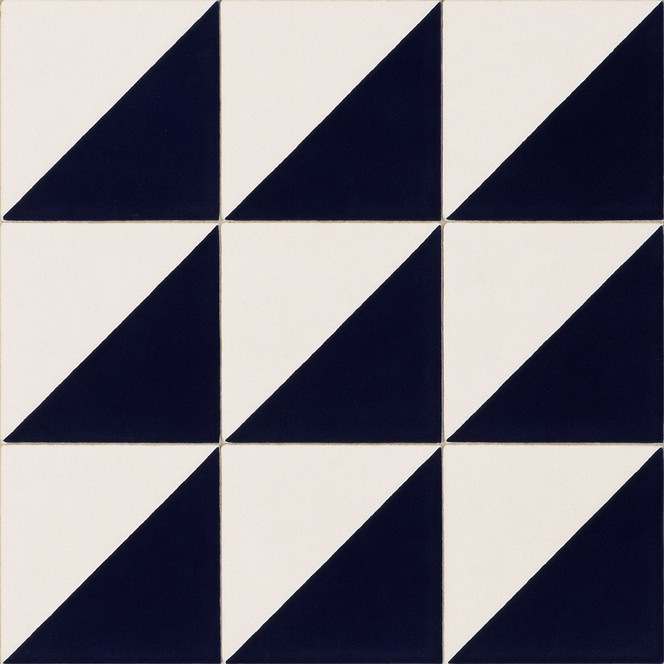
Mexican Tile with Blue White Diagonal Pattern
The Blue White Diagonal Mexican Tile from Dolores Hidalgo blends minimalist elegance with traditional craftsmanship. Featuring a sharp diagonal split between cobalt blue and off-white, this bicolor tile offers modern visual rhythm rooted in Mexican mayólica ceramic heritage. Whether arranged to form chevrons, diamonds, or zigzag patterns, each hand-glazed tile introduces a fresh geometric dimension to rustic, Mediterranean, or contemporary interiors.
Tile Pattern Description
This hand-painted diagonal Talavera tile is crafted using centuries-old techniques passed down through generations of women artisans in Dolores Hidalgo. The clean bisection creates strong directional energy, while the glazed finish adds tactile warmth. Ideal for kitchen backsplashes, entryway walls, or stair risers, it brings artisanal integrity to modern spaces without overwhelming them.
Artisan Detail
Each blue and white geometric Mexican ceramic tile is hand-cut, tin-glazed, and fired in traditional kilns in Dolores Hidalgo. While the pattern appears simple, women artisans apply the cobalt pigment with care, preserving slight brushstroke marks and glaze depth. These subtle imperfections enhance its handmade character.
Mexican Heritage Influence
Though minimalist in appearance, the blue and white diagonal pattern tile carries within its crisp geometry a profound narrative of Mexican cultural heritage and artistic evolution. Its roots can be traced to Dolores Hidalgo, a town in Guanajuato renowned since the 18th century for its Talavera ceramics—an art form born of colonial exchange between Spain’s tin-glazing traditions and indigenous Mexican pottery techniques. In this historic center, local female artisans inherited a craft handed down from generation to generation, adapting European motifs and color palettes through the lens of native flora, fauna, and spiritual symbolism. Over centuries, these women developed an intuitive understanding of how to manipulate clay, glaze, and fire to achieve vibrant pigments and durable finishes. The deep cobalt blue used in the diagonal pattern, for instance, originates from mineral-based formulas introduced by Spanish potters but refined by Mexican artisans who sourced local minerals to perfect the hue. The off-white field, too, reflects a meticulous process of preparing a tin-based opaque glaze, which requires precise firing temperatures to prevent cracking or color shifts.
Yet, the heritage influence goes beyond materials and methods—it lives in the very act of handcrafting each tile. In workshops passed on within families, the painting of geometric motifs once carried symbolic meaning tied to agricultural cycles, religious iconography, and regional identity. While mid-century modern design favored abstraction and simplicity, Dolores Hidalgo artisans wove their ancestral memory into every brushstroke, ensuring the diagonal design’s minimalism did not erase cultural resonance. Instead, they transformed abstraction into a contemporary expression of old-world values: community collaboration, respect for nature’s rhythms, and devotion to beauty as a form of resilience. Each tile, signed by a small signature or workshop mark on its reverse side, thus becomes a vessel not only of architectural function but of living history—an artifact embodying the perseverance of folk traditions amid globalization.
When installed in an entryway or backsplash, these diagonal tiles serve as subtle ambassadors of heritage. Their directional flow can guide the eye along walls or staircases, suggesting pathways once trodden by artisans through dusty lanes of Dolores Hidalgo. Paired with other traditional decorative elements—such as hand-forged iron grilles, reclaimed wood beams, or hand-woven textiles—the tiles form a dialogue between past and present. The result is a design vocabulary that feels both timely and timeless, honoring the ingenuity of Mexican women potters who, for centuries, have infused their craft with cultural memory and artistic innovation. Through this seamless marriage of mid-century abstraction and centuries-old technique, the Blue White Diagonal Mexican Tile stands as a testament to the remarkable ability of folk art to reinvent itself without forgetting its origins.
Design Versatility
The Blue White Diagonal Mexican Tile’s appeal lies not only in its storied heritage but also in its extraordinary adaptability to diverse design contexts. At its core, the tile’s sharp diagonal division between deep cobalt and soft off-white forms a strong graphic element that can be leveraged in myriad ways to shape spatial perception. When installed as a backsplash behind a farmhouse sink, the tiles draw the eye upward, accentuating vertical lines in cabinetry and creating a sense of loftiness in the room. The diagonal motif, when repeated across a wall, generates a chevron pattern that imparts an energetic rhythm—an effective visual cue in narrow corridors or compact powder rooms where dynamic movement prevents space from feeling static.
In a more understated application, laying the tiles in alternating orientations produces a subtle zigzag effect that feels both modern and handcrafted. Designers may choose to blend these diagonal tiles with plain white or muted gray tiles, reserving the patterned tile for a central swath or border that anchors larger field tiles. This method suits transitional interiors aiming for cohesive restraint: the blue-white tiles inject color and pattern without overshadowing neutral palettes or minimalist furnishings.
Beyond kitchens and bathrooms, the tiles shine in stair riser installations, where each step becomes a canvas for geometric interplay. The diagonal split aligns naturally with the stair’s pitch, guiding upward momentum and lending visual interest to otherwise overlooked surfaces. In outdoor covered patios or sunrooms, the tiles pair beautifully with terracotta floors and wrought-iron accents, reinforcing a Mediterranean ambiance. Grouping the diagonal pattern with hand-painted floral Talavera tiles creates a striking contrast—geometry meets organic form, each enhancing the other’s character.
For commercial spaces—cafés, wine bars, boutique shops—the bold yet clean geometry offers a cost-effective way to introduce brand identity through color. A feature wall clad in these tiles becomes a memorable backdrop for photography or social media, attracting customers with its blend of artisanal authenticity and contemporary graphic punch. Meanwhile, the tile’s durability and glazed surface ensure ease of maintenance, a practical advantage in high-traffic environments.
In interior schemes emphasizing eclectic layering, the Blue White Diagonal Mexican Tile negotiates harmony among diverse elements: African mudcloth textiles, Scandinavian plywood furnishings, or Japanese ceramic accessories. Its binary color scheme provides a neutral anchor, while its diagonal thrust injects subtle dynamism that complements, rather than competes with, varied textures and patterns. Ultimately, the tile’s design versatility stems from its capacity to function as both background and focal point—an emblem of handcraft that adapts fluidly to any stylistic narrative.
Conclusion
Introduce dynamic geometry and authentic craftsmanship into your space with the Blue White Diagonal Mexican Tile. Hand-glazed in Dolores Hidalgo by skilled artisans, each piece carries the weight of cultural heritage while offering boundless design possibilities. To explore our full collection or place an order, visit our product page or contact us directly.