 US Dollar
 Euro
Euro
 Australian Dollar
 Canadian Dollar
 Polish Zloty
 British Pound


Hand-carved wood mirrors are more than functional accents; they are works of art carrying the imprint of skilled craftsmanship and cultural tradition. Each mirror reveals meticulous detailing and natural character, demonstrating deep artisan dedication. These qualities make them both decorative and meaningful in any interior. To explore a diverse range of these timeless creations, visit this collection of artisan carved wood mirrors from Rustica House.
History and Craftsmanship
Mirrors have played symbolic and decorative roles since ancient times. In pre-Columbian Mesoamerica, reflective surfaces (sometimes polished stone, obsidian, or metallic coatings) were highly valued for ceremonial, spiritual, and symbolic purposes. The European mirror (glass backed by metal or silver) came with colonial influence, and over time these functional objects merged with local artistic styles to produce decorative framed mirrors.
With the arrival of the Spanish during the colonial era, European styles—especially from Spain and other parts of Europe—began to influence architecture, furniture, religious ornamentation, and interior decoration throughout the Americas. Spanish Colonial style often included elaborate carving, floral or vegetal motifs, fruit or grape clusters, scrollwork, sometimes heraldic or religious motifs. In regions where wood was abundant, carving of frames for religious objects, furniture, and mirrors became a way to display craftsmanship.
In Mexico, one of the central states for artisan woodwork is Michoacán. That state has a long tradition of woodworking: the state is known for its abundance of forested areas, varied types of wood (pine, cedar, walnut, etc.), and a strong tradition of passing down artisan skills through generations. In particular, towns in Michoacán were organized in their crafts under the guidance of figures like Vasco de Quiroga, who in the early colonial period encouraged specialization: certain towns or communities became known for specific crafts. Wood carving and furniture making has been among the major artisan activities in the state.
The quality of hand-carved mirrors typically depends on several factors:
- Type of wood: hardwoods, softwoods, reclaimed
- Carving tools, relief depth, detail, and finishing
- Finish: stain, seal, wax, patina to show wood grain
- Frame durability: joints and glass mounting quality
- Uniqueness: each hand-carved mirror is different
Thus, hand-carved mirrors combine artistry, function, and cultural expression; in places like Michoacán they reflect indigenous skills, colonial influence, and local resources.
Mirrors from Rustica House
Below are four distinct mirrors from Rustica House collection. Each embodies a different style or scale, yet all share the hallmarks of craftsmanship.
Spanish Colonial Wood Mirror
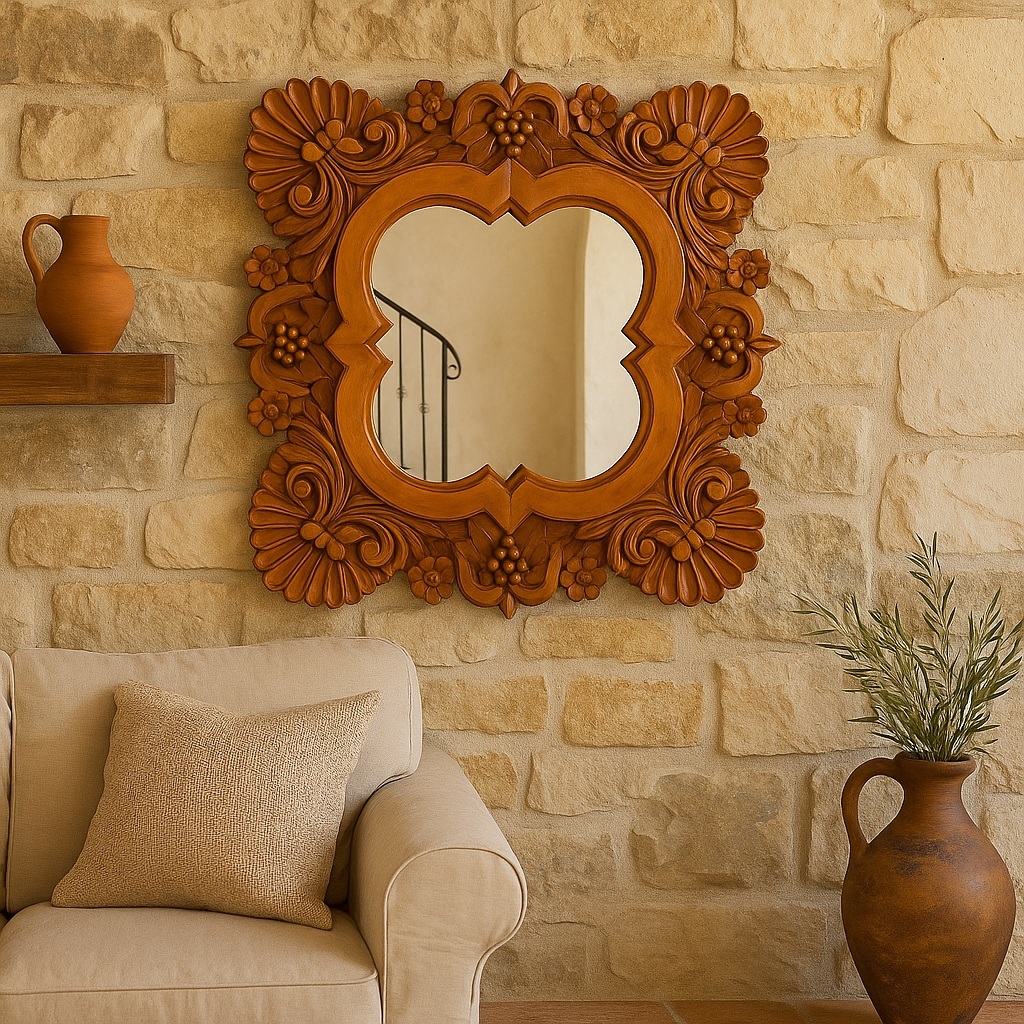
This mirror is a classic Spanish Colonial piece. It features a solid wood frame deeply carved with floral bursts, curling scrolls, and even small clusters of grapes. The relief carving is high quality: the motifs stand out in three dimensions so that light and shadow play across the surfaces, giving texture and richness. The finish tends to a warm, weathered tone—accentuating an aged or vintage look—even if the mirror is newly made. Because of its elaborate detail, this Spanish Colonial carved wood mirror serves well as a focal point in an interior: above mantels, in entryways, or in rooms styled with Colonial, hacienda, or traditional décor.
Large Hand-Carved Pine Mirror
This piece is larger in scale and more dramatic in theme. Carved in pine, the frame depicts a sun face at its center with flowing rays, surrounded by bold three-dimensional stars. The pine wood gives a somewhat lighter base tone than darker hardwoods; pine is softer, which allows more extensive carving depth with less risk of chipping if properly handled. The sun and stars motif gives the mirror a celestial motif that works especially well in rooms wanting a centerpiece. This large pine mirror with stars is bold, symbolic, and celebrates artisan detail while bringing universal yet locally resonant themes into rustic or traditional interiors.
Hand-Carved Dark Wood Mirror
This mirror leans toward the more refined and perhaps more versatile. It uses darker woods, which lend a stately, more formal appearance. The carvings include floral and leaf patterns, and a woven “basket crown” motif on the top. Because it's medium size, it’s more flexible: could be used over dressers, in bedrooms, guest rooms, or as accent pieces without overwhelming the space. The intricacy of carving suggests high artisan skill, and darker woods like mahogany or stained hardwoods tend to endure well with proper sealing and finishing. The medium dark wood hand-carved mirror blends elegance with artisan craftsmanship, making it suitable for both rustic and formal spaces.
Small Hand-Carved Wood Mirror
This is a smaller piece, carved from solid pine and finished in warm brown tones. Its frame is adorned with sunflower rosettes at crown and base, and flowing decorative motifs in between. Being smaller, it’s ideal for narrower spaces, such as bathrooms, powder rooms, small hallways, or as part of a gallery wall. The pine gives lighter weight and somewhat softer edges. The sunflower motif brings a folk-art touch, cheerful and bright, evocative of Mexican rural decorative aesthetics. The small pine carved wood mirror adds charm through its details while complementing spaces without overwhelming them.
Conclusion
Hand-carved wood mirrors represent an intersection of function, art, and history. From their deep roots in pre-Hispanic and colonial Mexico, to the artisan workshops of Michoacán, these mirrors carry cultural narratives as much as they do reflections. The carvings reveal skill, the woods reveal natural beauty, and the overall design reveals a heritage of style—especially Spanish Colonial and folk influences.
When choosing a hand-carved mirror, consider: the woods used, the carving depth and style, the size (so the mirror harmonizes with the room), and the finish. These aspects will influence both beauty and longevity.
If you're drawn to pieces with rustic charm, colonial elegance, or folk motifs, the pieces from Rustica House (such as the Spanish Colonial mirror, the Sun & Stars large pine piece, the dark wood medium mirror, or the sunflower pine mirror) offer excellent options.